Can a bruised Adobe stock turn a +6.5% rally into a lasting comeback as AI competition intensifies into 2030?

Is Adobe Inc. still a tech leader after the selloff?
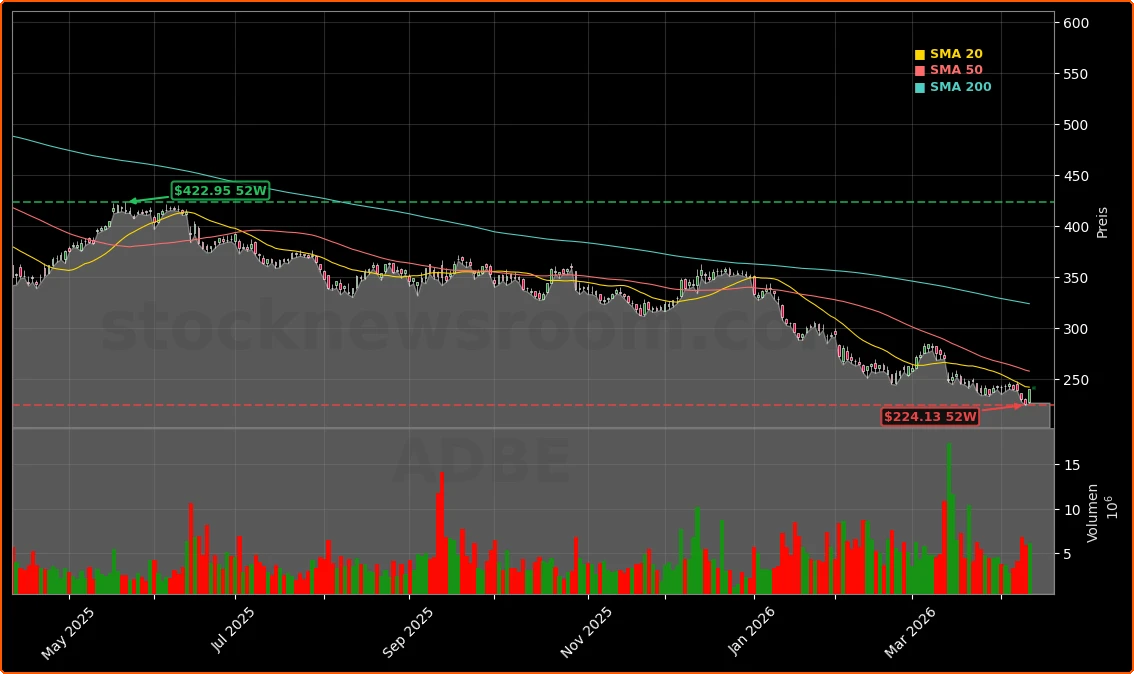
At about $240 per share and a market cap near $97 billion, Adobe Inc. trades well below its pandemic-era highs and under its key 50- and 200-day moving averages. The stock has dropped 28% year-to-date despite Monday’s rally and remains one of the more bruised large-cap names on the NASDAQ and S&P 500 technology roster. Yet the company continues to post solid fundamentals: record 2025 revenue of $23.77 billion, up 11% year-over-year, powered by its Digital Media and Digital Experience segments.
Profitability remains robust, with gross margins around 25% and a highly predictable subscription model in Creative Cloud, Document Cloud and Experience Cloud. A forward P/E near 9.6 and a trailing multiple around 13–14 are well below Adobe’s five-year median, suggesting a major derating versus its pre-2025 growth stock status. Some valuation services now classify ADBE as significantly undervalued relative to long-term fair value estimates, even as insider selling signals lingering caution inside the C‑suite.
Operationally, Adobe’s strategy hinges on embedding generative AI into its entire workflow stack. Firefly, its flagship generative platform, is now tightly integrated into Photoshop, Illustrator and Premiere, with more than 35% of Photoshop subscribers actively using AI features. That engagement matters for any Adobe Forecast, because it underpins potential upsell, seat expansion and higher average revenue per user if usage translates into new premium tiers and enterprise licenses.
How does AI competition shape the Adobe Forecast?
The core risk to any bullish Adobe Forecast is the speed and scale of AI competition. Google is rolling out advanced Gemini-powered image tools that encroach directly on Photoshop and Lightroom territory. Meanwhile, Canva and a wave of browser-first AI design and video tools are targeting small businesses and creators who historically defaulted to Adobe. Even enterprise incumbents like NVIDIA and cloud hyperscalers such as Apple’s ecosystem partners are expanding AI content capabilities that could erode Adobe’s moat over time.
Adobe is countering with both technology and distribution. Firefly is trained on licensed, rights-cleared content, a positioning that aims to reassure brand and legal teams wary of copyright issues in open AI models. On the enterprise side, the company is pushing “agentic AI” capabilities that automate marketing workflows and customer journeys, as illustrated by Lenovo’s rollout of the Adobe Data Insights Agent to unify and analyze global customer data. New partnerships like Tesco’s AI-driven personalized marketing initiative underline how deeply Adobe’s Experience Cloud is embedded in real-world retail and e-commerce operations.
Security remains a watchpoint. A recently patched zero-day in Acrobat Reader, which allowed code execution via malicious PDFs, highlighted how central Adobe’s document ecosystem remains to global IT risk. While the company moved quickly with an emergency update, repeated vulnerabilities could pressure trust in the Document Cloud franchise if not consistently managed.
What are Wall Street analysts pricing into Adobe?
Analyst sentiment has turned more mixed but leans cautiously optimistic. Across roughly 31 rated opinions, ADBE still carries a Buy consensus with an average 12‑month price target around $365, implying meaningful upside from current levels. The three latest calls from Citigroup, Goldman Sachs and UBS cluster near $262.67 on average, signaling short-term caution but not capitulation after the selloff. Goldman Sachs has one of the more conservative stances with a $220 target, while Morgan Stanley previously outlined a bullish case that stretches up to $510 if AI execution exceeds expectations.
On the more skeptical side, BTIG initiated coverage on Adobe and Figma with Neutral ratings, reflecting uncertainty about how much incremental growth generative AI can realistically add to an already mature creative software market. The wide dispersion of targets underscores the core question for investors: is Adobe now a value play on durable cash flows, or still a growth stock that needs to re-accelerate revenue to justify any premium multiple?
For long-horizon projections, at least one widely circulated Adobe Forecast pegs potential value as low as $187 per share by 2030 in a bear case where competition compresses margins and growth. Bulls, however, argue that if Firefly and Experience Cloud become mission-critical AI infrastructure for marketing and content at scale, the stock could more than double from here over the next cycle.
What scenarios matter most for the 2030 Adobe Forecast?
Investors should focus on three levers that will likely define the Adobe Forecast into 2030. First is AI monetization: beyond engagement metrics, can Adobe capture higher subscription tiers, consumption-based pricing or new SKU categories around Firefly and agentic workflows? Enterprise rollouts with retailers like Tesco and global manufacturers will be key case studies to watch.
Second is competitive resilience. If Google, Canva and others successfully train users away from Creative Cloud—especially in education, prosumer and SMB segments—Adobe’s historical pricing power could erode. Conversely, high switching costs in large agencies, studios and marketing departments remain a defensive asset that could keep revenue growth in the high single to low double digits.
Third is execution risk during leadership and macro transitions. A planned CEO handover, combined with a fragile macro backdrop that can hit marketing and creative budgets, raises the bar for clean, consistent quarters. Any major stumble on security, like another critical Acrobat exploit, or on product rollout could quickly reset sentiment in a stock whose technicals are still fragile despite Monday’s bounce relative to the broader S&P 500 and NASDAQ.
Related Coverage
Readers who want a deeper dive into how earnings and valuation intersect with Adobe’s AI strategy should look at Adobe Earnings -2.5%: Can AI Growth Offset the Valuation Crash?, which examines whether early AI revenue and a looming CEO change can justify the stock’s dramatic reset. For a broader sector angle on how cloud and AI infrastructure are reshaping software winners and losers, Amazon AI Partnership Boom: $50B Bet to Shake Up Cloud explores whether Amazon’s AI partnership strategy could redefine leadership in the next phase of the AI cycle.
Overall, the Adobe Forecast into 2030 balances a beaten-down valuation against credible AI-driven growth catalysts in both creative and marketing software. For U.S. investors building technology exposure, the stock now looks less like a momentum play and more like a quality compounder whose fate will hinge on Firefly adoption, enterprise AI deals and sustained competitive moats. The next few quarters of product execution and customer wins will determine whether today’s discount transforms into long-term outperformance on Wall Street.