Are Citigroup Earnings finally proving that Jane Fraser’s radical overhaul can turn a perennial laggard into a genuine Wall Street winner?

How did Citigroup Earnings beat expectations?
Citigroup Inc. opened the 2026 reporting season for Wall Street banks with a clean beat on both the top and bottom line. For Q1 2026, the group generated revenue of $24.63 billion, up roughly 14% from $21.6 billion a year earlier and well ahead of consensus expectations near $23.5 billion. Net income rose to $5.79 billion, a year‑on‑year increase of 42%, translating into earnings per share of $3.06 versus forecasts around $2.63.
This step‑up in profitability marks the highest quarterly revenue in about a decade and the best return on tangible common equity in roughly five years. Return on average tangible common equity came in at 13.1%, already ahead of management’s previously communicated full‑year target range of 10% to 11%. Despite a higher provision for credit losses of $2.8 billion, the bank’s operating leverage improved as revenue growth outpaced a 7% rise in expenses.
Citigroup Earnings also showed that cost discipline is starting to flow through. The efficiency ratio improved by more than four percentage points to about 58%, compared with just over 62% in the prior‑year quarter, underscoring that the multi‑year restructuring under CEO Jane Fraser is beginning to deliver tangible margin gains.
Which businesses powered Citigroup Inc. this quarter?
The upside in Citigroup Earnings was driven by strength across all five core divisions, with particular momentum in the institutional businesses that matter most for global markets. Services, the bank’s transaction and cash‑management “crown jewel,” increased revenue by around 17% to $6.1 billion as corporate clients continued to move and manage cash across more than 180 countries.
Markets activity was the standout. Total trading revenue climbed around 19% to $7.25 billion, benefiting from heightened volatility tied to the conflict in Iran, swings in energy markets and active positioning across rates and credit. Fixed Income, Currencies and Commodities (FICC) revenue reached roughly $5.2 billion, just shy of a 2020 record and ahead of estimates of about $5.0 billion. Equity sales and trading produced a record $2.08 billion, comfortably beating expectations near $1.73 billion.
Banking revenue rose about 15% to $1.8 billion, including a roughly 12%–19% increase in investment banking fees to $1.23–$1.3 billion amid a strong quarter for M&A. Wealth management delivered around 11% revenue growth to $3.1 billion, and U.S. consumer cards revenue advanced 4% to $4.8 billion with returns approaching 20%, reflecting resilient spending among American households.
What risks and credit trends did Citigroup highlight?
Behind the headline strength, Citigroup Earnings also revealed a cautious stance on credit. The bank booked $2.8 billion in total provision for credit losses, slightly higher than the $2.7 billion level a year earlier. Net credit losses were $2.2 billion, while the allowance build of nearly $600 million reflected seasonal mix changes, portfolio quality and increased uncertainty in the macroeconomic outlook, particularly for less affluent consumers facing higher energy and living costs.
Management provided more detail on its roughly $22 billion exposure to private credit, emphasizing that the portfolio has not yet generated losses and is viewed as manageable. Citigroup’s Common Equity Tier 1 ratio stood at a solid 12.7%, more than a full percentage point above regulatory minimums, giving the bank room to keep returning capital even as regulatory capital rules evolve.
In parallel with earnings, the bank accelerated shareholder distributions. Citigroup repurchased $6.3 billion of stock during the quarter while maintaining its dividend policy, a move that underlines its confidence in capital generation. For U.S. investors comparing big banks, that buyback pace positions Citigroup alongside peers like JPMorgan Chase and Wells Fargo as a significant capital return story.
How do Citigroup Earnings compare with JPMorgan and Wells Fargo?
Citigroup’s report dropped on the same day as JPMorgan Chase and Wells Fargo, giving Wall Street a clean read‑through on the sector. JPMorgan delivered a strong quarter with double‑digit profit growth and a beat on revenue, but its shares traded slightly lower as investors focused on future margin pressure. Wells Fargo, by contrast, fell sharply after net interest income missed estimates, even though earnings per share came in ahead of consensus.
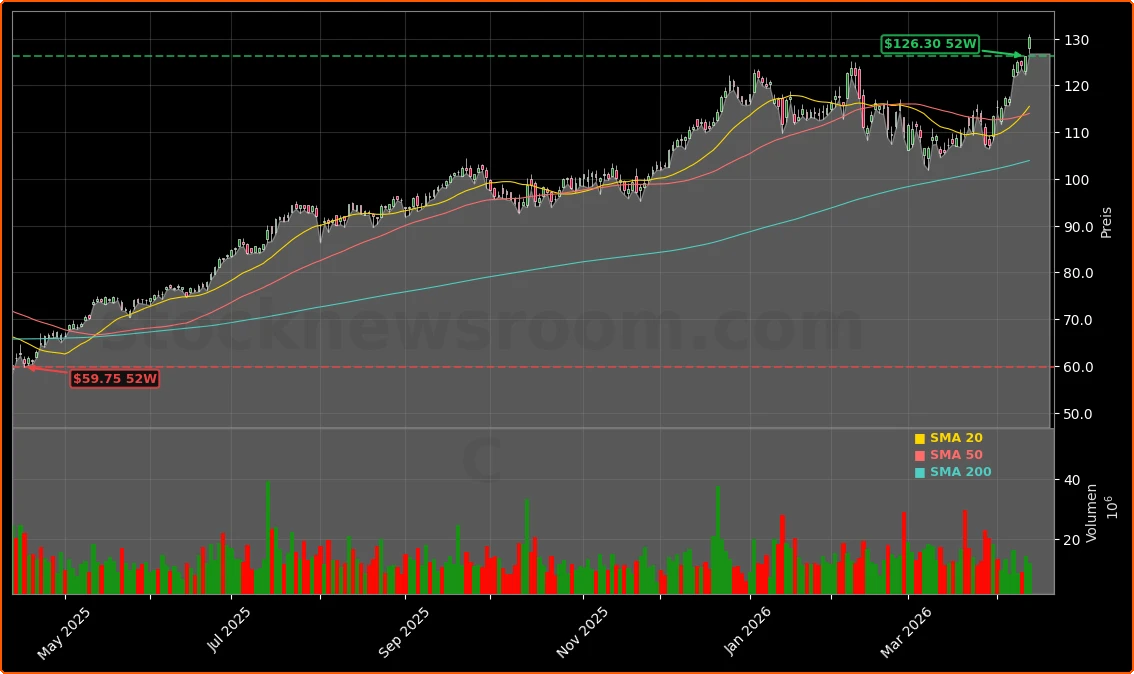
Against this backdrop, Citigroup Earnings stood out positively. The stock climbed roughly 3.2% on the day to about $130.32, extending year‑to‑date gains that already outpaced many large peers before today’s move. The strong performance reflects a mix of low starting valuation, visible restructuring progress and the leverage to global trading and services at a time when market volatility is high.
RBC Capital Markets analyst Jared Cassidy, who rates Citigroup “Outperform,” has highlighted the leadership’s focus on accountability and believes the narrative can pivot from restructuring to growth once the transformation is complete. That view appears increasingly validated by the latest quarter’s broad‑based revenue growth and improving returns.
What does this quarter mean for the Citigroup turnaround?
CEO Jane Fraser described Q1 2026 as an “exceptionally strong start to the year,” pointing to double‑digit revenue growth, a 42% jump in net income and the markets business surpassing the $7 billion revenue mark. She noted that roughly 90% of the bank’s regulatory and back‑office transformation programs have now reached their target state or are close to it, and reiterated that Citigroup is in the final phase of its global divestiture plan.
Management reaffirmed guidance for 2026, including expectations that net interest income excluding markets will grow by 5%–6%. At the same time, the bank raised its forecast for branded cards net credit losses to 4.0%–4.5%, acknowledging the pressure on lower‑income U.S. consumers. Looking ahead, Citi plans an Investor Day next month, where investors expect updated profitability targets and more detail on how the group will deploy excess capital.
For diversified U.S. and global equity portfolios, Citigroup’s latest quarter reinforces a broader theme: market volatility, deal activity and cross‑border corporate flows are delivering healthy earnings for the largest universal banks. With tech leaders like NVIDIA and Apple still dominating the NASDAQ, the question for allocators is whether outperforming financials such as Citigroup can continue to narrow the gap and offer a value‑driven complement to high‑multiple growth names. In that context, Citigroup Earnings are likely to remain a key data point for bank exposure decisions over the rest of 2026.
Related Coverage: Investors interested in the strategic backdrop behind this quarter’s numbers may want to revisit how Citi’s restructuring has evolved. Citigroup Strategic Shift Warning as Global Focus Resets digs into the bank’s multi‑year transformation, including divestitures and capital reallocation, and asks whether the reset is unlocking hidden value or just extending a long turnaround story. For a macro lens on how employment and monetary policy could shape bank fundamentals, US Labor Market Analysis Warning: Jobless Boom and Fed Risk examines the risk of a “jobless expansion” and what it might mean for Federal Reserve decisions, credit quality and sector positioning.
We are off to an exceptionally strong start to 2026: revenue was up 14% and net income grew 42%, with our diversified business model delivering consistent growth even in uncertain times.— Jane Fraser, CEO of Citigroup Inc.
In summary, Citigroup Earnings showcased a powerful combination of record trading revenue, resilient consumer and corporate activity, and visible progress on the bank’s turnaround agenda. The stock’s move to new 52‑week highs signals growing investor confidence that Citi is finally closing the gap with peers on profitability and capital returns. The next few quarters and the upcoming Investor Day will show whether the bank can sustain double‑digit returns and turn this strong start to 2026 into a durable new phase of growth.