Can Johnson & Johnson’s latest earnings surge and dividend hike still justify its premium valuation for long-term investors?

How did Johnson & Johnson Earnings perform in Q1?
Johnson & Johnson Earnings for the first quarter showed why the stock remains a core holding in many U.S. portfolios. Sales rose 9.9% year over year to $24.06 billion, ahead of consensus estimates around $23.6 billion. Adjusted EPS of $2.70 beat expectations by a few cents, even though it declined 2.5% versus $2.77 a year earlier as investment ramped up behind new launches. On a reported basis, net earnings came in at $5.24 billion, or $2.14 per diluted share.
The top line was driven by double‑digit growth in the Innovative Medicine segment and high single‑digit gains in MedTech. Innovative Medicine revenue increased 11.2% to $15.43 billion, led by oncology and immunology, while MedTech sales rose 7.7% to $8.64 billion, helped by cardiovascular and orthopedics. Operationally, total company growth was 6.4%, with currency providing a roughly 3.5‑point tailwind.
Despite these positives, margins compressed. Adjusted pre‑tax income margin fell to 32.5% of sales from 36.6% a year earlier, as Johnson & Johnson stepped up R&D and commercial spending on new drugs and devices and absorbed higher tariff and manufacturing costs. Free cash flow dropped sharply to about $1.5 billion in the quarter, largely due to timing of U.S. rebate payments and elevated capital expenditures, but management reiterated a full‑year free cash flow goal of roughly $21 billion.
What’s driving growth inside Johnson & Johnson?
The core of the Johnson & Johnson Earnings story is an increasingly oncology‑heavy Innovative Medicine portfolio. Cancer drug revenue jumped nearly 23% to $6.97 billion, powered by multiple myeloma workhorses Darzalex, Carvykti and Tecvayli, as well as lung‑cancer combination Rybrevant/Lazcluze. Darzalex alone generated close to $4 billion, up from $3.2 billion a year ago, and remains the company’s single biggest product.
Immunology was more mixed. Flagship drug Stelara saw sales crater by about 60% as biosimilar competition kicked in following its patent cliff. But successor therapy Tremfya more than picked up the slack, with global revenue surging to about $1.6 billion, up roughly 68% year over year, supported by uptake in inflammatory bowel disease. Recently approved oral peptide Icotyde (for plaque psoriasis) adds another leg of growth in immunology and could become one of J&J’s largest products over time, according to management commentary highlighted by BioSpace and other outlets.
Neuroscience is also emerging as a growth pillar. Depression nasal spray Spravato grew more than 40%, and Caplyta, acquired via Intra‑Cellular Therapies, continues to ramp after its U.S. approval as adjunctive therapy for major depressive disorder. Johnson & Johnson sees peak sales potential for Caplyta above $5 billion if upcoming bipolar mania data are positive.
How important is MedTech in the Johnson & Johnson Earnings mix?
While Innovative Medicine still generates the majority of profit, MedTech is quietly improving the long‑term profile behind the latest Johnson & Johnson Earnings. Cardiovascular products led the way: electrophysiology grew mid‑single digits driven by pulsed‑field ablation platform Varipulse, while heart‑recovery specialist Abiomed posted mid‑teens sales growth as physicians embraced Impella devices. Shockwave’s intravascular lithotripsy catheters delivered high‑teens growth, cementing leadership in the treatment of calcified lesions.
Orthopedics and Vision also contributed. Trauma, hips and knees grew mid‑single to high‑single digits, and Vision revenue rose 6.7%, with premium intraocular lenses and Acuvue contact lenses offsetting some competitive pressure in U.S. surgical vision. Management is preparing to separate the orthopedics business around mid‑2027, a move that should leave a more focused, faster‑growing MedTech portfolio centered on cardiovascular, surgery and vision technologies that compete with names like Intuitive Surgical and rival innovators in digital surgery.
Looking ahead, the device pipeline includes the OTAVA robotic surgical system, intended to challenge incumbents in soft‑tissue robotics, and U.S. approvals targeted for Varipulse Pro and a dual‑energy ThermoCool catheter. For investors who already follow high‑innovation franchises such as NVIDIA in AI hardware or Apple in consumer tech, J&J’s MedTech arm represents a comparable, albeit less flashy, innovation engine inside healthcare.
What changed in guidance and the dividend outlook?
The latest Johnson & Johnson Earnings update came with modest but important tweaks to 2026 guidance. Management now expects full‑year sales between $100.3 billion and $101.3 billion, versus a prior $100.0‑$101.0 billion range, implying about 7% reported growth at the midpoint. Adjusted EPS guidance was nudged up by $0.02 to a range of $11.45‑$11.65; the midpoint of $11.55 still sits roughly in line with Wall Street expectations tracked by firms like Citigroup and Morgan Stanley.
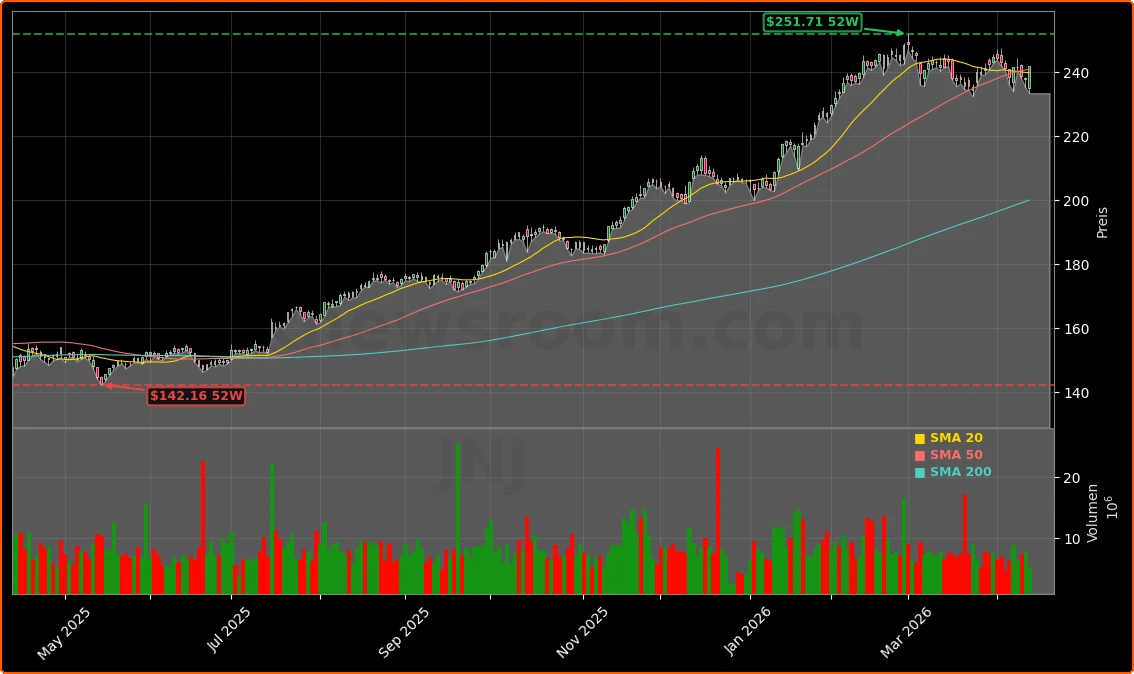
On capital returns, Johnson & Johnson extended its status as a Dividend Aristocrat and Dividend King. The board approved a 3.1% increase in the quarterly dividend from $1.30 to $1.34 per share, or $5.36 annually, marking the 64th consecutive year of payout growth. At Tuesday’s close of $241.66, the new dividend equates to a yield of about 2.2%, comfortably above the S&P 500 average, though below some high‑yield peers in big pharma.
That dividend discipline continues to attract long‑term income investors and large institutions. Recent 13F filings show firms like Willis Investment Counsel and Roffman Miller Associates modestly increasing their JNJ positions, even as valuation debates surface. Simply Wall Street recently argued the stock may be trading above its intrinsic value, while others, including RBC Capital Markets and Goldman Sachs, emphasize the defensive profile and accelerating growth into the late 2020s.
Related Coverage
For a deeper dive into how Icotyde could reshape psoriasis treatment and support future Johnson & Johnson growth, see Johnson & Johnson FDA approval ICOTYDE Boom Explained, which examines whether a single drug can move the needle for a $575 billion healthcare giant. Investors looking across the healthcare landscape at innovation‑driven stories beyond J&J may also want to read Novo Nordisk AI Partnership Boom: Can It Close the Obesity Gap?, which explores how partnerships between drugmakers and AI leaders such as OpenAI are reshaping expectations for growth and competitive advantage.
We’ve added new products to our portfolio, and it gives us a clear line of sight to double-digit growth by the end of the decade.— Joe Wolk, Chief Financial Officer of Johnson & Johnson
In summary, the latest Johnson & Johnson Earnings report underscored a rare mix of durable dividend growth, double‑digit underlying revenue expansion ex‑Stelara and a clearer path to potential double‑digit sales growth by 2030. For U.S. investors seeking a defensive core holding with genuine innovation upside, Johnson & Johnson remains a key healthcare bellwether to watch into the next earnings season and beyond.