Can the Novo Nordisk AI Partnership with OpenAI turn a battered obesity champion into the next big winner of the healthcare AI boom?

How is Novo Nordisk stock reacting?
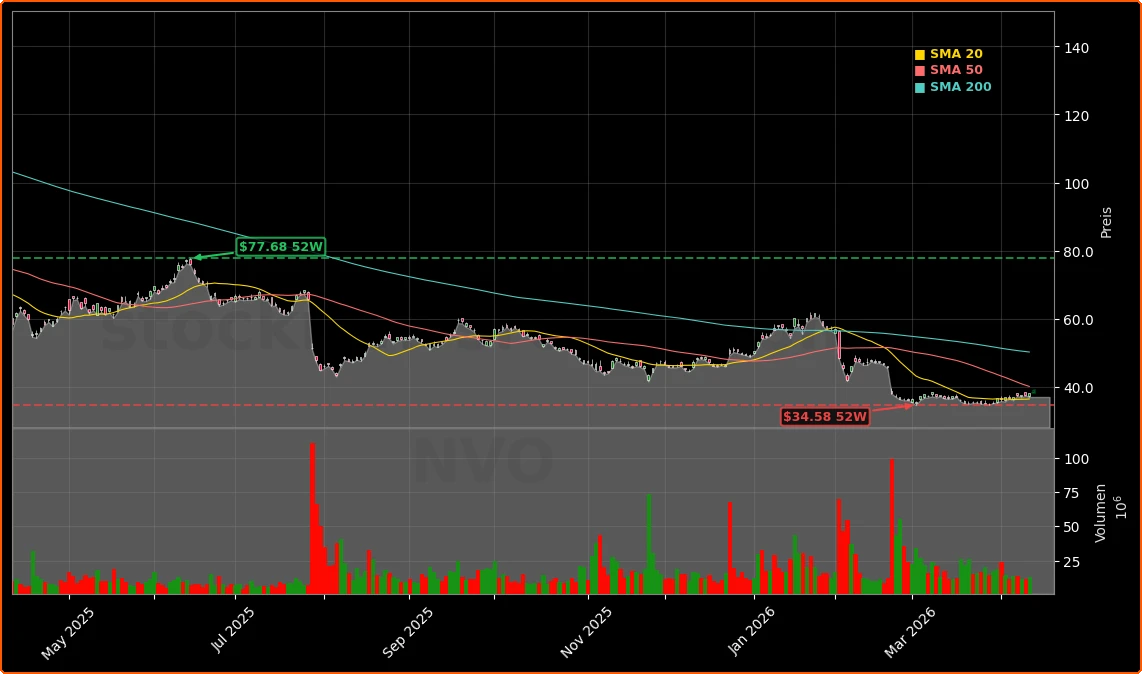
Novo Nordisk A/S (NVO) was last trading at $37.98, up 1.23% from Monday’s close of $37.94, with pre‑market quotes near $39.12 (up about 3.0%) on Tuesday. The announcement of the Novo Nordisk AI Partnership with OpenAI comes after a bruising 12‑month stretch in which the stock has dropped roughly 38%, even as demand for obesity drugs remains structurally strong. Options data recently showed a put/call ratio below its historical norm and rising implied volatility, hinting at growing speculative interest as traders reassess the downside that may already be priced in.
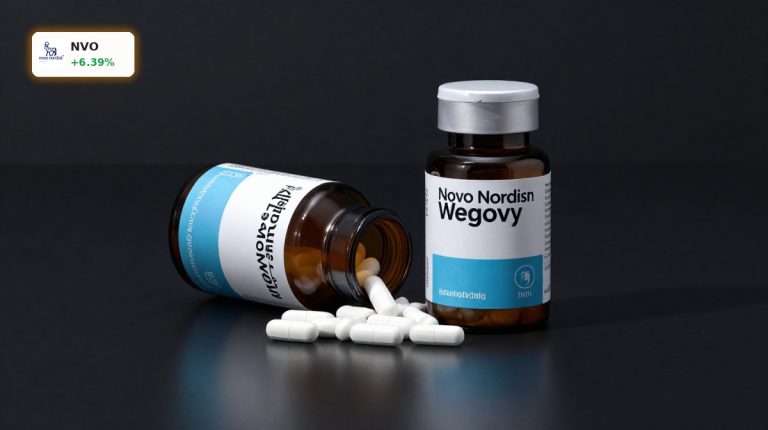
Fundamentally, Novo Nordisk continues to return capital to shareholders through a DKK 15 billion (roughly $2.2 billion) buyback program and a solid dividend, while also winning fresh product approvals such as once‑weekly basal insulin Awiqli in the U.S. Yet analysts at firms like Jefferies have cut price targets on concerns around GLP‑1 pricing pressure and uncertainty over oral Wegovy, which helps explain why the stock trades on a discounted earnings multiple compared with many U.S. large‑cap pharma peers.
What does the OpenAI deal actually do for Novo Nordisk?
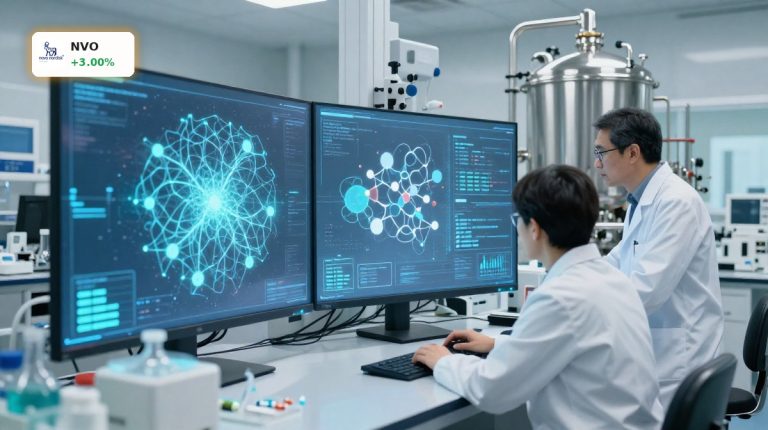
At the core of the Novo Nordisk AI Partnership is the deployment of cutting‑edge AI models to analyze complex, high‑dimensional data at scale. Novo Nordisk plans pilot projects across research and development, manufacturing, and commercial operations, with full integration of AI solutions targeted by the end of 2026. Management stresses that the technology will not replace staff but augment scientists and operational teams by surfacing patterns that would be nearly impossible to detect manually.
In drug discovery, generative AI can help prioritize targets, design better molecules, and quickly test hypotheses in silico before committing to expensive lab and clinical work. In clinical development, models can optimize trial design, patient selection, and adaptive protocols, improving success rates and potentially cutting years off timelines. There is also significant scope in the heavily regulated documentation process: drafting regulatory submissions that once took several weeks with large human teams can be compressed to minutes with AI‑assisted systems, then reviewed and refined by experts.
On the operations side, Novo Nordisk expects AI to enhance demand forecasting for blockbuster GLP‑1 products, streamline supply chains, and optimize commercial outreach. With obesity and diabetes therapies frequently constrained by manufacturing and distribution bottlenecks, even modest gains in efficiency could translate into hundreds of millions of dollars in incremental revenue and better patient access.
Can AI help Novo Nordisk catch up with Eli Lilly?
The Novo Nordisk AI Partnership arrives at a critical moment in the obesity arms race. Eli Lilly has seized investor attention with its own GLP‑1 franchise and the launch of its oral obesity pill Foundayo, fueling debate over whether it can sustain premium valuation levels on Wall Street. Novo Nordisk, meanwhile, is rolling out higher‑dose Wegovy in the U.S. and exploring oral formulations, but it has conceded market share in some segments as supply constraints and intense competition bite.
In this context, the AI tie‑up is as much a strategic signaling device as a technology upgrade. Novo CEO Mike Doustdar emphasizes that millions of people with obesity and diabetes still lack adequate treatment and that many potential therapies remain undiscovered. AI‑driven discovery platforms could, in theory, expand Novo Nordisk’s pipeline beyond GLP‑1s into new mechanisms or combination therapies that blunt future pricing erosion and patent‑expiry risks that analysts like those at Jefferies are already flagging.
For U.S. investors, the question is whether these initiatives will show up in the numbers before the market loses patience. Simply Wall Street’s discounted cash flow work suggests NVO may be trading 60%‑plus below intrinsic value, helped by a relatively low P/E versus global pharma peers, but many on Wall Street remain cautious until there is clearer visibility on 2026–2027 sales and margin trajectories. If the AI program leads to faster label expansions, new obesity and diabetes products, or more resilient pricing, it could force a rerating of the stock over the medium term.
How does this fit into the broader AI‑healthcare boom?
The Novo Nordisk AI Partnership also plugs into a larger story: the convergence of big pharma with leading AI platforms. While NVIDIA has been the obvious hardware winner from AI training demand and Apple and Tesla showcase consumer‑facing AI, healthcare is emerging as a quieter but potentially massive second‑wave beneficiary. From a U.S. portfolio perspective, this means exposure to AI is no longer limited to the traditional tech complex on the NASDAQ; it increasingly runs through select healthcare names on the NYSE as well.
For Novo Nordisk, partnering with OpenAI gives it access to frontier‑level models without having to build an entire foundational AI stack in‑house. That may allow it to leapfrog slower incumbents and protect returns in obesity and diabetes, even if pricing pressure grows. The move also raises competitive pressure across the sector: rivals will likely feel compelled to ramp up their own AI investments, potentially partnering with other leading model providers or hyperscale cloud platforms.
Related Coverage
For a deeper dive into how Novo Nordisk is using product strategy rather than just AI to defend its obesity leadership, see our coverage of the Wegovy high‑dose rollout and discount tactics in the U.S. market. That analysis explores whether the company’s aggressive pricing and dosing strategy can outmaneuver Eli Lilly before new oral competitors fully scale.
Investors tracking both sides of the obesity duopoly should also read our piece on Eli Lilly’s GLP‑1 pill Foundayo and the durability of its valuation premium. Together with the Novo Nordisk AI Partnership news, these articles frame the next phase of the GLP‑1 battle that is reshaping global pharma and influencing flows across U.S. healthcare portfolios.
The integration of AI into our daily work gives us the ability to analyze datasets at a scale that was previously impossible, spot patterns we could not see before, and test hypotheses faster than ever.— Mike Doustdar, CEO of Novo Nordisk
The Novo Nordisk AI Partnership with OpenAI is ultimately about compressing time: moving from data to drug to revenue faster in a fiercely contested market. For investors in NVO, the deal underscores that management is willing to spend political and technological capital to protect its obesity and diabetes franchise. The next two to three years will show whether AI‑accelerated R&D and operations can translate into renewed growth and a higher multiple, but for now the partnership keeps Novo Nordisk firmly in the conversation as one of the most innovative names in global healthcare.