Is NVIDIA Quantum AI’s new Ising model family the spark that extends the AI chip supercycle into the quantum era?

How does NVIDIA Quantum AI shift the market narrative?
The Ising announcement marks one of the clearest signals yet that NVIDIA Quantum AI is not just marketing language but a second act on top of the GPU boom. Ising is described as the world’s first open family of quantum AI models, built to tackle two of quantum computing’s knottiest problems: processor calibration and quantum error correction. Early adopters span leading labs and universities, from Harvard’s School of Engineering and Applied Sciences to Lawrence Berkeley National Laboratory’s Advanced Quantum Testbed, signaling broad institutional interest.
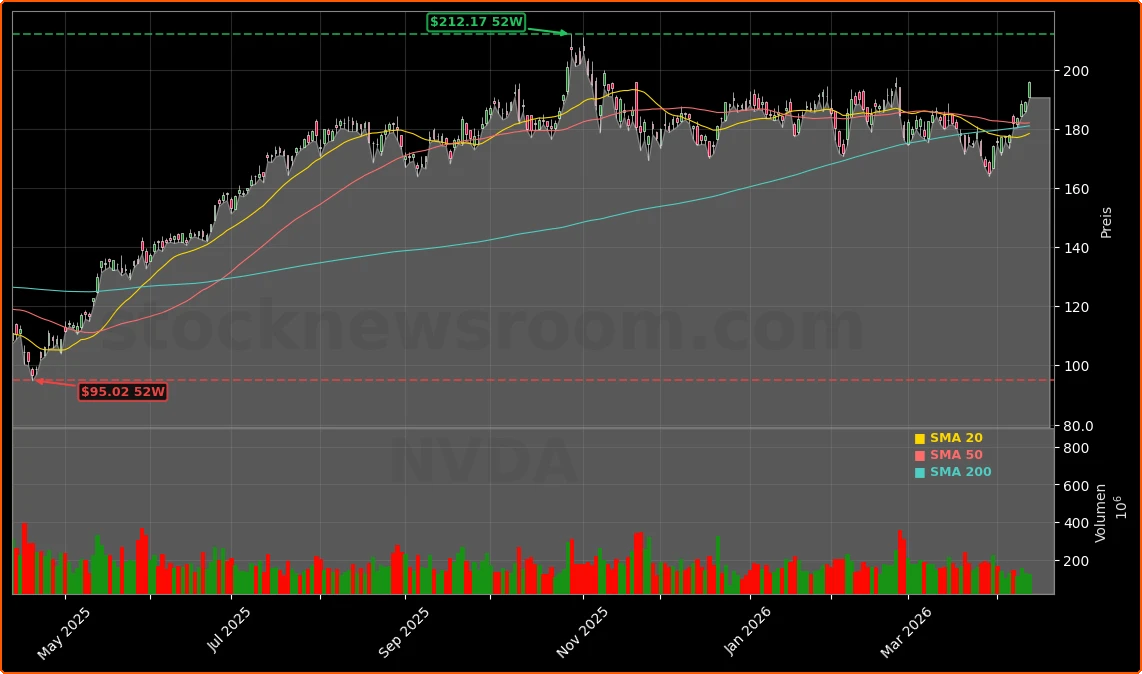
Wall Street, meanwhile, is treating the launch as fuel for the ongoing AI trade rather than a near-term revenue driver. NVDA shares are up more than 70% over the past 12 months and remain about 7% below their all-time closing high near $207, leaving room for upside if growth estimates are met. With a forward P/E near 38.6x and expectations for revenue to climb from roughly $44 billion to almost $79 billion year over year, the stock still prices in a powerful AI and semiconductor supercycle.
What exactly is NVIDIA’s Ising model family?
Ising consists of two main modules. Ising Calibration is a vision-language model that ingests measurements from quantum processors and automates calibration tasks that today can take physicists days. By letting AI agents continuously tune qubits, NVIDIA says calibration times can fall from days to hours, an essential step if quantum hardware is ever to scale to millions of qubits.
The second component, Ising Decoding, uses 3D convolutional neural networks to decode error syndromes in real time. In internal benchmarks, these models run up to 2.5x faster and as much as 3x more accurately than pyMatching, the current open-source standard for quantum error correction decoding. That performance, when paired with NVIDIA GPUs and its CUDA-Q hybrid quantum-classical software stack, positions NVIDIA Quantum AI as the control plane for future quantum machines rather than just a provider of simulation horsepower.
Crucially, Ising is open and can run locally, allowing labs and enterprises to keep proprietary data in-house. The models are distributed alongside a cookbook of workflows and training data, and they interface with NVIDIA NIM microservices as well as NVQLink, a specialized QPU-GPU interconnect designed for real-time error correction and control.
How big is the opportunity – and the risk – for NVIDIA?
The quantum computing market is projected to surpass $11 billion by 2030, still small relative to today’s AI data center spending but potentially a high-margin extension of the platform. At the same time, the broader AI infrastructure cycle is already massive: hyperscalers are expected to invest more than $200 billion in AI-heavy capex, with NVIDIA currently controlling roughly 80% of the AI data center accelerator market.
That “sovereign AI” buildout – where nations and large enterprises deploy their own models on local infrastructure – has been flagged by Constellation Research’s R. Ray Wang as a key reason investors see NVIDIA as a relative safe haven amid software volatility. Wang has pointed to projections of up to $1 trillion in cumulative sales from NVIDIA’s Blackwell and Vera Rubin architectures through 2027. But he also warns that physical constraints, from energy to chemicals like sulfuric acid, could slow the pace of chip production if geopolitical tensions escalate in the Middle East.
Another emerging risk is in critical materials. Gallium, a key ingredient in gallium nitride (GaN) power electronics used in high-efficiency AI data centers, is heavily processed in China, which has already tightened export controls. NVIDIA’s work with Navitas on 800V HVDC GaN-based power systems means that gallium supply could indirectly influence the cost and speed of new AI capacity, even if the GPUs themselves remain silicon-based.
Where do AMD, Amazon and others fit into the AI cycle?
While NVIDIA Quantum AI and the Ising launch spotlight NVIDIA’s innovation edge, the competitive field is thickening. Advanced Micro Devices is rolling out MI300-series accelerators and positioning its ROCm software stack as the main alternative to CUDA in data centers. Although AMD trades at an even richer trailing P/E near the mid-90s and faces its own export-control headwinds, it is the only credible challenger competing in both AI accelerators and x86 CPUs simultaneously.
Cloud giants are also dialing up in-house silicon. Amazon’s latest shareholder letter highlighted that chips such as Trainium, Graviton and Nitro are now running at more than $20 billion in annualized revenue, up from $10 billion just months earlier. While much of this is focused on general compute and inference workloads rather than frontier training, it illustrates how hyperscalers can chip away at demand for merchant GPUs over time. For now, though, NVIDIA’s integrated hardware and software ecosystem – from CUDA and CUDA-Q to networking and now Ising – continues to command premium share and pricing power.
How is Wall Street positioned on NVIDIA now?
Despite a more modest year-to-date gain of just over 3%, NVIDIA retains strong support from major Wall Street banks. Benchmark recently reiterated a Buy rating with a $250 price target, while Rosenblatt reaffirmed its Buy call and a $325 target, and Cantor Fitzgerald maintains an Overweight rating with a $300 target. These targets imply meaningful upside from current levels, even after the multi-year rally that lifted the stock roughly 300% from the end of 2022 to its peak in late 2025.
Fundamentally, NVIDIA’s profitability still outpaces peers in the semiconductor and equipment group. A P/E of about 38.6x sits slightly below some high-growth rivals, while Return on Equity north of 30%, EBITDA over $50 billion, and revenue growth above 70% underscore why many managers still treat the name as a core AI holding. At the same time, the stock now trades closer to sector averages than during the early AI frenzy, suggesting expectations have normalized and that future outperformance will need to come from execution in new areas like NVIDIA Quantum AI, power-efficient architectures and domain-specific accelerators.
Related Coverage
For a deeper dive into how NVIDIA’s broader AI roadmap fits into valuation and earnings expectations, readers can explore NVIDIA AI Strategy +65% Boom: Can This Rally Keep Running?, which analyzes whether explosive AI demand can keep translating into outsized stock gains. Investors tracking the wider tech and space-infrastructure race may also want to read Amazon Globalstar Acquisition: $11.6 Billion Bet to Close the Gap With Starlink, detailing how Amazon’s satellite ambitions could reshape cloud and connectivity dynamics that ultimately intersect with AI workloads.
AI is essential to making quantum computing practical. With Ising, AI becomes the control plane — the operating system of quantum machines.— Jensen Huang, founder and CEO of NVIDIA
In sum, the Ising launch shows NVIDIA Quantum AI evolving from GPU-powered simulation to a full control stack for future quantum-classical systems, deepening the company’s moat across the AI infrastructure landscape. For U.S. investors, NVIDIA remains a high-growth, premium-valued semiconductor leader benefiting from a multi-year AI and quantum supercycle, but one increasingly exposed to materials, regulatory and competitive risks. The next few quarters – including the upcoming May earnings report – will reveal whether NVIDIA can turn its quantum ambitions into another leg of durable growth.