Is the latest Tesla Forecast signaling a fading EV story or the start of a high-risk AI and robotaxi reboot?

How is the new Tesla Forecast shaping the stock?
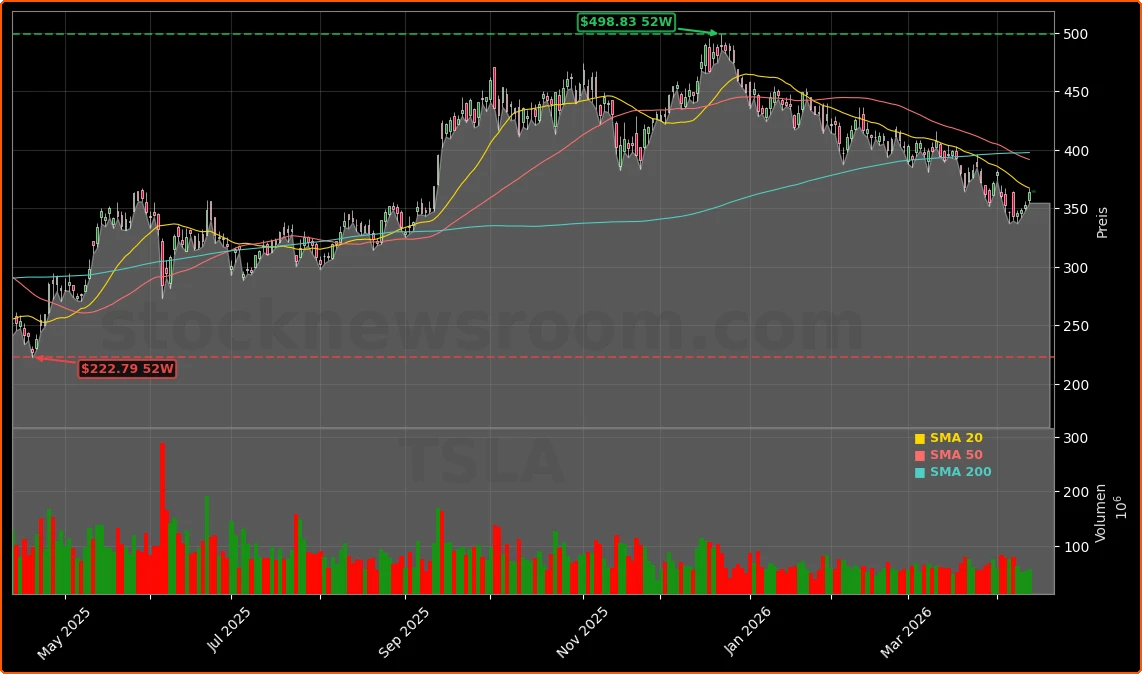
Tesla Inc. shares climbed 3.33% to $364.16 on Tuesday, extending a multi-day rebound as a key bear on Wall Street stepped aside. UBS analyst Joseph Spak upgraded Tesla to Neutral from Sell, keeping a $352 price target, arguing that current levels “more evenly balance” near-term EV headwinds against long-term upside in robotaxis and the Optimus humanoid robot. The move comes after TSLA fell more than 20% year-to-date and remains well below its 52-week high of $498.83, but solidly above the $222.79 low, underscoring how sentiment—not fundamentals alone—drives this name.
From a valuation standpoint, Tesla still looks expensive. Its trailing P/E around 326x dwarfs the automobiles peer average near 23x, while its price-to-sales multiple above 13x vastly exceeds legacy automakers like Ford and General Motors. At the same time, EBITDA of roughly $2.9 billion and gross profit of about $5 billion outclass industry rivals, highlighting the cash-generation that funds its $20 billion-plus 2026 capex plan in AI infrastructure, new factories and fleet expansion.
What does UBS assume for cars, robotaxis and Optimus?
The heart of the updated Tesla Forecast is a sharp downgrade to auto growth but a cautious nod to AI optionality. UBS now models only about 1.6 million vehicle deliveries in 2026, essentially flat versus the 1.64 million delivered in 2025 and well under consensus that looks for closer to 3 million by 2030. Spak cites soft U.S. EV demand and aggressive Chinese competitors as key constraints, arguing the days of 30%-plus annual volume growth are over—at least for this cycle.
On the autonomy side, Tesla’s commercial robotaxi service still operates only in Austin, Texas, despite CEO Elon Musk’s goal of being in “dozens” of cities by 2026. UBS expects a deliberately slow rollout, emphasizing safety and regulatory acceptance, and explicitly does not model “meaningful scaling” of robotaxis before the end of the decade. For Optimus, the Gen 3 humanoid robot unveiled in Q1 2026, UBS forecasts about 5,000 units in 2027 and 30,000 by 2030—far below Musk’s long-term aspiration of 1 million robots per year.
That conservative trajectory contrasts with bullish narratives from funds like Baron Partners, which highlight Optimus and robotaxis as potential revenue streams that could eventually eclipse the auto business. Prediction markets echo UBS’s caution: contracts put the probability of Optimus shipping by year-end 2026 at barely the high teens, suggesting the market sees the roadmap as credible but delayed.
Tesla Forecast vs. competitors like Ford and NVIDIA
The evolving Tesla Forecast sits in a crowded landscape of both EV and AI competitors. In autos, Ford and General Motors trade at single-digit to low double-digit earnings multiples, reflecting cyclical pressures but far less hype. Ford just received a Buy rating and $15 target from UBS, with analyst Joseph Spak arguing rising gas prices and a cheap multiple create an opportunity that looks more traditional and less execution-dependent than Tesla.
In AI, Tesla is increasingly framed as a “physical AI” peer to chip and cloud giants. NVIDIA now carries roughly three-quarters odds on major prediction platforms to finish 2026 as the world’s largest company by market cap, while Tesla’s odds sit around 1%, implying investors still view NVIDIA’s data-center AI stack as the core beneficiary of the boom. Big Tech peers like Apple continue to invest heavily in on-device AI and autonomous-driving software, and Alphabet’s Waymo division is racing Tesla toward scalable robotaxis from a very different, LiDAR-heavy tech stack.
This competitive backdrop matters for portfolios: in the NASDAQ 100, Tesla is no longer the unchallenged growth poster child. The stock is down more than 20% this year even as other “Magnificent Seven” names rebound, and banks such as JPMorgan, via analyst Ryan Brinkman, maintain an Underweight on TSLA with a $145 target—over 60% downside from current levels—citing rising inventories and free cash flow pressure.
What role do Shanghai and energy play in the Tesla Forecast?
A key differentiator in the latest Tesla Forecast is the growing importance of the Shanghai Gigafactory and the energy segment. Tesla’s China leadership has highlighted Shanghai as the central hub for scaling Optimus production, leveraging a supply chain and workforce that previously ramped Model Y to full output in about six weeks. The company targets eventual capacity of up to 1 million robots per year from Shanghai alone, with volume production of Gen 3 Optimus planned before the end of 2026 if execution stays on track.
Meanwhile, Tesla’s energy generation and storage business quietly posted $3.84 billion in Q4 2025 revenue, up 25% year over year, and helped lift overall gross margin back to roughly 20%. For investors, that diversification is critical: it offers a buffer against volatile EV margins and gives the AI and robotics narrative a physical infrastructure backbone in batteries and grid-scale storage. If Shanghai hits even a fraction of its long-term robot targets while energy continues to compound, the 2030 earnings mix could look very different from today’s car-heavy profile.
Related Coverage
For a deeper dive into how Tesla’s autonomous ambitions intersect with slowing EV demand and mounting safety scrutiny, see Tesla Robotaxi boom: AI dream collides with EV slowdown risk, which analyzes whether the robotaxi and Optimus vision can support today’s valuation if core car growth disappoints. Investors interested in the broader EV and robotaxi space should also read Lucid Group CEO Change: -4.4% Plunge and $750M Shock Deal, examining how fresh Saudi and Uber capital may reshape Lucid’s own autonomous strategy amid a brutal stock slump.
Overall, the Tesla Forecast is shifting from hyper-growth EV story to a complex AI, robotics, and energy thesis where execution risk is high but so is potential upside. For U.S. and global investors, the stock now represents a high-volatility bet that Musk can turn today’s expensive narrative into tangible robotaxi and Optimus cash flows by 2030. The upcoming Q1 2026 earnings call and Shanghai updates will be crucial checkpoints for deciding whether Tesla deserves a core position or remains a tactical trade around the AI hype cycle.