Can Intel’s new AI partnerships with Google and Elon Musk really justify a near-record valuation after years of lagging rivals?

How far can this AI-driven rally go?
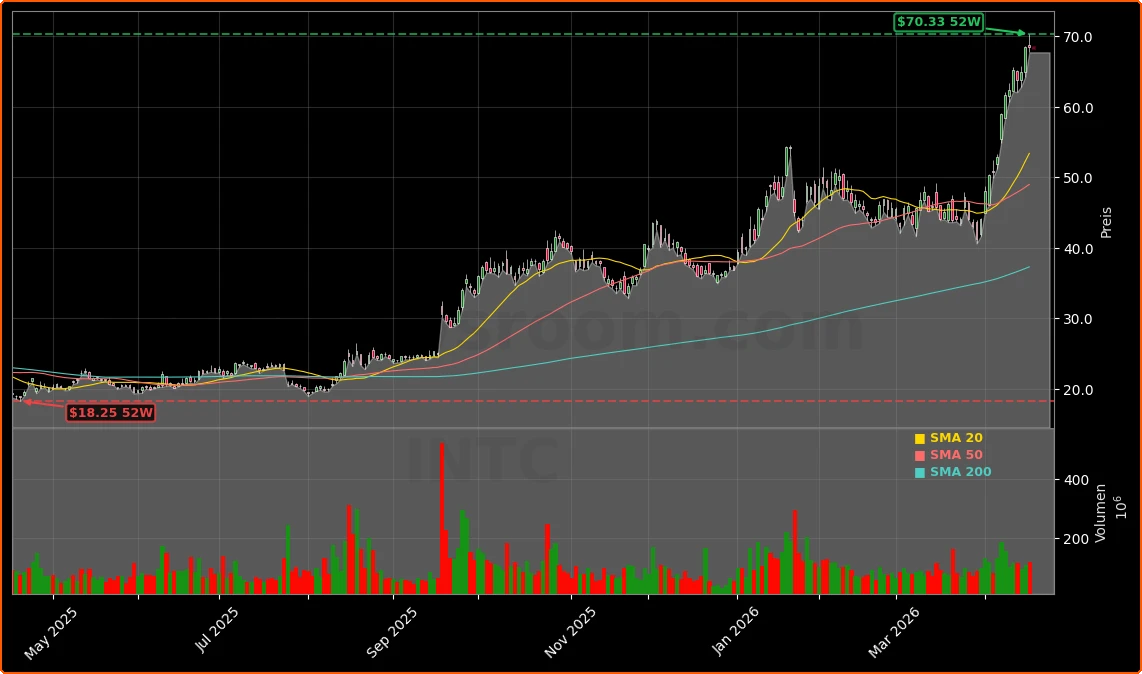
The latest Intel move comes against a powerful macro tailwind: the Nasdaq Composite has climbed about 17.7% since late March as tensions in the Middle East appeared to cool and risk appetite returned. Intel has massively outpaced that index, adding more than $130 billion in market cap in just a few weeks and recently touching an intraday high near $69.55, according to Bloomberg data. At Friday’s close of $68.50 (after-hours: $68.25, -0.36% as of 5:30 p.m. ET), the stock sits only single digits below its all-time high from August 2000.
This makes Intel one of the standout AI momentum stories of 2026 alongside NVIDIA, Broadcom and AMD, even though its core financial metrics are still catching up. The new hype is anchored in the belief that Intel AI Partnerships can finally convert the company’s costly turnaround into real earnings power as hyperscalers, automakers and AI infrastructure players scramble for additional chip capacity.
What exactly did Intel and Google agree?
The first major catalyst is a multiyear collaboration with Google Cloud. Intel announced that Google will deploy its new Xeon 6 CPUs to run AI and general-purpose workloads in data centers over multiple product generations. Unlike past point-product wins, this agreement is explicitly framed as a long-term roadmap alignment, offering better visibility into future demand for Intel’s server portfolio.
Beyond CPUs, Intel and Google are co-developing a custom infrastructure processing unit (IPU) aimed at making hyperscale data centers more efficient for AI traffic. That moves Intel closer to the custom silicon strategies that have helped Broadcom and AMD deepen their own relationships with Meta and Alphabet. In other words, Intel AI Partnerships are now targeting not just standard x86 compute, but the bespoke accelerators and networking offload chips that underpin large language model training and inference at scale.
For U.S. investors, the significance is twofold: Google’s endorsement counters the narrative that cloud giants are permanently shifting away from Intel toward ARM and internal designs, and it potentially creates stickier, multi-generation silicon sockets that could stabilize Intel’s data center revenue over the rest of the decade.
How big could Musk’s Terafab bet be?
The second—and more speculative—leg of the story is Intel’s role in Elon Musk’s Terafab project. Terafab is pitched as a semiconductor fabrication concept designed to enable roughly 1 terawatt of computing power per year, implying truly massive demand for advanced nodes and packaging. Initial capital investment is estimated in the $20 billion to $25 billion range, with some projections suggesting total outlays could eventually reach into the trillions.
Intel is positioned as a key manufacturing and technology partner, potentially leveraging its IDM 2.0 strategy and U.S.-based fabs to support Terafab’s long-run buildout. If even a portion of the more ambitious spending estimates materializes, this could represent a multi-decade demand anchor for Intel Foundry operations and complement AI chip demand from customers like Tesla. The link between Intel AI Partnerships and Terafab is exactly what has fueled hopes that Intel can emerge as a critical supplier in the global AI infrastructure race rather than just a legacy PC CPU vendor.
Do the numbers support Intel’s new valuation?
The rally has pushed Intel’s valuation to extreme levels. On trailing figures, the stock trades at more than 900 times earnings, and the forward P/E near 135 still dwarfs that of Apple, NVIDIA and many other mega-cap tech names. Analysts are divided: Mizuho recently raised its Intel price target to $59 with a bullish stance on AI and foundry optionality, yet the broader Wall Street consensus remains closer to a “Hold,” with average targets in the low-$50s, implying downside from current levels.
Upcoming Q1 2026 earnings on April 23 will be pivotal. Intel must demonstrate that its AI orders and foundry pipeline are translating into tangible revenue acceleration and margin improvement. A disappointment could trigger a sharp pullback similar to January’s post-guidance slump, especially now that expectations are higher and the multiple is stretched. Still, many institutional buyers appear willing to treat any selloff as a chance to add exposure to Intel AI Partnerships given the scale of the potential TAM in data center, automotive and custom chips.
How does Intel stack up in the AI chip race?
In the broader AI semiconductor landscape, Intel is still playing catch-up. IndexBox data show Broadcom and AMD gaining share with custom accelerators and GPUs tied to Meta and Alphabet, while NVIDIA continues to dominate the high-end GPU market. However, Intel has unique levers: an integrated manufacturing footprint in the U.S. and Europe, the chance to monetize foundry capacity for third parties, and now prominent alliances with Google Cloud and the Terafab initiative.
Jensen Huang’s recent comments that NVIDIA “doesn’t pick winners” and instead backs a wide range of AI players underscore how diverse the ecosystem has become. Intel’s strategy is to be both a competitor and, in some cases, a partner—supplying chips, tools or capacity wherever AI compute demand surfaces. For diversified U.S. portfolios, that combination of upside optionality and geopolitical relevance is a key part of the bull case, even if execution risk and valuation remain front and center.
Related Coverage
For a deeper dive into how Musk and Google factor into Intel’s broader restructuring, see Intel Strategy Rally: +4.0% Surge on Musk and Google AI Deals, which analyzes whether the recent rebound can be sustained. To compare Intel AI Partnerships with a more consumer-focused approach, Apple AI Strategy +2.6% Rally: Edge AI Boom or Hype? looks at how Apple is leveraging on-device AI and hardware integration to drive its own valuation reset.
Overall, Intel AI Partnerships with Google and Terafab have reignited investor confidence, pushed the stock near two-decade highs and reframed the company as a serious contender in AI infrastructure. For U.S. investors, the key question now is whether execution on these deals can grow into the elevated multiple before sentiment cools. The upcoming earnings report and further details on foundry wins will determine whether this AI-powered rerating marks the start of a durable leadership phase or a temporary overshoot in a very crowded trade.