
Is the latest Intel Forecast a realistic AI boom story or just the next chapter in an overheated chip rally?

How does the new Intel Forecast change the story?
The most dramatic shift in the Intel Forecast comes from Citigroup. Analyst Atif Malik reaffirmed his Buy rating and lifted his price target on Intel Corporation to $130 from $95, explicitly reframing CPUs as the orchestration layer for autonomous AI agents rather than mere support chips for GPUs. In a new total addressable market model, Malik projects the global CPU market growing 35% annually to $132 billion by 2030, powered by an eye‑catching 185% annual growth rate in so‑called agentic CPU workloads.
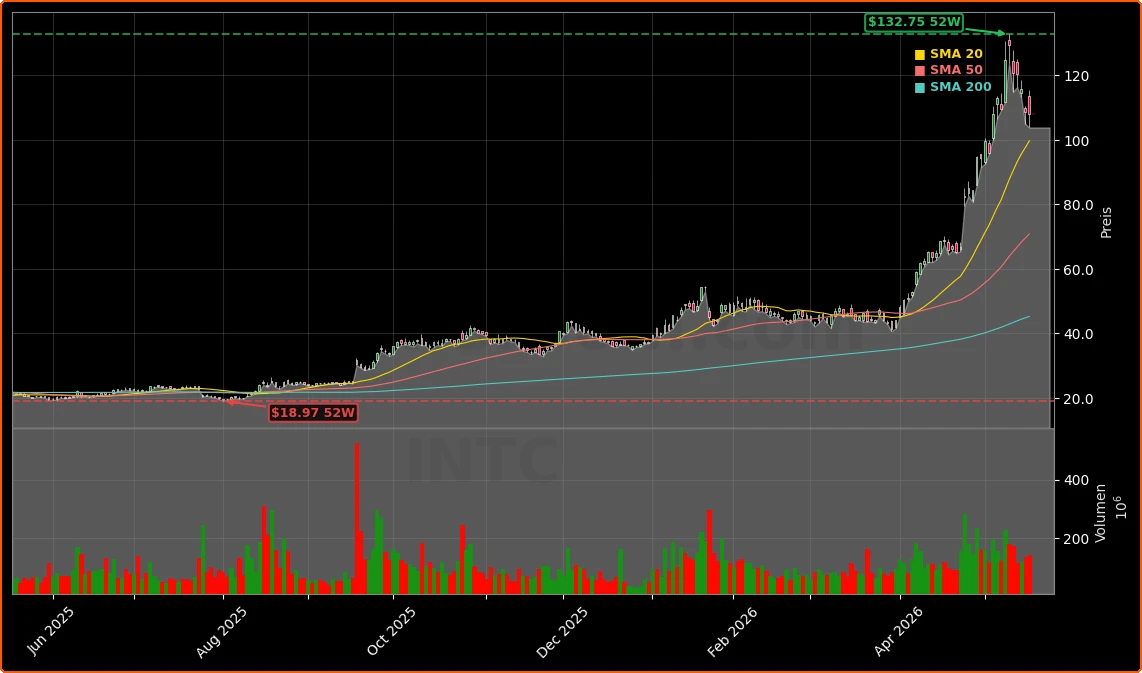
This Intel Forecast lands as the stock has already staged a spectacular rebound, more than tripling over the past year and trading well above many legacy price targets that cluster near $84–$85. Benchmark’s Cody Acree joined the bullish camp on Monday, lifting his target to $140 from $105 while keeping a Buy rating and arguing that the market still underestimates Intel’s earnings power in fiscal 2027 and 2028. Yet the shares are sliding in afternoon trading as worries about higher interest rates pressure richly valued AI names across the NASDAQ and S&P 500.
What do Intel’s latest numbers show?
Under CEO Lip‑Bu Tan, Intel is trying to execute a double transformation: defending its x86 CPU franchise while building a world‑class foundry backed by U.S. government capital. For Q1 2026, Intel delivered revenue of $13.58 billion, up 7.2% year over year, with non‑GAAP earnings of $0.29 per share. The Data Center and AI segment grew 22% to $5.05 billion, while Intel Foundry revenue rose 16% to $5.42 billion, signaling tangible demand for its advanced 18A process node and packaging technology.
Management’s guidance for Q2 2026 calls for revenue between $13.8 billion and $14.8 billion and a non‑GAAP gross margin around 39%. That modest margin outlook underlines that the turnaround remains a work in progress. On a GAAP basis, Q1 still showed a net loss of $3.73 billion, driven in part by a $4.07 billion goodwill impairment at Mobileye, and free cash flow was negative $3.87 billion. Intel Foundry is bleeding roughly $2.5 billion per quarter, and a change in depreciation estimates has flattered reported profitability versus older accounting assumptions.
How does Intel stack up against NVIDIA and AMD?
For U.S. investors, the Intel Forecast must be viewed in the broader AI hardware context dominated by NVIDIA and Advanced Micro Devices. While Intel’s Client Computing Group grew just 1% last quarter, AMD’s client segment expanded 26% and its data center business 57%, highlighting continued share loss in PCs and servers. That is one reason many analysts still regard AMD as the cleaner listed play on AI accelerators, with manufacturing outsourced to Taiwan Semiconductor and a visible Instinct GPU roadmap for hyperscalers.
Even so, Intel has scored important strategic wins. Its Xeon 6 chips were chosen as host CPUs for NVIDIA’s DGX Rubin NVL8 systems, and it signed a multiyear collaboration with Google on custom accelerator and IPU designs. Intel has also joined the Terafab project alongside SpaceX, xAI, and Tesla, and is reported to be close to securing foundry business from Apple, a long‑sought validation of its 18A process in the premium smartphone and PC ecosystem. The U.S. government’s 9.9% equity stake further anchors Intel as a national strategic asset in the semiconductor supply chain.
Is valuation the weak link in the Intel Forecast?
Despite the bullish Intel Forecast from Citigroup and Benchmark, valuation is the main sticking point for many on Wall Street. At Monday’s $108.17 quote, Intel trades on a forward P/E that has fluctuated around triple‑digit territory this spring, far above its historical range and out of line with many peers. Consensus price targets near $84–$85 imply more than 20% downside from current levels, and the stock has drawn far more Hold ratings than Buys, with at least a few Sells still on the board.
The market’s mood has already started to turn. Composite sentiment scores have slid sharply in recent weeks as retail investors take profits following gains of nearly 200% year to date and over 400% in the past twelve months. Hedge funds have opened sizeable put positions against Intel, even as some long‑only institutions quietly add to holdings. The Philadelphia Semiconductor Index, which includes Intel, is up roughly 65% in 2026 alone, a pace that invites bubble comparisons to the months preceding the 2000 NASDAQ peak.
What should U.S. investors watch next?
For American portfolios, the practical takeaway from the Intel Forecast is not simply “buy the AI dip”. The bull case hinges on two measurable factors: whether Intel can translate its AI design wins into sustained Data Center and AI growth above 20%, and whether 18A yields ramp fast enough to narrow foundry losses and lift margins toward the low‑to‑mid‑40s. Any upside surprise to 2026 or 2027 earnings per share, where estimates remain relatively low around $0.50 but could potentially double, would support the more aggressive targets from Citigroup and Benchmark.
The bear case focuses on execution risk and macro sensitivity. Higher long‑term Treasury yields increase the discount rate applied to Intel’s far‑out cash flows, and tighter financing conditions could crimp hyperscaler capex on which much of the agentic AI thesis depends. A disappointing Q2 report, a delay in next‑generation process milestones, or widening foundry losses would all challenge the optimistic Intel Forecast and likely force a retracement toward consensus targets.
Related Coverage
The CPU now serves as the orchestration layer and critical control plane for the entire AI stack.— Lip-Bu Tan, Intel CEO
Investors looking for more context on recent volatility can read “Intel Plunge -6.1%: AI Chip Highflyer Faces Profit Shock”, which explores whether the latest drawdown is simple profit‑taking after an AI melt‑up or the first real crack in Intel’s turnaround narrative.