
Is Intel’s red-hot AI and Intel Foundry story hitting its first serious reality check after a spectacular stock surge?

Why is Intel falling after a record run?
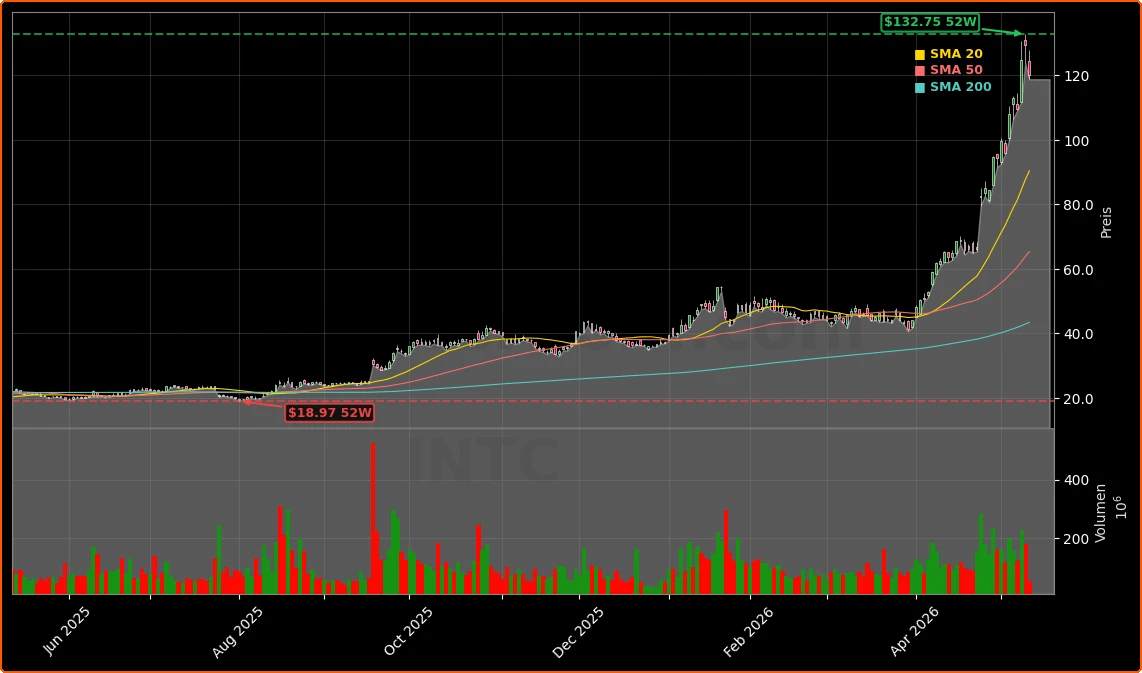
After a parabolic move that left the stock up roughly 200% year to date and more than 400% over the past 12 months, Intel Corporation is finally seeing a sharp pullback. The shares opened near record territory before sliding about 7% by early afternoon ET, underperforming a broadly weaker semiconductor complex on the NASDAQ. The drop follows several volatile pre‑market sessions in which Intel gave back 3%–5% at a time as traders locked in profits and reacted to headlines ranging from Korean tax and AI‑dividend chatter to sector‑wide risk‑off moves.
Despite today’s weakness, Intel remains one of the top performers in the S&P 500 this year, powered by a dramatic re‑rating around its AI roadmap and the emerging Intel Foundry narrative. The stock’s extreme sensitivity to incremental news now cuts both ways: positive foundry headlines can trigger euphoric buying, while any hint of execution or macro risk can quickly spark profit‑taking.
How big is the Apple boost for Intel Foundry?
The biggest structural driver behind the recent rally is growing confidence that Intel can build a viable alternative to Taiwan Semiconductor in advanced manufacturing. A preliminary chipmaking agreement with Apple centered on Intel’s 18A node at its Chandler, Arizona fab has been interpreted as an early validation of Intel Foundry’s roadmap. Analysts at Wedbush describe the arrangement as a clear positive, while also flagging open questions about yields, timelines, and the long‑term cost structure of Intel’s fabs.
Separate commentary from Benzinga highlights that this Apple deal arrives alongside forecasts that the data‑center CPU market could approach an $80 billion opportunity by 2028, driven by AI‑centric infrastructure. That backdrop gives Intel more room to amortize its enormous capex bill, but it also sharpens the focus on whether the company’s 18A and 14A nodes can truly compete with the most advanced processes in the industry. For now, investors are willing to pay up for the optionality of Intel Foundry capturing volume from marquee clients such as Apple, NVIDIA, Tesla, xAI, and SpaceX.
Can Intel compete with AMD and Nvidia in AI?
On the competitive front, Advanced Micro Devices and NVIDIA remain the clear near‑term winners in high‑end AI accelerators, but their strength is not necessarily bad news for Intel. A powerful AI server “super cycle” in CPUs and accelerators is lifting the entire group, with GF Securities projecting the server CPU total addressable market to surge from about $26 billion in 2025 to roughly $135 billion by 2030. Intel’s Xeon line, and future AI‑optimized CPUs, are central to this thesis as AI agents and inference workloads consume huge CPU resources alongside GPUs.
Recent results from AMD underscore this dynamic: a 38% year‑over‑year revenue jump to $10.2 billion and a 57% increase in data‑center revenue demonstrate that demand for AI compute remains intense. While AMD has been chipping away at Intel’s x86 share, the broader AI build‑out means the pie is getting much bigger. Intel’s own turnaround strategy banks on regaining CPU competitiveness while leveraging Intel Foundry to win custom AI silicon from cloud giants and large enterprise customers seeking alternatives to TSMC-heavy supply chains.
What are analysts and institutions signaling?
Wall Street’s stance on Intel has been evolving as the stock re‑rates from value laggard to AI and reshoring beneficiary. Deutsche Bank recently raised its price target for Intel, citing new custom orders flowing into the foundry business and growing visibility on third‑party manufacturing demand. Although the firm did not change its overall stance on Intel’s cyclical risks, the target hike reflects a more constructive view on Intel Foundry’s ability to attract blue‑chip customers beyond internal CPU production.
On the ownership side, a fresh Form 13F filing shows Intel Capital and related entities managing roughly $470 million in institutional holdings, underscoring the company’s role as both operator and investor across the semiconductor ecosystem. At the same time, smaller sales like the April disposal of Intel shares by Congressman Cliff Bentz, disclosed under the STOCK Act, highlight that some market participants view the stock as stretched after its massive run. So far, however, there has been no sign of a broad institutional exodus.
How does Ohio and US policy fit the Intel Foundry story?
Domestic manufacturing and policy support are another key pillar of the Intel Foundry thesis. Intel’s $20 billion Ohio One project, which had faced timing uncertainties, is now back in the spotlight as executives and state leaders reaffirm their commitment, buoyed by the company’s AI‑driven share price surge. The plan is to begin production around 2031, positioning the site as a strategic hub for US‑made advanced chips. Alongside the Arizona 18A fab targeted for Apple and others, Ohio is central to Washington’s efforts to reduce dependence on Asian supply chains and to bolster national security around cutting‑edge semiconductors.
Critical suppliers such as ASML are also leaning into this trend, with their EUV lithography tools enabling the very high‑end nodes Intel is racing to deploy. That tight integration between US industrial policy, Intel’s capex plans, and the Intel Foundry customer pipeline is a major reason why many investors now see Intel not just as a cyclical PC chip stock, but as a long‑duration strategic asset in the global AI build‑out.
Related Coverage
For a deeper dive into how the emerging Apple relationship first ignited investor optimism, readers can revisit this analysis of the Intel–Apple deal and the 13.9% share price surge that put Intel on record watch. That piece explores whether the Apple partnership is the turning point that truly validates the foundry strategy and sets the stage for the current debate around valuation and execution risk.
Intel’s pullback today does little to change the core narrative: the company is attempting a once‑in‑a‑generation pivot from integrated manufacturer to global contract producer, with Intel Foundry at the center of its AI and reshoring strategy. For US investors, the stock now represents a high‑beta bet on domestic semiconductor capacity, CPU‑driven AI workloads, and the success of high‑stakes deals with customers like Apple and NVIDIA. The next few quarters of design wins, node rollouts, and fab ramp updates will show whether Intel Foundry can turn soaring expectations into durable cash flows and justify keeping the name in long‑term AI portfolios.