Is the Intel Apple Deal the turning point that finally validates Intel’s risky foundry bet and justifies its soaring valuation?

How much is the Intel Apple Deal moving Intel?
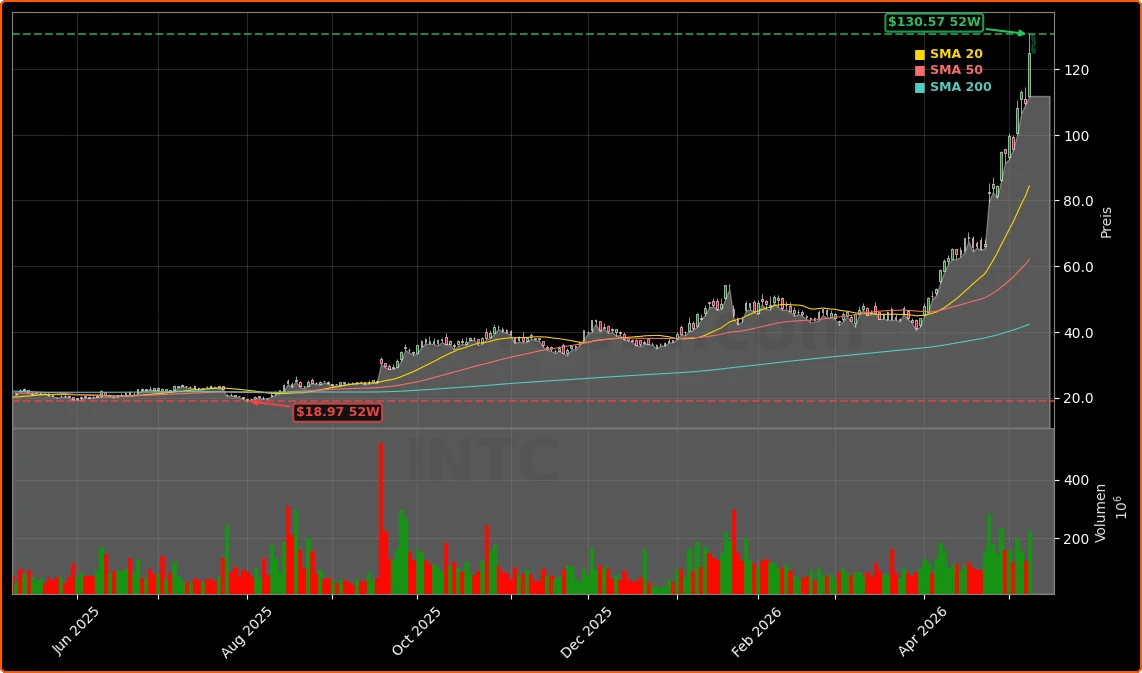
Intel shares closed Friday at $126, up roughly 13.9% on the day, and were quoted around $130.42 in early Monday trading, adding another 4.40%. That puts the stock at new record territory and far above its 52‑week low, underscoring how central Intel has become to the semiconductor-led surge in the S&P 500 and NASDAQ. The immediate catalyst is a report that Intel has struck a preliminary agreement to manufacture some chips for Apple devices in the United States, a long-sought external win for Intel’s young foundry business.
The Intel Apple Deal follows more than a year of negotiations and is still short on detail: it is not yet clear which Apple products will use Intel-fabricated chips or when high-volume production might begin. Even so, the prospect of tapping Apple’s massive shipment base in iPhones, iPads, and Macs is enough to move the needle for sentiment. For now, investors are treating the news as validation that Intel’s costly push into contract manufacturing may finally be attracting top-tier customers.
What does the Intel Apple Deal change for Intel’s foundry plan?
The core of Intel’s turnaround story is its ambition to become a leading global foundry, competing directly with Taiwan Semiconductor Manufacturing and Samsung. Intel has invested heavily in advanced process nodes, packaging technologies such as EMIB, and new U.S. fabs backed in part by government incentives. Until now, it has struggled to land large external clients beyond a handful of specialty projects, which raised doubts about utilization and long-term returns.
Landing Apple—even on a limited basis—addresses that concern. Apple has historically relied on Taiwan Semiconductor for its most advanced chips, so any shift of production to Intel would be a symbolic break with that dependence and a sign that Intel’s technology is catching up. It also ties directly into Washington’s push to bring more high-end semiconductor production onshore, a political tailwind that supports Intel’s strategic positioning.
However, the Intel Apple Deal also brings execution and margin risk. Foundry contracts in their early phases tend to be capital-intensive with lower profitability as capacity ramps. Bank of America has acknowledged the strategic upside but argues that early-stage margin pressure and potential delays could limit near-term financial benefits, even if the headline partnership looks impressive.
How does Intel stack up against NVIDIA and other rivals?
Intel’s explosive move has pushed it into the group of a handful of semiconductor names responsible for a large share of the S&P 500’s gains this year, alongside players like NVIDIA and other AI beneficiaries. Yet the business models differ sharply. While Intel remains primarily a hardware and foundry story, Nvidia’s moat is increasingly defined by software, especially its CUDA platform, which has become the de facto standard for AI workloads and keeps developers locked into its ecosystem.
That contrast matters for valuation. Intel now trades at a triple-digit forward price-to-earnings multiple, far above its historical norm of about 10 in 2021. Based on current estimates, Intel could still be at roughly 53 times earnings in 2029, meaning the stock would remain priced for aggressive growth years into the future. In other words, the market is front-loading a lot of success from the Intel Apple Deal and the broader AI opportunity long before the cash flows arrive.
At the same time, the halo from the Apple agreement is spilling over to suppliers and equipment makers that stand to benefit from any capex tied to new capacity. Companies like Applied Materials, which provide manufacturing gear to foundries, are being watched closely to see whether these megadeals can justify their own elevated valuations.
Are Wall Street analysts buying the rally?
Despite the surge, not all analysts are ready to chase Intel at current levels. Bank of America recently raised its price target on Intel to $96 from $56 but kept an Underperform rating. The firm argues that much of the upside from the Intel Apple Deal is already embedded in the stock and cautions that the risk-reward looks unfavorable after such a steep run. The new target sits well below today’s $120‑plus quote, effectively signaling downside from here.
Other Wall Street firms have highlighted similar concerns about valuation and execution. With Intel more than 50% above its 50‑day moving average and up roughly 50% in just the last 10 trading days, technical indicators also warn of an overheated setup. The stock’s surge has been amplified by a broader semiconductor rally driven by AI optimism and strong demand for memory and high‑end compute, which can make individual names more vulnerable if sentiment reverses.
Still, the combination of a marquee customer in Apple, heavy U.S. policy support, and Intel’s sharpened focus on manufacturing scale has made the company one of the defining plays of the current chip cycle. For growth-oriented investors willing to tolerate volatility, that mix is precisely what keeps capital flowing into the name despite skeptics on the Street.
What should investors watch next?
From here, the key questions revolve around the specifics of the Intel Apple Deal: which chips Intel will build, on which process nodes, and how quickly volumes can ramp. Any confirmation from Apple’s product roadmap—such as future iPhone or Mac announcements referencing Intel-made components—would likely act as fresh catalysts. Investors will also scrutinize Intel’s next earnings updates for guidance on capex, foundry revenue contributions, and expected margins.
More broadly, the stock’s trajectory will be shaped by whether the AI-driven semiconductor rally can maintain its pace and whether competitors like NVIDIA and other chipmakers continue to post blockbuster results. If the sector cools or if execution on the Apple partnership stumbles, highly stretched multiples could compress quickly.
Related Coverage: For a deeper dive into how this story unfolded and what it might mean for Intel’s long-term AI ambitions, readers can revisit the earlier analysis “Intel Apple Deal Sends Stock Soaring 13.6% in AI Rally”, which explores whether the foundry gamble can turn Intel into a sustained AI winner.
In summary, the Intel Apple Deal has vaulted Intel Corporation into the center of the semiconductor narrative, rewarding shareholders with spectacular short-term gains but also elevating expectations to a challenging level. For U.S. investors, the stock now represents a high-beta wager on Intel’s ability to execute on its foundry pivot and deepen its partnership with Apple over time. The coming quarters will reveal whether this surge marks the foundation of a new growth era or the high-water mark of the current AI mania.