Is Intel’s explosive AI inference rally a sustainable turnaround story or a valuation trap in the making for investors?

Is Intel’s AI rally getting ahead of itself?
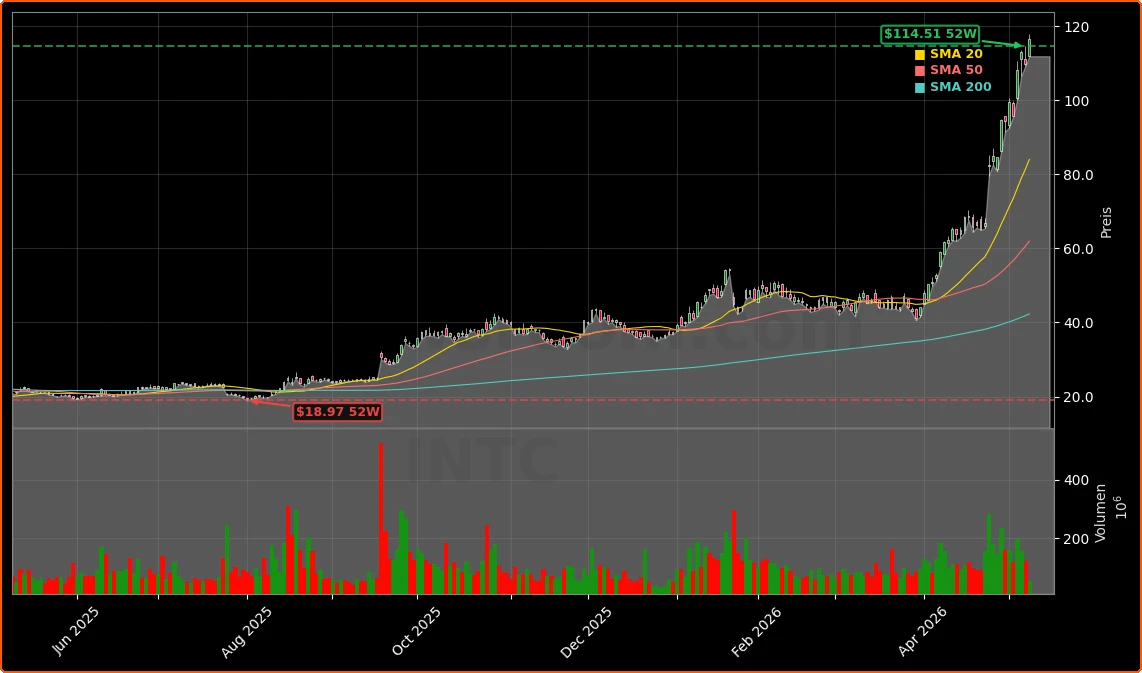
At today’s price near $116.58, Intel is up roughly 197% year to date and about 200% versus the same period last year, putting the stock among the best performers on the NASDAQ and the S&P 500. The rally accelerated after Q1 2026 results on April 23, when Intel posted non‑GAAP EPS of $0.29 on $13.58 billion in revenue, up 7.2% year over year and comfortably ahead of consensus. Data Center and AI revenue jumped 22% to $5.05 billion, while the Intel Foundry unit rose 16%, signaling that the company’s multi‑year turnaround is gaining operational traction even as reported GAAP numbers are weighed down by a $4.07 billion Mobileye impairment.
Despite that progress, valuation has become a flashpoint. Forward P/E has swelled to around 119, drawing sharp pushback from more cautious voices on Wall Street. Research shop 24/7 Wall St. reiterated a SELL rating this week with a price target of $88.66, implying more than 20% downside from current levels and arguing that the risk‑reward now demands near‑flawless execution. Their bear‑case scenario sees potential downside toward the mid‑$60s if foundry losses persist and PC demand weakens.
Why Intel AI Inference is changing the CPU story
The core of the bull case is the changing balance between GPUs and CPUs in AI. Historically, training large models was dominated by GPU clusters from players like NVIDIA, with CPUs playing a supporting role at a GPU‑to‑CPU ratio of roughly 8:1. Inference – the deployment and use of already trained models – is different. For simple chat workloads, some industry insiders now see ratios closer to 4:1, while more complex agent‑based Intel AI Inference scenarios are approaching 1:1, with CPUs heavily utilized for orchestration, logic and data handling.
This shift is crucial for Intel because it directly links rising AI usage to sustained demand for high‑end Xeon processors and future AI‑optimized CPU families. Intel executives have highlighted that matrix extensions and other accelerators built into its data‑center CPUs are already speeding up AI workloads for major cloud customers. If Intel AI Inference continues to scale at an exponential pace as enterprises embed AI into everyday applications, the company could see a multi‑year tailwind across servers, networking and even power and cooling infrastructure partners.
That narrative is reinforced by hyperscaler partnerships. Google has tapped Intel for custom ASIC IPUs, and Intel’s Xeon 6 has been selected as host CPU for NVIDIA’s DGX Rubin NVL8 systems, positioning Intel at the heart of heterogeneous AI clusters rather than on the sidelines.
How new leadership and foundry bets reshape Intel
The leadership story is another pillar of the rerating. CEO Lip‑Bu Tan, who took over in March last year, spent most of his first months rebuilding credibility as Intel lost ground in cutting‑edge AI accelerators. Over the past two quarters, that perception has shifted. Tan has actively courted major tech clients, winning favor with political leaders in Washington while securing interest from US heavyweights like Apple and Tesla in Intel’s manufacturing roadmap.
Recent reports that Apple is exploring Intel and Samsung as potential US foundry partners for future chip production have been read as a strong vote of confidence in Intel’s 18A and advanced packaging capabilities. For investors, even a partial manufacturing mandate from a company of Apple’s scale would de‑risk Intel’s massive capex program and validate its strategy of building a geographically diversified alternative to Asian contract manufacturers.
At the same time, Tan is pushing aggressive bets on technologies such as directed self‑assembly, where Intel aims to lead ahead of Samsung and TSMC in high‑volume deployment. Management has also flagged that advanced packaging demand is already running in the billions of dollars per year, potentially making Intel a key enabler of the next wave of AI systems built around chiplets and heterogeneous compute.
What are the key risks for US investors now?
Against this upbeat backdrop, skeptics underline several red flags. Intel Foundry still posted a $2.4 billion operating loss in the latest quarter, and free cash flow remains negative at roughly -$3.9 billion as the company invests heavily in fabs and process nodes. Management has even floated the possibility of pausing development of its future 14A node if customer demand does not materialize, underscoring that the foundry build‑out is not risk‑free.
For US investors running concentrated exposure to AI winners such as NVIDIA and mega‑cap platforms like Apple, the question is whether to rotate into Intel at this stage or wait for a pullback. On one hand, Intel AI Inference exposure offers portfolio diversification away from pure GPU plays and toward CPUs, networking and packaging – parts of the stack that may benefit as AI usage broadens beyond a handful of hyperscalers. On the other, any disappointment in Q2 guidance, a slowdown in PC recovery or delays in landing marquee external foundry customers could trigger a sharp valuation reset.
Related Coverage
For a deeper dive into how new partnerships are feeding into the AI narrative, readers can revisit our recent analysis, “Intel SpaceX Partnership +4.5% Rally Shocks Wall Street”. That piece examines whether collaboration with SpaceX and the broader Intel AI Inference boom are enough to justify Intel’s more than 400% surge over the past year and the premium multiples now attached to the stock. Together with today’s developments, it paints a fuller picture of how strategic alliances and AI workloads are reshaping Intel’s risk‑reward profile for Wall Street.
In sum, the Intel AI Inference story has transformed the company from an overlooked CPU “dinosaur” into one of the market’s most closely watched AI turnaround plays. For American investors, the stock now represents a high‑beta, high‑valuation way to bet on AI workloads shifting toward CPU‑heavy architectures and on a US‑based foundry alternative winning scale. The next few quarters – particularly customer wins on 18A and progress on narrowing foundry losses – will determine whether Intel can grow into this valuation and keep Intel AI Inference at the center of the AI infrastructure conversation.