Can Intel’s sudden Wall Street comeback finally turn its AI and foundry ambitions into a durable bull case?

What Does the Intel Upgrade Mean for Wall Street?
Bank of America Securities upgraded Intel Corporation to ‘Buy’ on June 11, 2026 — a decisive reversal from its prior ‘Underperform’ rating. The firm raised its price target from $96 to $135, implying roughly 10% upside from Friday’s intraday high and 17% from Thursday’s close. This Intel Upgrade is not just tactical: BofA analysts now project Intel’s 2030 earnings power at $6 per share, more than double prior estimates of $3–$4. Their bullish case centers on two converging trends — surging demand for AI inference workloads (which favor CPUs over GPUs) and Intel’s accelerating progress in contract manufacturing via Intel Foundry. Notably, Intel says inference workloads surpassed training workloads in 2025 — a structural shift that could redefine competitive dynamics against NVIDIA and AMD.
How Does Intel Compare to AMD and NVIDIA?
While NVIDIA dominates AI training with its H100 and Blackwell chips, and AMD gains traction with MI300X deployments at Meta and Microsoft, Intel is betting big on the next layer: AI inference at scale. Unlike training, which demands massive parallelism, inference is latency-sensitive and benefits from high-core-count, power-efficient CPUs — Intel’s historic strength. That’s why BofA sees Intel capturing meaningful share in AI servers outside hyperscale GPU clusters. Meanwhile, J.P. Morgan’s Harlan Sur maintains a $45 price target — implying 60% downside — citing unresolved execution risks, a $2.3 billion loss in the foundry segment, and concerns over dividend sustainability. Barclays and Wells Fargo have taken middle-ground positions, lifting targets to $100 and $110 respectively, but stopping short of a full ‘Buy’ call.
Is Intel’s Foundry Bet Gaining Real Traction?
Yes — and it’s becoming geopolitically urgent. Intel has agreed to license its 14A process node for the Terafab consortium, a Western-led initiative to reduce reliance on Taiwan Semiconductor Manufacturing Co. (TSMC). This move signals credibility with major European and U.S. chip buyers. Reuters reports Intel has already alerted Chinese customers to lead times of up to six months — a sign of constrained supply and growing demand. Yet execution remains the hurdle: Intel’s foundry segment generated just $4.6 billion in revenue in Q1 2026 while burning $2.3 billion. Still, BofA notes that major U.S. cloud providers are now evaluating Intel’s advanced packaging and manufacturing capabilities — a critical first step toward long-term design wins.
Why Is Intel Still Under-Weighted in U.S. Portfolios?
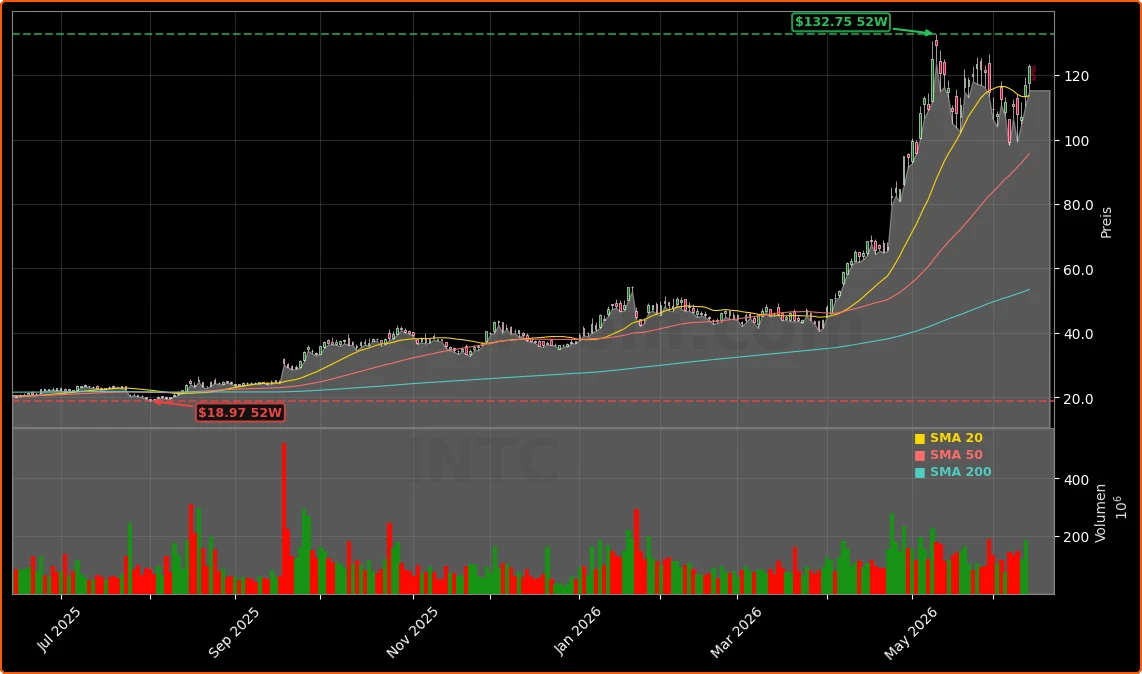
Despite a 463% gain over the past 12 months — outpacing AMD by 2x — Intel remains under-owned by institutional investors. The iShares Semiconductor ETF (SOXX) holds Intel at just 6.30%, while the GraniteShares 2x Long INTC ETF (INTW) holds a staggering 66.67% — a telling contrast between directional traders and long-term allocators. Analysts cite lingering skepticism around Intel’s turnaround timeline, especially after losing server CPU share to AMD and Arm over the past decade. But with Wall Street’s median target at just $82.33 — $40 below current levels — the gap between consensus and BofA’s $135 target underscores how much room remains for portfolio reallocation if Q2 earnings on July 23 deliver evidence of acceleration in AI server wins and foundry bookings.
Intel Upgrade: What’s Next for Investors?
The next major catalyst is Intel’s Q2 2026 earnings report, scheduled for July 23. Wall Street expects earnings of $0.19 per share — a sharp turnaround from a $0.10 loss a year earlier — and revenue of $14.40 billion, up from $12.86 billion. Technical indicators remain largely bullish: Intel trades 23.1% above its 50-day moving average, and its 20-day SMA remains above both the 50-day and 200-day SMAs — a ‘golden cross’ that formed in August 2025 and remains intact. Yet momentum is softening: the MACD has turned negative, suggesting near-term consolidation. Key resistance sits at $126.50, with the 52-week high at $132.75. A breakout above $126.50 could trigger fresh institutional buying — especially if BofA’s Intel Upgrade proves to be the first of several.
Related coverage: For deeper analysis on how BofA’s Intel Upgrade reshapes the AI chip narrative, see Intel Upgrade +5.9% as BofA Turns Bullish on AI Push. Investors weighing Intel against its peers should also read AMD Upgrade +4.3% After Citi Buy Call and Meta AI Win, which explores whether Wall Street is finally re-rating CPU players as AI infrastructure enablers.
We see Intel uniquely positioned to benefit from the CPU-intensive AI inference wave and the strategic push toward Western semiconductor sovereignty.— Bank of America Securities Analyst Team
Bank of America Securities’ Intel Upgrade marks a pivotal shift in sentiment — not just for Intel, but for the broader CPU-AI thesis. For U.S. investors, this represents a timely opportunity to reassess under-owned semiconductor exposure amid accelerating AI infrastructure spend. The next earnings report will test whether Intel’s execution can match its upgraded expectations. For long-term portfolios, the $135 target offers a clear near-term catalyst — and a compelling reason to initiate or add exposure ahead of Q2 results.