
Can Intel AI Strategy finally turn AI buzz into a credible comeback story before rivals widen the gap again?

Can Intel AI Strategy reset sentiment?
Intel’s latest push combines product messaging with a more disciplined financial story. At Computex, Chief Executive Lip-Bu Tan highlighted Xeon 6 chips tied to the company’s 18A process, while executives from Perplexity and SambaNova appeared alongside Intel to discuss a multiyear collaboration around AI inference. That matters because Intel is no longer trying to win attention with chip launches alone. It is trying to show that its Intel AI Strategy can connect silicon, manufacturing, and customer adoption in a way investors can model.
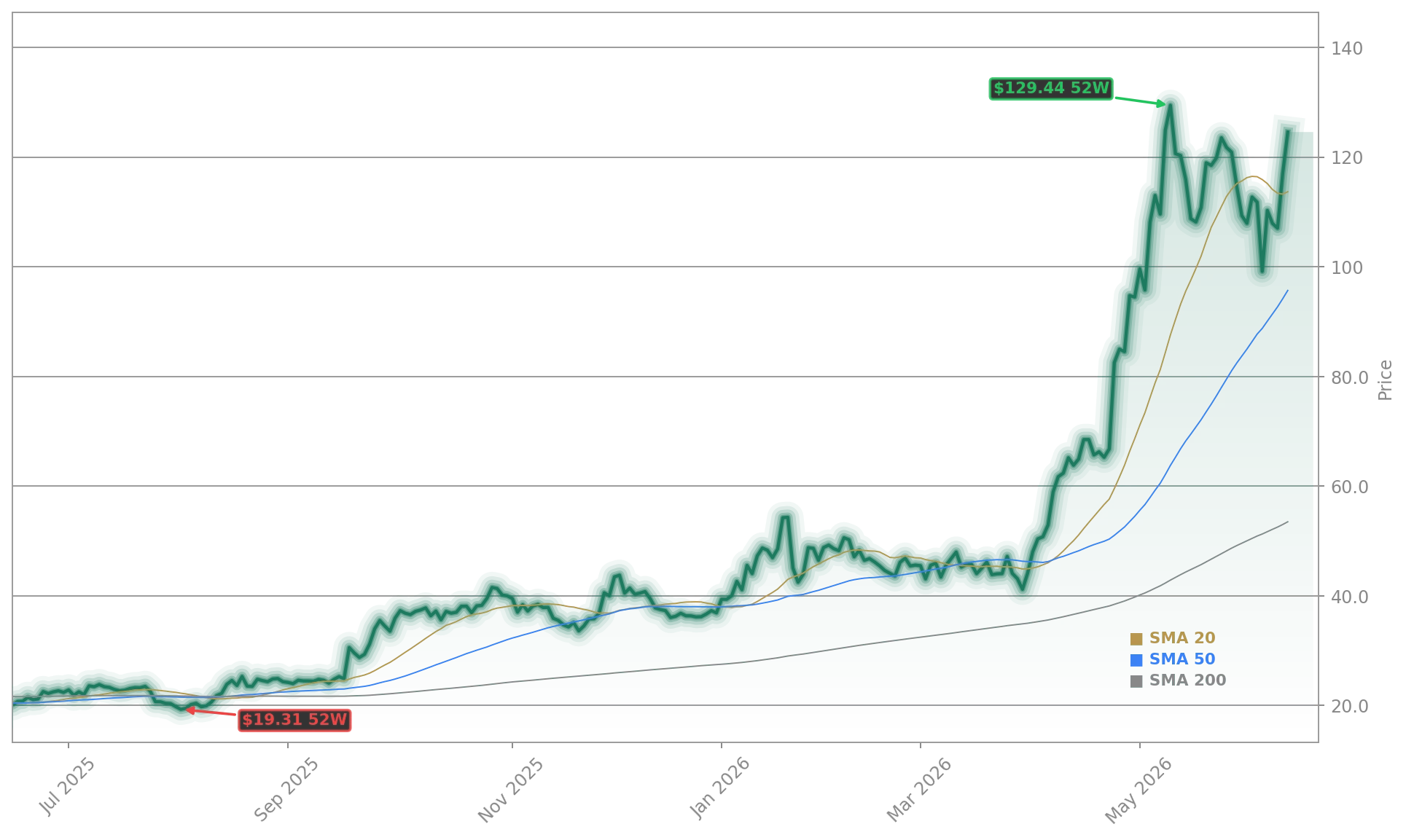
The market reaction is notable. Tuesday’s close of $107.93 remained well below Intel’s 52-week high of $132.75, so this is not a breakout to new highs. Still, the sharp pre-market move indicates traders see fresh upside in the narrative after a period of skepticism around execution, profitability, and Intel’s place versus NVIDIA and other AI leaders.
Is Intel closing the AI gap?
Intel’s first-quarter numbers showed why the debate remains open. Revenue rose 7% year over year to $13.6 billion, while GAAP earnings came in at a loss of $0.73 per share. On an adjusted basis, Intel earned $0.29 per share and generated $1.1 billion in operating cash flow. For Q2, management guided for revenue of $13.8 billion to $14.8 billion, adjusted gross margin of 39.0%, and adjusted earnings per share of $0.20.
The healthiest growth came from the businesses most relevant to the Intel AI Strategy. Data Center and AI revenue climbed 22% to $5.1 billion, and Foundry revenue rose 16% to $5.4 billion. By contrast, the Client Computing Group increased only 1% to $7.7 billion. That split helps explain why Intel is talking less about legacy PC cycles and more about AI infrastructure, foundry utilization, and manufacturing economics.
At the same time, pressure is increasing. NVIDIA has launched its RTX Spark Superchip to push deeper into AI PCs, adding to competitive noise around Intel’s core franchise. Intel has responded by welcoming competition and emphasizing its roadmap, customer relationships, and x86 ecosystem scale.
What does Intel need from Taiwan?
Taiwan remains central to Intel’s roadmap. Tan has described TSMC as a partner, not just a rival, underscoring that Intel still plans to outsource some advanced production while scaling its own 18A and future 14A efforts. That pragmatic stance may be more important to investors than old debates about manufacturing purity. In AI infrastructure, speed matters, and the Taiwan ecosystem remains critical for packaging, validation, and supply-chain coordination.
That ecosystem is also where Intel is being pulled into a broader industry buildout. Astera Labs’ expansion in Taiwan highlights how AI platform deployment increasingly depends on tight integration among chip designers, systems companies, and manufacturing partners, including Intel, NVIDIA, and Apple-linked supply chains. For US investors, that means Intel’s comeback case is no longer a simple CPU story. It is a network-execution story.
Are analysts and funds turning constructive?
Institutional positioning suggests patience has not disappeared. Bank of New York Mellon increased its Intel stake in the fourth quarter, while total institutional ownership stands at 64.53%. MarketBeat also noted that analysts still carry a consensus Hold rating with an average price target of $83.35. That target sits below current levels, a reminder that Wall Street has not fully re-rated Intel despite the recent rally.
Related Coverage: Investors also watched the pressure building in PCs after Intel PC Chips -3.1% as Nvidia Targets Its Core PC Market examined how Arm-based AI processors could challenge one of Intel’s most important franchises. That earlier piece fits today’s setup because Intel’s answer is increasingly tied to foundry progress, enterprise AI inference, and platform partnerships rather than PCs alone.
Intel AI Strategy is becoming easier to define: grow data center AI, prove 18A, use partnerships to accelerate inference adoption, and defend the balance sheet while margins recover. If Intel can convert that plan into more consistent profits, the pre-market jump may hold. The next earnings report will be the clearest test for investors deciding whether this turnaround deserves a higher multiple.
Fazit folgt.