
Is the Intel Plunge just routine profit-taking after an AI-fueled melt-up, or the first crack in the chip boom story?

Is the Intel Plunge a turning point for AI chips?
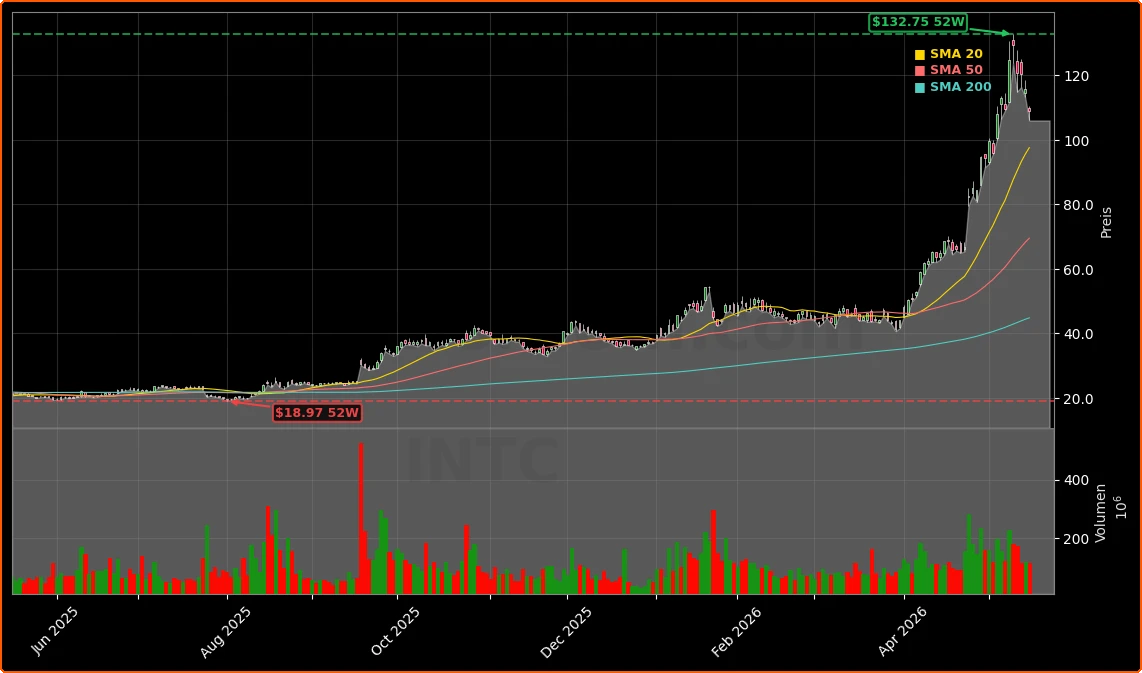
The Intel Plunge stands out even in a weak tape for semiconductors. Intel Corporation closed at $108.87, down from a previous close of $114.33, as rising Treasury yields, renewed inflation worries, and aggressive profit-taking hit high-beta tech stocks. The Philadelphia Semiconductor Index dropped more than 3%, with Intel among the worst performers as investors locked in gains after a vertical move fueled by AI enthusiasm and speculation about a major foundry deal with Apple.
Chip peers also retreated, though less dramatically. NVIDIA and AMD each fell several percentage points, while Micron and other memory and networking names joined the selloff. Traders pointed to a combination of macro headwinds and positioning: after Intel’s stock surged roughly 214% year to date and more than 80% in the past month, many institutional portfolios had already reached or exceeded target weightings, leaving limited incremental buying power at elevated prices.
Despite the Intel Plunge, the stock remains one of 2026’s standout gainers in the S&P 500 and a key driver of the NASDAQ 100’s earlier outperformance. The current pullback is large in absolute terms but still modest relative to the prior run-up, which had pushed Intel above its dot-com-era peak and firmly reinserted the company into the AI leadership narrative on Wall Street.
How did Apple optimism fuel Intel’s surge?
The recent parabolic phase before the Intel Plunge was powered by a dramatic re-rating of Intel’s long-term role in the AI supply chain. Reports of a preliminary manufacturing agreement with Apple to build custom chips for iPhones and Macs triggered a series of explosive sessions, including intraday jumps of more than 15% and a nearly 14% single-day spike. For investors, the idea that Apple might again rely on Intel for advanced manufacturing radically changed perceptions of Intel’s foundry ambitions and its ability to compete with Taiwan Semiconductor in leading-edge process technology.
Those headlines landed just weeks after a blowout Q1 2026 earnings report. Intel delivered non-GAAP EPS of $0.29 versus expectations near breakeven, with Data Center and AI revenue climbing 22% year over year to $5.05 billion. Management highlighted strong traction for custom AI accelerators, Gaudi products, and next-generation CPUs aimed at inference workloads, while government support and large customer prepayments underpinned the company’s multibillion-dollar foundry build-out.
Analysts responded by racing to catch up. Mizuho, for example, lifted its Intel price target to $124 earlier this week, citing strong agentic AI server demand and a structurally improving foundry story. Other Wall Street firms have framed Intel as a late-cycle AI infrastructure beneficiary, arguing that hyperscalers and cloud providers will seek alternatives to NVIDIA’s premium-priced GPUs over time, opening room for Intel’s accelerators and custom silicon.
How does Intel’s drop compare with AMD and NVIDIA?
The Intel Plunge is part of a broader rotation within AI hardware, not an isolated collapse. AMD and NVIDIA have also given back a portion of their massive 2025–2026 gains as traders rebalance exposure ahead of key catalysts. All three remain sharply positive for the year, with Intel still the top percentage gainer among major US-listed chipmakers despite today’s selloff.
What makes Intel’s move more dramatic is its newly acquired “high-beta” status. Historically seen as a mature PC and server CPU player, Intel has transformed into a speculative AI and foundry turnaround story. That shift means the stock now tends to lead both up and down when sentiment swings across the AI complex. Portfolio managers emphasize that single-day moves of 4%–8% are increasingly normal in this group, especially ahead of major earnings such as NVIDIA’s upcoming May 20 report, which often moves the entire sector in lockstep.
Strategists also note that higher bond yields are pressuring long-duration growth assets. AI hardware names are particularly rate-sensitive because their valuations embed years of anticipated cash flows from data center build-outs, AI servers, and edge computing deployments. When yields spike, discounted cash flow models compress, and richly valued winners like Intel can see outsized downside volatility.
Does the Intel Plunge change the long-term thesis?
For now, most institutional investors see the Intel Plunge as a sharp but technically driven correction rather than a fundamental break. The AI infrastructure backdrop remains intact: cloud providers are still racing to add capacity, enterprises are ramping AI workloads, and governments are subsidizing domestic chip manufacturing. Intel’s foundry build-out, partnership with AI server players, and potential Apple contract all remain in play.
At the same time, skepticism has grown louder. Some portfolio managers argue the stock’s near-500% rise from last year’s lows was not fully justified by underlying earnings power, warning that Intel still trails cutting-edge rivals on process technology and GPU performance. Others point out that alternative architectures, such as Arm-based server CPUs, are gaining traction and could chip away at Intel’s and AMD’s x86 dominance over time, even if the overall AI server market expands.
From a technical perspective, several technicians highlight the $80–$85 area as a plausible support zone if selling accelerates, framing it as a potential re-entry level for long-term investors who missed the initial surge. For traders, the next key watch point is NVIDIA’s earnings next week, which could either stabilize sentiment across AI chips or trigger another leg down if expectations prove too aggressive.
Related Coverage
Investors looking for a deeper dive into the recent volatility can read Intel Foundry -7.3% Plunge: AI Rally Faces Reality Check, which analyzes how Intel’s earlier drop this week fits into the broader pattern of an overheated AI trade and what it could mean for the sustainability of the foundry narrative.
In summary, the Intel Plunge underscores how quickly sentiment can swing on Wall Street after a parabolic AI rally, but it does not yet invalidate the company’s turnaround or foundry ambitions. For US investors, the key is distinguishing a violent but normal consolidation from a genuine deterioration in competitive position and demand. The coming weeks, especially NVIDIA’s results and Intel’s next updates, will show whether this setback turns into a buying opportunity or a warning that the AI chip trade has run too far, too fast.