
Can the high‑stakes Apple China Trip secure Beijing ties, calm geopolitics and still keep the $4 trillion giant’s growth story intact?

What does the Apple China Trip signal for investors?
The Apple China Trip comes at a delicate moment for both geopolitics and markets. President Trump is traveling to meet Chinese President Xi Jinping with a high‑profile CEO delegation that includes Tim Cook, Tesla CEO Elon Musk and NVIDIA chief Jensen Huang. Trump has said he wants Xi to “open up” China so American companies can “work their magic,” underscoring how central access to the world’s second‑largest economy remains for the S&P 500’s biggest tech names.
For Apple, China is still a core profit engine. The company generates more than 15% of its revenue there and dominates the premium smartphone segment. In the latest quarter, Greater China contributed roughly $20.5 billion in sales, helping drive record March‑quarter revenue of $111.18 billion and earnings per share of $2.01. Any hint from the Apple China Trip that regulatory pressure will ease, or that U.S. firms will get better market access, could support that growth narrative and help justify Apple’s premium valuation.
How is Apple trading versus other mega caps?
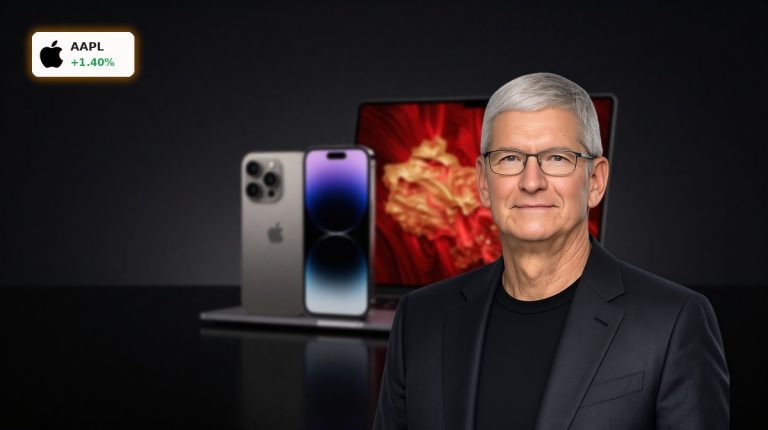
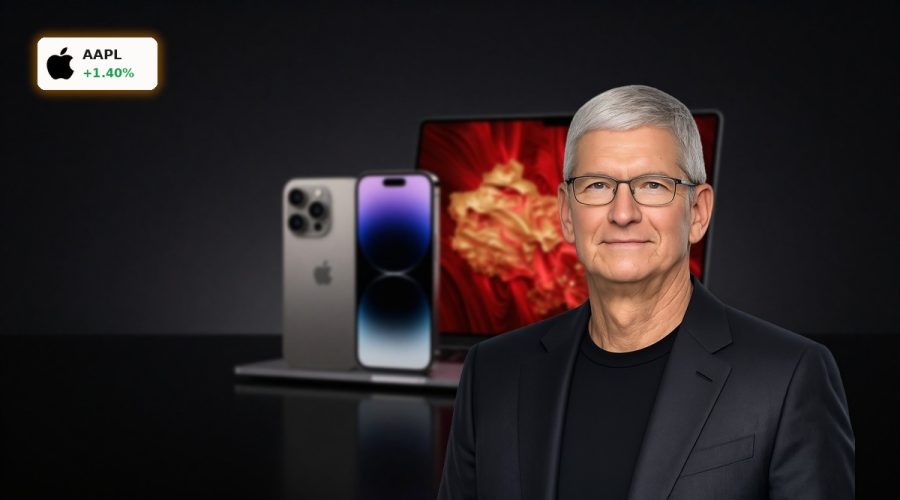
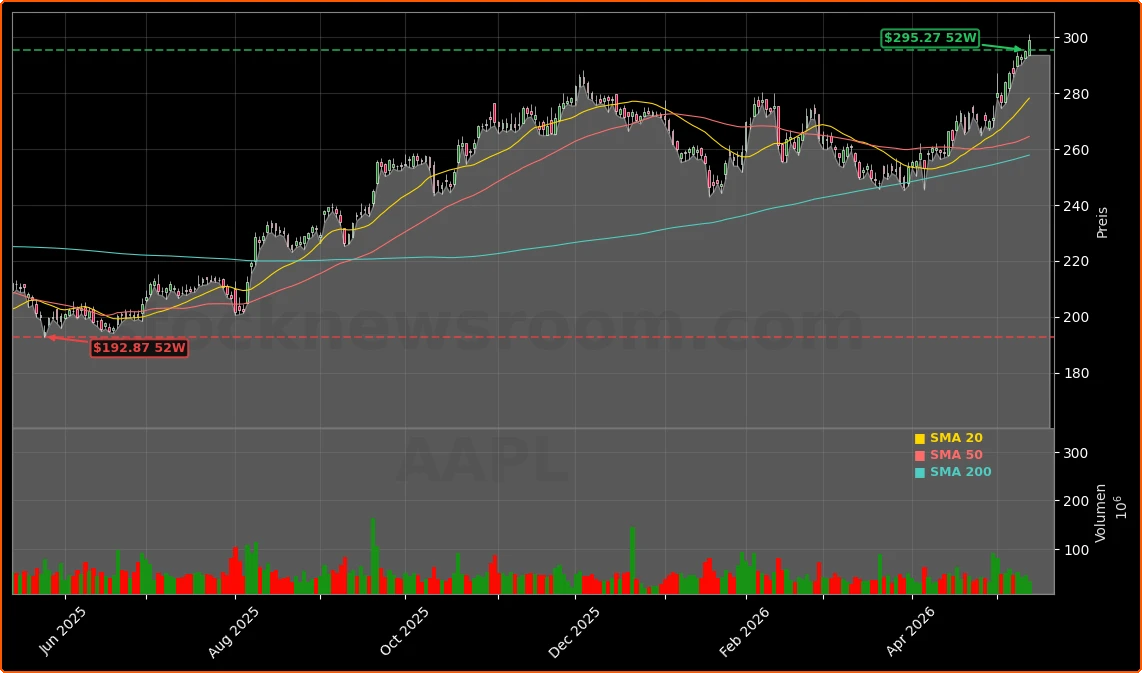
Apple stock finished Wednesday’s session at $298.94, up 1.40% from Tuesday’s close of $294.49 and on pace for a potential record close if it can push convincingly through $300. The move adds to a run of more than 20% since the late‑March lows and around 48% over the past 12 months, even as some investors argue the valuation is stretched. Apple trades at roughly 38 times earnings, a software‑like multiple for what is still primarily a hardware business.
In the broader “Magnificent Seven” context, the stock has lagged some peers year‑to‑date, with Alphabet and NVIDIA posting stronger gains. Yet Apple remains one of the heaviest weights in the NASDAQ and S&P 500, and many institutional portfolios still treat it as a core holding. Daiwa, for example, recently reiterated an “Outperform” rating on Apple and raised its price target from $310 to $325, highlighting the strength of the company’s ecosystem and downplaying concerns about near‑term turbulence from supply‑chain memory costs in the second half of 2026.
What role does China play in Apple’s growth story?
China is both Apple’s opportunity and its biggest geopolitical risk. The company’s iPhone shipments rose about 5% year over year in Q1 2026, even as the global smartphone market shrank by 6% due to memory shortages and higher component costs. Strong Chinese demand for the iPhone 17 lineup helped Apple reclaim the top spot in global smartphone market share, at roughly 21%.
That backdrop makes the Apple China Trip particularly important. A more constructive U.S.–China tone could extend the current “trade truce,” reduce the odds of new tariffs and protect Apple’s extensive manufacturing and retail footprint in the region. Analyst Gil Luria has praised Tim Cook for steering the company through prior rounds of U.S.–China tension, and Cook’s presence in Beijing as part of Trump’s delegation reinforces his role as Apple’s chief geopolitical operator even as he prepares to move into an executive chair position.
How do leadership and AI strategy intersect?
On April 20, Apple announced that Tim Cook will become executive chair effective September 1, with hardware chief John Ternus taking over as CEO. Under Cook, Apple’s market capitalization rose from roughly $350 billion in 2011 to around $4.35 trillion, generating a total return above 2,500%. The latest fiscal year ended in late September delivered $461 billion in revenue, up from $391 billion the year before, and EPS of $7.49 versus $6.11, a performance that hardly suggests a business in decline.
Still, Cook has faced criticism for moving too slowly on generative AI. Many iPhone 17 buyers were disappointed by the lack of major AI upgrades in iOS, prompting concerns that Apple was ceding ground to rivals. Apple has since responded by striking a deal with Alphabet to integrate Google’s Gemini models into “Apple Intelligence” and a revamped Siri, with big announcements expected at WWDC in early June. The Apple China Trip is happening just weeks before that event, giving Cook an opportunity to reassure Chinese officials that AI‑driven features will respect local rules while keeping iPhone devices desirable in a fiercely competitive market.
What are the financial and valuation stakes now?
Beyond geopolitics, Apple continues to generate massive cash flows. Free cash flow yields around 2.3%, and the company recently authorized a new $100 billion share repurchase and raised its dividend by about 4%, signaling confidence in recurring cash generation. At the same time, insiders including long‑time director Arthur Levinson and several top executives have sold shares in recent weeks near the $280–$290 range, a move some traders interpret as a sign that the easy money in the current rally may have been made.
Apple’s high multiple also stands out when compared to faster‑growing competitors. Alphabet, for instance, trades at less than half Apple’s P/E ratio despite stronger recent stock performance, while Tesla and AI leaders like NVIDIA command rich valuations but have clearer direct AI growth narratives. Online prediction markets even assign only about a one‑in‑five probability that Apple will finish May above $300, underlining just how crowded the trade has become. For portfolio managers benchmarked to the NASDAQ or S&P 500, the Apple China Trip and upcoming WWDC will be key catalysts to reassess whether Apple still deserves an outsized allocation.
Related Coverage
Investors looking for a deeper dive into how leadership changes intersect with AI ambitions should read this analysis of Apple’s CEO transition and stock performance. That piece examines how John Ternus could steer the company into a new phase of AI‑driven growth while Tim Cook shifts his focus toward global policymaker engagement and geopolitical strategy.
Today Apple is proud to report our best March quarter ever.— Tim Cook, CEO of Apple Inc.
The Apple China Trip ultimately crystallizes the core Apple thesis: a premium brand with huge China exposure, a late but accelerating AI push, and a still‑dominant hardware franchise priced like a software platform. For U.S. investors, the combination of near‑record share prices and elevated geopolitical risk argues for watching policy headlines and WWDC announcements closely before making big allocation shifts. With Cook’s China diplomacy and Ternus’s upcoming handover, the next few months will show whether Apple can turn geopolitical access and AI partnerships into the next leg of sustainable growth.