Can blockbuster Apple Earnings and a massive buyback keep powering the stock as the company heads into its post-Cook era?

How did Apple Earnings move the stock?
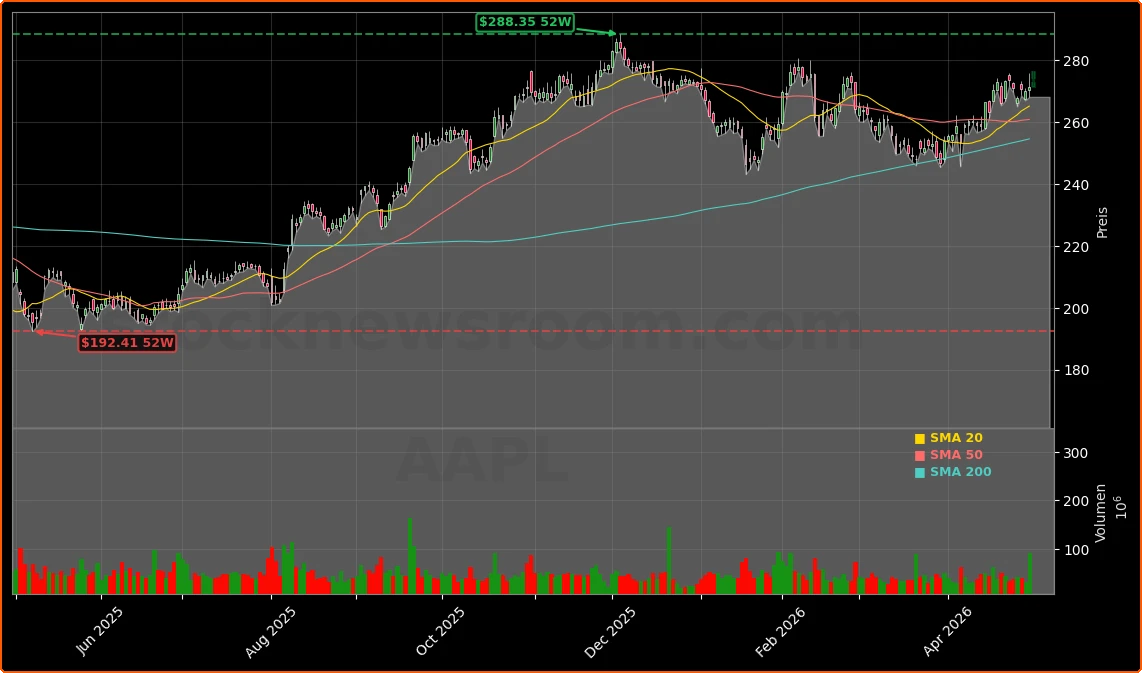
Apple Inc. reported fiscal second‑quarter results on Thursday after the U.S. market close, and the numbers landed ahead of already elevated expectations. Revenue rose 17% year over year to about $111.2 billion, topping Wall Street estimates just under $110 billion. Diluted earnings per share increased 22% to $2.01, beating consensus forecasts around $1.95–$1.96. Following the Apple Earnings release, shares climbed roughly 1.9% in late trading to about $276.50, adding to a 0.44% gain earlier in the day and pushing the stock closer to its December 2025 record high near $288.60.
At the time of the report, Apple’s market price of $271.35 leaves it about 6% below that all‑time peak but well above its 200‑day moving average, extending a powerful rebound from the June 2025 low. The strong Apple Earnings print also contributed to firmer S&P 500 and Nasdaq futures, reinforcing the company’s status as a key driver of major U.S. equity benchmarks and of mega‑cap tech sentiment alongside peers like NVIDIA and Tesla.
What was behind the revenue beat at Apple?
The latest quarter was Apple’s best March period in its history, powered by broad‑based strength across hardware and services. iPhone remained the growth engine, with revenue of about $56.99 billion, up roughly 22% year over year and marking a second straight quarter of more than 20% segment growth. Management said the iPhone 17 lineup is now the most popular in the company’s history, though tight component availability prevented even stronger numbers.
Services again punched above their weight for profitability. The segment generated around $30.98 billion in revenue, a roughly 16% increase and an all‑time high, supported by App Store, cloud storage, Apple Music and video subscriptions. Because Services carry gross margins nearly double those of hardware, this mix shift helped push overall gross margin to about 49.3%, ahead of analyst models near 48.4%. Mac revenue reached $8.4 billion, iPad $6.9 billion and wearables roughly $7.9 billion, each topping forecasts as the low‑cost MacBook Neo and updated tablets attracted both students and AI‑focused developers.
How strong is Apple’s global demand picture?
Geographically, growth was robust across all major regions, with particular strength in Greater China. Revenue there climbed roughly 28% year over year to about $20.5 billion, comfortably ahead of expectations that had been below $19.5 billion. That rebound helps counter earlier concerns that local competition from Samsung, Xiaomi and OPPO could permanently erode Apple’s high‑end share in the world’s largest smartphone market.
Apple also highlighted a new all‑time high installed base of more than 2.5 billion active devices, spanning iPhone, iPad, Mac and wearables. That metric is critical for long‑term investors, because it expands the addressable market for high‑margin services and ecosystem lock‑in. Despite an industrywide soft patch in global smartphone shipments in early 2026, Apple’s premium positioning and brand loyalty continue to support resilient demand and upgrade cycles.
What guidance and capital returns did Apple give?
Looking ahead, management issued a stronger‑than‑expected outlook for the June quarter, guiding for revenue growth of 14% to 17% year over year and a gross margin between 47.5% and 48.5%. This upbeat forecast helped drive the post‑close rally and signals that Apple sees continued momentum in both hardware and Services despite industry headwinds.
The board approved a massive new $100 billion share repurchase authorization and raised the quarterly dividend by about 4% to $0.27 per share. Since 2018, Apple has reduced net cash by more than $100 billion as it returned capital to shareholders through buybacks and dividends. Management indicated it will no longer target a specific “net cash neutral” level but will instead independently evaluate cash and debt while keeping repurchases as a central tool for shareholder value creation. For income and total‑return investors, the combination of dividend growth and aggressive buybacks underscores Apple’s confidence in its long‑term cash‑generation capacity.
What risks cloud the Apple Earnings story?
Despite the upbeat Apple Earnings, management was unusually explicit about one major risk: the global memory shortage driven by AI data‑center demand. CEO Tim Cook warned that memory costs are set to rise significantly and could have an increasing impact on profitability in coming quarters. The company has already faced supply constraints for certain iPhone and Mac models, and Cook expects Mac availability to remain tight for several months as component shortages persist.
Analysts at firms such as D.A. Davidson and Needham see these higher memory prices as a headwind that could pressure gross margins or force Apple to tweak product configurations and pricing, particularly at the premium end. At the same time, Apple continues to be perceived as lagging in generative AI investment when compared with U.S. hyperscalers and chip leaders like NVIDIA. To close the gap, Apple is partnering with Alphabet’s Google Gemini on AI features in Siri and iOS and signaling a more personalized Siri rollout later this year, potentially at WWDC.
How does the CEO transition change the outlook?
Beyond the headline Apple Earnings beat, this quarter will be remembered as the one that formally set up Apple’s next leadership chapter. After nearly 15 years as CEO, Tim Cook will step down on September 1, 2026, to become Executive Chairman. Longtime hardware chief John Ternus, a 25‑year veteran who helped shape iPhone, iPad and AirPods, will take over as CEO. On the earnings call, Ternus said this is the most exciting time of his career at Apple and pledged to lead with the company’s long‑standing product‑first values.
Cook framed the timing of his departure around strong recent performance, a robust roadmap and confidence that Ternus is the right successor. For investors, the transition raises questions about Apple’s AI strategy, future product breakthroughs such as a potential foldable iPhone and whether the company will lean even more heavily into its hardware roots. Nonetheless, the smooth, internally driven succession and the backdrop of record Apple Earnings help reduce immediate governance concerns for large institutional holders.
Related Coverage
For a deeper dive into what the leadership change could mean for innovation and AI positioning, readers can explore Apple CEO Transition Warning: Can Hardware Lead an AI Boom?. That analysis looks at how John Ternus’s hardware background might shape Apple’s strategic priorities once he takes the reins from Tim Cook and how those choices could affect long‑term shareholder returns.
One of the most important decisions he’ll make is where to spend his time, and I would spend it where the greatest benefit to the company and the users are.— Tim Cook, outgoing Apple CEO
In summary, the latest Apple Earnings delivered record March‑quarter results, a powerful outlook and a massive buyback that reaffirm the company’s central role in U.S. equity portfolios. While rising memory costs, supply constraints and the upcoming CEO transition add complexity to the story, Apple’s scale, services growth and ecosystem strength keep the long‑term investment case intact. The next few quarters of Apple Earnings and AI‑driven product updates will show whether the stock can break through its prior highs and extend its leadership in the S&P 500 and Nasdaq for years to come.