Will the Apple CEO Transition to John Ternus unlock a new hardware-led AI chapter or expose how far the tech giant has fallen behind?

How is Wall Street pricing the Apple CEO Transition?
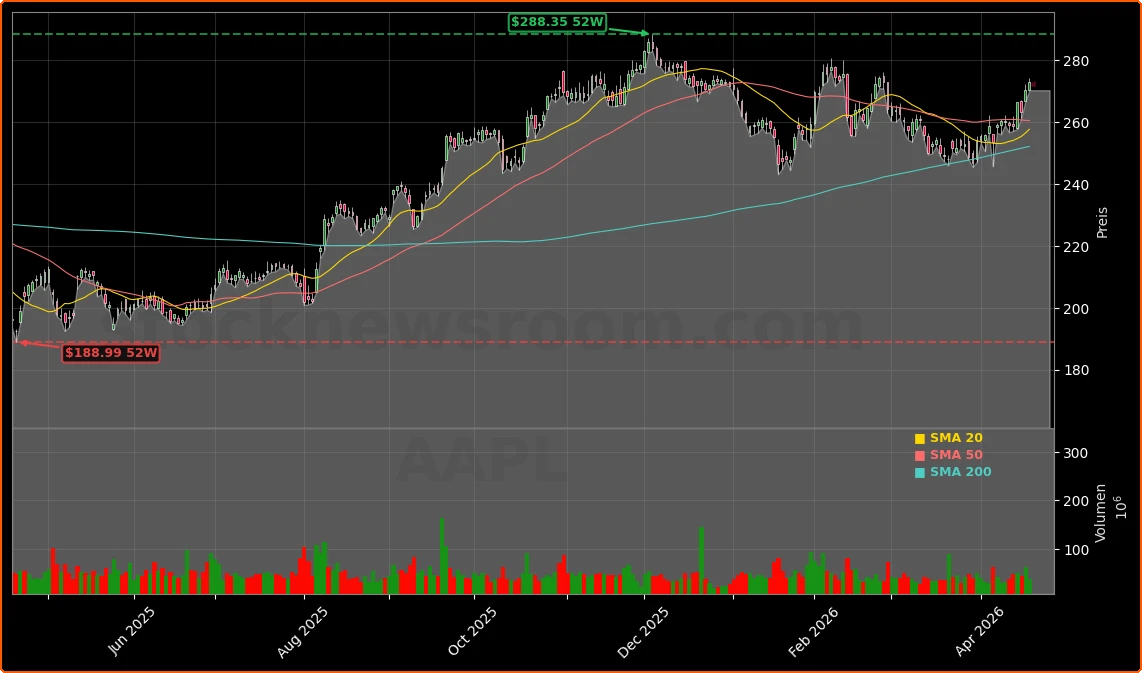
On Monday, Apple (AAPL) closed at $273.05 on NASDAQ, up 1.04% for the session, before slipping to about $271.50 in after-hours trading (‑0.57% as of late evening ET). The stock trades roughly 6% below its 52‑week high of $288.61 and well above the 52‑week low of $189.81, signaling that the Apple CEO Transition is not being treated as a shock event. Daily moves were modest compared with the broader NASDAQ, where profit‑taking in high‑multiple tech names continued.
Analysts broadly see stability rather than disruption. Morgan Stanley’s Erik Woodring remains constructive with a $300 price target, arguing upcoming April 30 fiscal Q2 earnings could be a “clearing event” for the stock. Goldman Sachs keeps a bullish stance with a $330 target and an earnings‑per‑share estimate of $2.00 versus a roughly $1.93 consensus, while Bank of America projects EPS climbing from about $8.55 this year to $9.74 by 2027 and maintains a $325 target. Despite legal overhangs and AI skepticism, consensus around AAPL still sits at a “Moderate Buy” with average targets near $305, implying low‑teens upside.
Who is John Ternus and why now for Apple?
Ternus, 50, is a 25‑year company veteran and mechanical engineer who rose through the hardware ranks, working on the iPad, AirPods, Mac and the latest iPhone lineup. He led the shift to Apple Silicon in Macs, a move that significantly boosted performance and margins, and recently oversaw the successful low‑priced MacBook Neo and iPhone Air. Culturally, insiders describe him as collaborative and low‑ego, more in the mold of Cook than the hard‑charging style associated with Steve Jobs.
The timing of the Apple CEO Transition is tied to both succession planning and rising strategic pressure. Cook, now 65, has been expected to step aside before the end of the decade after overseeing Apple’s expansion into wearables, services and a 2.5‑billion‑device installed base. He exits the CEO role ahead of what could be a pivotal Worldwide Developers Conference in June, where investors expect a clearer AI roadmap. By moving to executive chairman, he will continue to shape high‑level strategy and, crucially, lead engagement with regulators and political leaders in the U.S., China and India.
Can Apple catch up in AI under Ternus?
The most important test for the Apple CEO Transition will be whether Ternus can close the perceived AI gap with rivals like Microsoft, Google, NVIDIA and Meta. While Apple has quietly integrated machine‑learning capabilities into its chips since 2017 and launched “Apple Intelligence” features such as on‑device text rewriting and image tools, it has largely avoided the massive capital expenditures associated with training frontier models. Instead, it is leaning on partners: Google’s Gemini is poised to power a major Siri upgrade, and earlier deals brought OpenAI’s ChatGPT into Apple’s ecosystem.
Critics argue this strategy leaves Apple dependent on others for headline AI breakthroughs. Supporters counter that Apple’s strength lies in on‑device, privacy‑preserving AI that runs efficiently on its custom silicon—an area where Ternus’s hardware expertise is a clear asset. Upcoming projects, from a first foldable iPhone expected around September to accelerated development of AI‑centric wearables such as smart glasses and advanced AirPods, will test whether he can turn that hardware edge into a differentiated AI story.
How does Apple stack up against other megacaps?
Under Cook, AAPL delivered a roughly 1,900% price return since 2011, outpacing the S&P 500 but lagging some megacap peers. Tesla and NVIDIA posted far larger gains over the same period, aided by explosive themes like EVs and AI chips. Over the last year, Apple’s stock has underperformed both the so‑called Magnificent Seven basket and the semiconductor indices, rising about 40% versus more than 65% for the group and over 150% for leading chip names.
Even so, Apple remains a core holding for many U.S. retail and institutional portfolios. The company’s services segment is now its second‑largest business behind the iPhone, with high-margin recurring revenue from the App Store, iCloud, Apple Music, Apple TV+ and financial services like Apple Pay. AI is already a revenue driver here: subscription fees from third‑party AI apps such as ChatGPT and Anthropic’s Claude on iOS are expected to push App Store AI revenue toward $1 billion this year, with Apple taking a cut.
What risks accompany the Apple CEO Transition?
Beyond AI competition, Ternus inherits a complex risk matrix. Antitrust scrutiny is intensifying: the U.S. Department of Justice has an active case targeting alleged App Store abuses, India’s competition authority CCI is weighing a theoretically massive fine tied to in‑app payment rules, and the EU’s Digital Markets Act is driving changes around Siri and Apple TV. While regulators rarely impose maximum penalties, these cases could pressure margins or force business‑model tweaks over time.
On the operational side, Cook’s track record in supply‑chain management and geopolitical navigation set an extremely high bar. He guided Apple through Trump‑era tariffs, pandemic lockdowns and a gradual diversification of manufacturing beyond China, including expanded footprints in India and Texas. As executive chairman, Cook is expected to focus heavily on these themes, leaving Ternus freer to concentrate on products, innovation and AI—an implicit division of labor that may help de‑risk the leadership handoff.
Related Coverage
For a deeper dive into how an edge‑focused AI strategy and new Mac designs could influence growth under John Ternus, readers can explore Apple AI Strategy +2.6% Rally: Edge AI Boom or Hype?, which examines whether the recent rally in AAPL is sustainable or running ahead of fundamentals. Investors tracking AI valuations across the broader tech space may also want to read Palantir Presidential endorsement: valuation Warning for PLTR, where the focus on Palantir offers a useful comparison for how political headlines and AI optimism can stretch multiples.
Tim crushed it as CEO of Apple. Ternus has an opportunity to supercharge Apple’s multiple by changing the narrative, which is the biggest opportunity in big tech.— Gene Munster, Deepwater Asset Management
In sum, the Apple CEO Transition from Tim Cook to John Ternus is designed as a carefully managed succession rather than a rupture, but it comes at a moment when markets demand bolder answers on AI. For long‑term shareholders, the combination of Cook’s continued presence and Ternus’s hardware credentials supports continuity, while leaving room for a refreshed narrative around on‑device intelligence. The next few quarters—especially WWDC and the September product cycle—will show whether this Apple CEO Transition can unlock the next phase of growth for AAPL.