Can the Palantir Presidential endorsement really move the needle for PLTR, or will stretched AI valuations keep a lid on the stock?

How much is Trump’s praise really worth for Palantir?
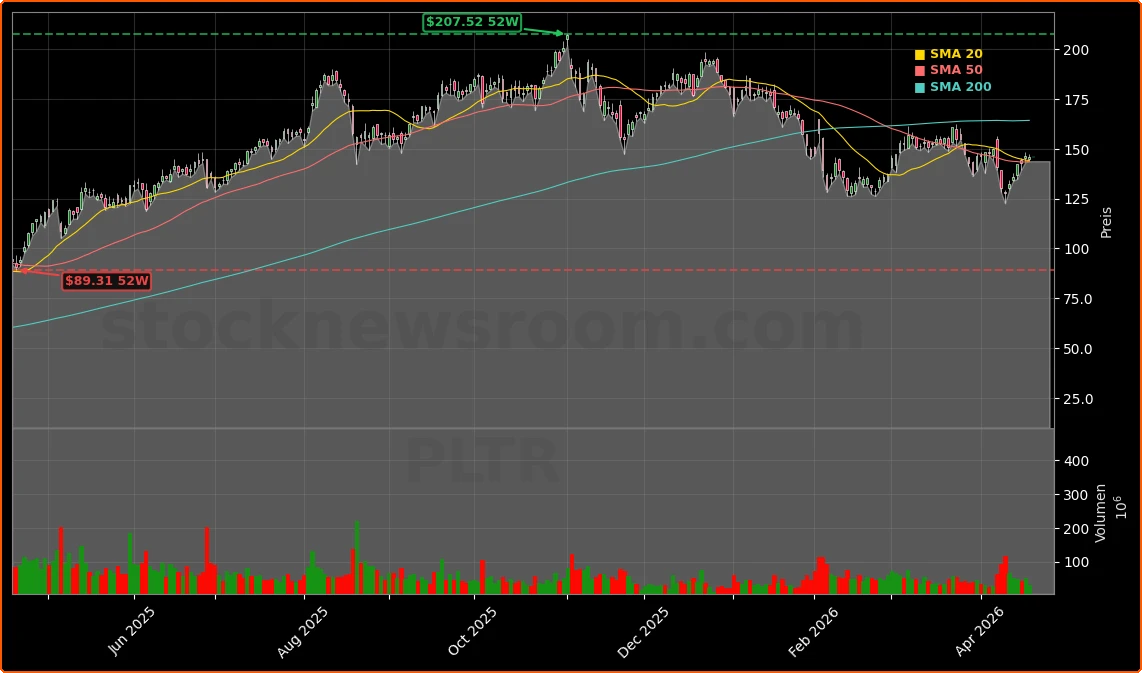
Palantir’s share price closed at $145.89 on Monday, down 0.34% from the prior session, with a modest uptick in after-hours trading. The move comes as traders weigh the Palantir Presidential endorsement against an already aggressive valuation and a technically fragile chart. The stock has been locked in a tight range around $145, and technical traders note that a clear break below that level could invalidate a recent short-term buy signal that flashed late last week.
From a positioning standpoint, bears remain active. Short sellers argue that the stock still prices in near-perfect execution on artificial intelligence and defense-related contracts. Many of those shorts are focused on resistance in the $155–$160 band; a sustained move above that region would likely force them to reassess, but as long as PLTR stays below it, the bear case of a pullback into the $120–$130 zone remains intact. For U.S. retail investors, this means the Palantir Presidential endorsement is only one factor in a much more complex risk–reward picture.
Palantir Technologies and the power of government revenue
Palantir Technologies Inc. has built its brand around close ties to the U.S. government and allied defense agencies. In the most recent full year, the company generated about $4.5 billion in revenue, with roughly 54% coming from government contracts. That segment grew 53% year over year, nearly keeping pace with the commercial business, which expanded an even stronger 60%, driven by demand for Palantir’s artificial intelligence platform across industries.
The Palantir Presidential endorsement plays directly into this government-heavy mix. Having a former U.S. president publicly describe Palantir as having proven “war fighting capabilities” implicitly strengthens its credibility with defense and intelligence buyers. In an era of heightened geopolitical tension and rising defense budgets, such validation could help the company win incremental contracts or renewals, especially against smaller or less battle-tested competitors.
Still, investors must separate headline buzz from contract reality. Federal procurement cycles are slow, competitive, and governed by formal processes. While Trump’s public stance is a net positive for optics, it does not guarantee immediate revenue acceleration, particularly when Palantir is already growing at a high double-digit pace off a substantial base.
How does Palantir stack up against AI peers?
On the NASDAQ, Palantir trades in the same broad AI narrative as megacaps like NVIDIA and Apple, and to a degree high-profile innovators like Tesla. Unlike those companies, however, Palantir Technologies Inc. is far more concentrated in software and data platforms for government and large enterprises, rather than consumer hardware or autonomous vehicles.
Where hardware leaders such as NVIDIA capture investor enthusiasm with surging demand for AI chips, Palantir’s story is about embedding AI into decision-making and military operations. That has produced stellar top-line growth, but it also leaves the stock exposed to scrutiny over whether its premium valuation—currently implying a price-to-earnings multiple well above 200—is sustainable. Analysts on Wall Street often compare Palantir to fast-growing cloud software names rather than to diversified tech giants, and by those standards, PLTR looks expensive even after a roughly 18% year-to-date pullback.
Large-cap peers also face valuation questions, but they typically benefit from broader revenue streams and index inclusion in the S&P 500, giving them deeper passive inflows. Palantir, by contrast, is still in the camp of high-beta AI names whose multiples can compress sharply if growth slows or sentiment turns.
What are analysts and traders watching next?
Fundamentally oriented investors are now focused on Palantir’s next earnings report in early May, which will test whether the Palantir Presidential endorsement coincides with tangible business momentum. The company must demonstrate that it can build on last year’s strong growth in both government and commercial segments without seeing a meaningful deceleration. As prior-year comparables get tougher, simply maintaining current growth rates becomes more challenging.
On the trading side, the near-term setup is delicate. The recent bounce produced a positive daily signal for technicians, but any decisive move below $145 would undermine that pattern and could reignite downside momentum. If sellers push the stock toward the $120–$130 range, valuation metrics would begin to look more palatable to long-term buyers who have been waiting on the sidelines.
Major investment banks, including Goldman Sachs, Morgan Stanley, and Citigroup, have highlighted valuation as a key swing factor for the stock, even as they acknowledge Palantir’s strong AI positioning and government franchise. While ratings and targets vary across firms, the consensus tone is that the market is already pricing in years of robust growth, leaving limited room for execution missteps.
Related Coverage: where does Palantir fit in the AI boom?
For a deeper dive into whether today’s valuation is justified, investors can read “Palantir Valuation +2.5% Rally: How Much Risk Now?”, which dissects the company’s premium multiple and asks if the current price embeds a durable AI winner’s premium or a fragile bubble. That analysis complements the discussion around the Palantir Presidential endorsement by putting hard numbers around the stock’s risk profile.
To understand the broader AI spending backdrop that shapes how investors view high-multiple names like Palantir, the article “Microsoft AI Strategy Boom: $37.5B Capex Shock for Investors” examines how aggressive AI infrastructure investments by mega-cap players are reshaping expectations across the sector. Against this backdrop, Palantir’s capital-light software model—and its reliance on political and defense relationships—offers a very different but related way to gain exposure to the AI theme.
“Palantir has proven to have great war fighting capabilities and equipment.”— Donald Trump
In the end, the Palantir Presidential endorsement is a meaningful branding win that reinforces the company’s defense and government narrative. For investors, however, the critical question remains whether future earnings can grow fast enough to justify today’s rich valuation. The coming quarters will show whether political praise, AI adoption, and contract wins can keep Palantir’s story intact—or whether multiple compression will overshadow even strong fundamental progress.