Is the Palantir AI Defense Strategy a durable Pentagon-backed growth story or just the latest high-valuation AI trade?

Is Palantir’s AI defense bet reshaping its stock story?
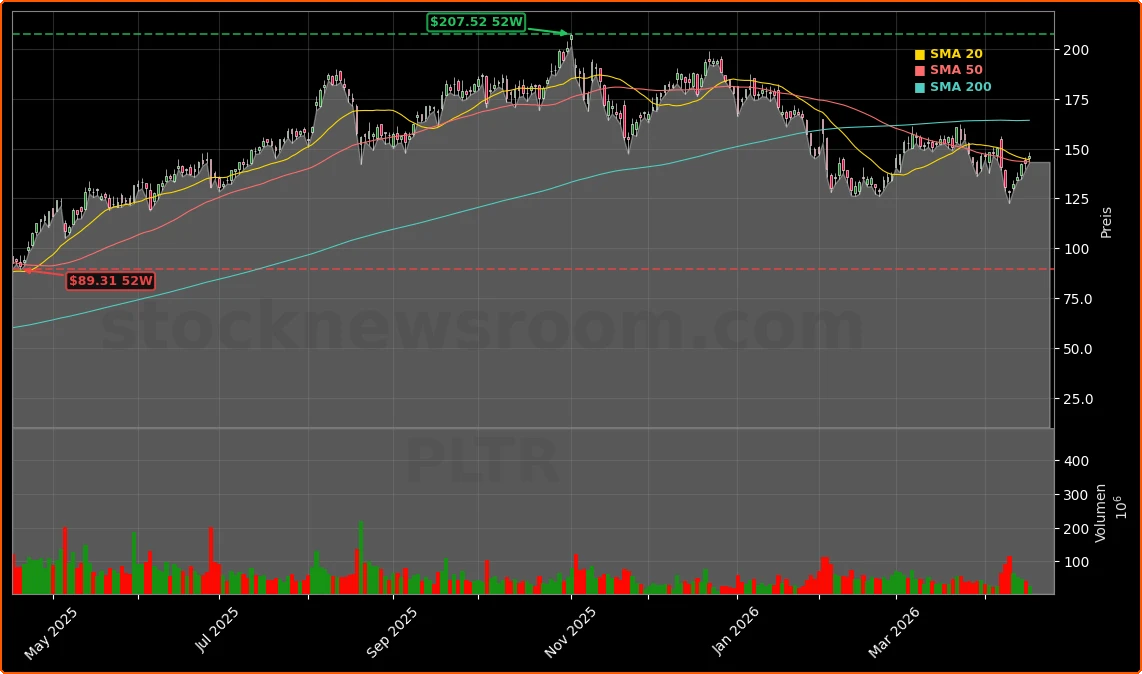
Palantir Technologies Inc. has become one of the hottest defense-exposed AI stocks on the NASDAQ, with shares up more than 50% over the past 12 months and trading Friday at $146.34, about 30% below their 52‑week high of $207.52 but well above the recent low near $89. The stock has bounced more than 11% this week as investors reassess earlier sell-off fears in the broader AI complex and rotate back into software names tied to national security and data analytics.
The core of the Palantir AI Defense Strategy is its role as a software and analytics backbone for Western-allied militaries and intelligence agencies. Its Gotham platform underpins battlefield and intelligence decision-making, while its Artificial Intelligence Platform (AIP) is being pushed hard into both defense and commercial use cases. That dual exposure is drawing attention on Wall Street as investors weigh whether AI-driven defense software could prove more resilient than cyclical consumer tech or ad-driven platforms.
Tactically, the chart remains mixed. Palantir trades inside its 52-week range, below its 100‑day simple moving average, and is still dealing with a February “death cross” where the 50‑day slipped under the 200‑day. Key resistance sits near $162, with strong support around $126.50; short-term traders are watching whether the stock can reclaim the $150 level that many see as a psychological line in the sand.
How central is Palantir to the Pentagon’s AI push?
The latest fuel for the Palantir AI Defense Strategy is a new U.S. Army deal that could be worth up to $10 billion over ten years, cementing Palantir as a core data and AI layer for the Department of Defense. The contract spans intelligence analysis, battlefield situational awareness and real-time decision support — areas where Palantir’s small, targeted models ingest massive classified and sensor data streams and convert them into actionable recommendations for commanders.
That operational relevance has gone from theoretical to real-time. In the current U.S. conflict with Iran, Palantir’s technology has been described internally as helping drive “the first large-scale combat operation that was really driven with AI,” underscoring how deeply the company’s software is embedded in modern warfare. President Trump recently amplified that visibility, publicly praising Palantir’s “great war fighting capabilities” on social media, a post that helped the stock quickly regain more than $10 billion in market capitalization.
While Palantir often trades alongside pure-play AI beneficiaries such as NVIDIA, its defense focus and government-heavy revenue base make its risk profile closer to a software-embedded defense contractor than a traditional high-beta tech stock. That distinction is becoming more important for U.S. investors seeking exposure to AI while hedging against consumer and advertising downturns.
Is Palantir’s valuation still in bubble territory?
On fundamentals, Palantir’s growth is hard to dismiss. Fourth-quarter revenue jumped 70% year over year to about $1.4 billion, with government sales rising 60% to $730 million and commercial revenue surging 82% to $677 million as customers from automaker Stellantis to GE Aerospace and fintech players adopted AIP. The company guided for Q1 revenue of roughly $1.5 billion, signaling continued acceleration off a year-ago base of $883.9 million.
Profitability is also inflecting. Net income soared to roughly $612 million in Q4 from $77 million a year earlier. The balance sheet is clean, with no debt, $1.4 billion in cash, about $5.8 billion in marketable securities and only $1.4 billion in total liabilities, including more than $450 million in deferred revenue that should convert into future sales.
Yet the market already prices in a lot of that strength. Palantir trades at a price-to-earnings ratio of roughly 226.6, more than three times the software industry average near 73. Its price-to-book multiple of 46.2 is over four times peers, while its price-to-sales ratio around 81.8 is more than nine times sector norms. EBITDA of $580 million and gross profit of $1.19 billion both sit below industry averages, highlighting that Palantir is still building operating leverage despite its premium valuation. For some institutional investors, that raises the risk that the Palantir AI Defense Strategy is being capitalized at bubble-like multiples.
What are analysts and short sellers doing with Palantir?
On Wall Street, opinions are sharply divided. Wedbush technology analyst Dan Ives this week called recent sell-off fears “over-blown,” reiterating an Outperform rating and a $230 price target, implying roughly 61% upside from current levels. He highlighted 137% year-over-year growth in U.S. commercial revenue last quarter and framed Palantir as a “long-term winner” in AI software, particularly in defense and mission-critical analytics.
Other banks have been more cautious, pointing to extreme multiples and execution risk as Palantir scales AIP beyond its government comfort zone, though many still acknowledge the company’s near-zero debt profile and strong cash reserves as mitigating factors. Across Wall Street, the bull case largely centers on Palantir’s unique positioning at the intersection of AI, defense and industrial data, while the bear case focuses on valuation and the possibility that defense-related revenue growth could normalize once current geopolitical tensions ease.
Short interest has picked up in recent weeks. Some traders are openly shorting Palantir into the May 4 earnings report, betting that even strong numbers could fail to justify the valuation. One such investor described the short as “conservative,” using a 2.68x leveraged position and targeting a pullback toward $100 over the coming months, citing strong resistance zones and the stock’s failure to reclaim prior highs.
How does Palantir’s AI approach differ from Big Tech?
Strategically, the Palantir AI Defense Strategy is built around smaller, domain-specific models tightly aligned to customer data sets, rather than the giant general-purpose language models popularized by Apple-style ecosystem plays or consumer-oriented AI assistants from companies like Tesla and others. Palantir argues that this narrower, problem-driven AI is more reliable, auditable and secure for warfighting, infrastructure, healthcare and financial applications where errors can be catastrophic.
This contrasts with broader AI narratives linked to firms such as NVIDIA, which monetizes AI primarily via chips, or cloud hyperscalers that rely on large language models to drive usage and ad or subscription revenue. For U.S. investors building diversified AI exposure, Palantir offers a distinct angle: a software-heavy, security-cleared platform designed to sit on top of existing hardware and cloud stacks, orchestrating data and decision-making rather than competing directly on silicon.
That differentiation might justify some valuation premium, but the magnitude of today’s multiples leaves little room for execution missteps. If growth were to slow meaningfully from the current 70% revenue clip, or if defense budgets shifted away from software modernization, the downside for multiple compression could be severe.
Related Coverage: Investors looking to dig deeper into valuation questions can read Palantir AI Valuation +4.9% Surge: Bubble or Justified?, which examines whether today’s pricing reflects durable AI defense cash flows or speculative enthusiasm. For a broader AI-sector lens, TSMC Earnings -3.1% Shock as AI Supercycle Meets Market Jitters analyzes how even record results at a leading chip manufacturer may not be enough when markets are already priced for perfection, a dynamic that also hangs over richly valued software names like Palantir.
We are still at the very start of things. This remains the beginning, the first moment of a first chapter.— Alex Karp, CEO of Palantir Technologies Inc.
In sum, the Palantir AI Defense Strategy has delivered explosive growth, a Pentagon mega-contract pipeline and rising geopolitical relevance, but at the cost of one of the highest valuations in global software. For U.S. investors, the stock represents a concentrated bet that AI-driven defense and industrial analytics will keep compounding fast enough to sustain nosebleed multiples. The next few quarters, starting with the upcoming May earnings, will show whether Palantir can grow into its price and remain a core AI-defense holding rather than a cautionary tale from the current AI boom.