Can Tesla’s FSD subscriptions and insurance discounts really justify a trillion‑dollar valuation and this latest 7.6% stock surge?

Is software now driving Tesla’s market move?
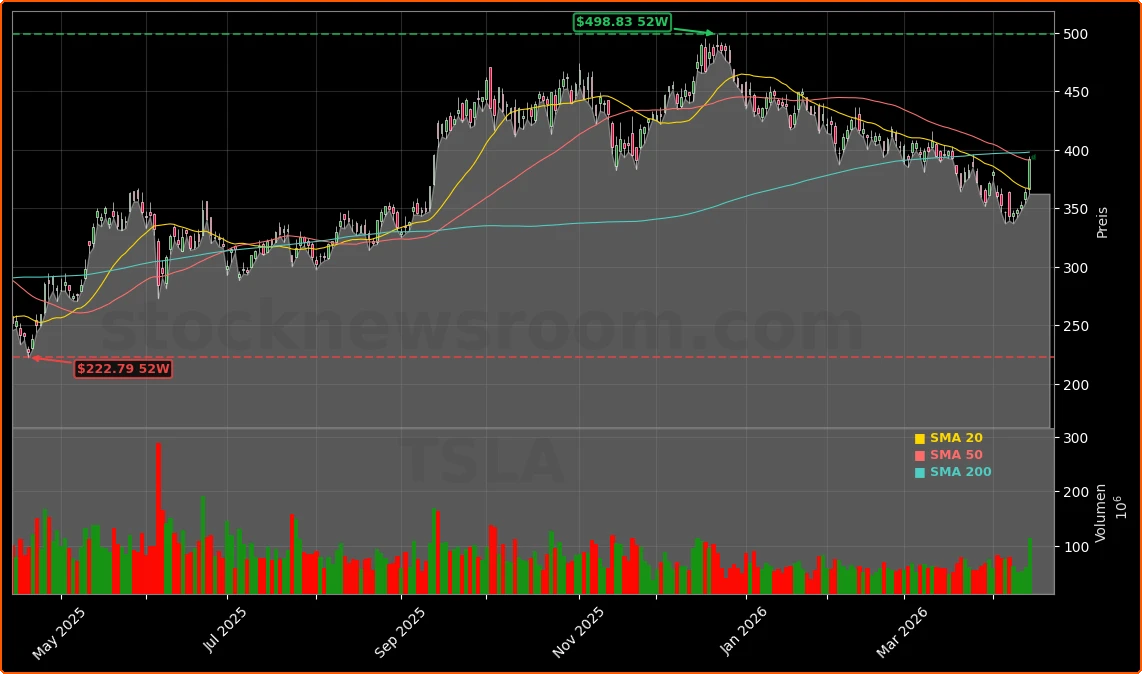
Tesla, Inc. shares jumped around 7.6% on Wednesday to approximately $391.95 on the NASDAQ, extending a seven-day run of roughly double‑digit gains and participating in a broader rebound of megacap growth names on Wall Street. Despite being down about 12% year‑to‑date, the stock has bounced sharply from its 2025 lows and now trades with a trailing P/E above 360 and a forward P/E near 190, a multiple that assumes the Tesla FSD Strategy can unlock sizable high‑margin software revenue.
UBS analyst Joseph Spak added fuel to the move this week by upgrading Tesla from “Sell” to “Neutral,” holding his price target at $352. His argument is that the sell‑off priced in much of the bad news, balancing short‑term risks in electric vehicles against longer‑term upside in what he calls “Physical AI” — from robotaxis to the Optimus humanoid robot. Other major houses remain split: Morgan Stanley sits around $410, while Wedbush remains firmly bullish with a $600 target and Wells Fargo stays skeptical near $125. Consensus compiled by Benzinga shows an average around $405, only modestly above current levels.
Technically, Tesla’s recent surge has pushed its relative strength index close to overbought territory near 70, underlining how much of the latest optimism is being pulled forward ahead of earnings. That puts additional focus on whether management can convincingly detail how the Tesla FSD Strategy will translate into recurring revenue and margin expansion.
How does the Spring Update change FSD economics?
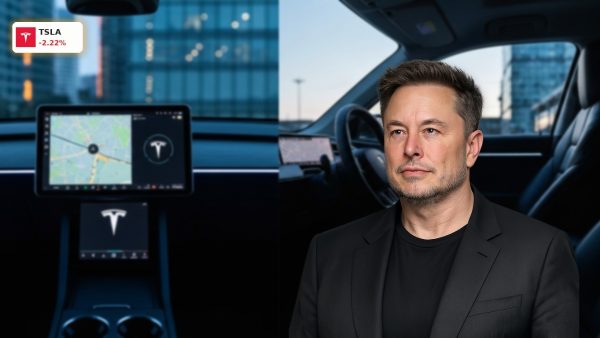
The new Spring Update 2026 is the clearest sign yet that Tesla is treating its global vehicle fleet as a software platform. Owners of models with the latest AI4 hardware can now subscribe to Full Self‑Driving (Supervised) directly from an upgraded in‑car app at $99.99 per month. A redesigned dashboard adds usage statistics and daily driving streaks — a gamified layer clearly designed to keep subscribers engaged and reduce churn, similar to how subscription apps in tech and gaming operate.
Older HW3 vehicles are excluded, limiting the initial addressable base but also nudging future buyers toward higher‑margin, FSD‑capable configurations. The move comes after Tesla delivered about 358,000 vehicles in Q1 2026, up 6.3% year on year but below expectations of roughly 369,000, putting pressure on management to offset softer unit growth with software monetization. In the U.S. context, this aligns Tesla more closely with AI‑heavy peers like NVIDIA and platform companies such as Apple, where recurring software and services streams are central to the equity story.
The Tesla FSD Strategy hinges on turning those monthly subscriptions into a flywheel: more subscribers mean more real‑world driving data, which should improve the neural networks powering FSD, which in turn can justify higher penetration and potentially higher pricing over time. For a company already valued at over $1.2 trillion, the stakes are high — auto hardware alone is unlikely to support current multiples.
Tesla FSD Strategy: Can insurance discounts lock in users?
Another under‑the‑radar but potentially powerful lever is insurance. Tesla has rolled out its new Safety Score 3.0, which for the first time separates manual driving from FSD‑assisted miles. Traditional safety factors still apply to manual driving, but any kilometer driven with FSD engaged now automatically receives a perfect score of 100. The overall insurance score is a weighted average — the more time a driver spends on FSD, the better the score and the lower the premium.
Initially, this program targets new Tesla Insurance customers in select U.S. states, including Texas, Arizona and Illinois. It builds on a 2025 experiment where drivers in Arizona and Texas earned roughly 10% discounts if FSD covered at least half their mileage. Now, the Tesla FSD Strategy explicitly aligns three incentives: drivers save money by using FSD more often, Tesla collects richer training data, and improved software can support higher subscription numbers and potentially better regulatory outcomes for future robotaxi offerings.
For U.S. investors, this insurance‑software loop is notable because it resembles a fintech‑style model layered on top of an automaker. It also differentiates Tesla from EV competitors like Lucid and Rivian, which currently lack integrated insurance platforms and large‑scale driver‑assistance datasets.
Is Europe becoming a new growth pillar for FSD?
On the regulatory front, the Netherlands has become Tesla’s beachhead for FSD in Europe. Dutch authority RDW has granted the first EU‑level approval for FSD after about 1.6 million test kilometers on European roads, more than 13,000 customer rides and over 4,500 controlled test scenarios. In the Dutch market, FSD is now available as a subscription: EUR 49 per month for vehicles equipped with Enhanced Autopilot and EUR 99 for base models.
This European breakthrough is critical for the Tesla FSD Strategy because it gives the company a concrete reference case within the EU’s stricter safety and liability framework. RDW’s approval and test data now move to the European Commission, after which member states will vote on broader authorization — a process that could take time but, if successful, would open a large premium‑priced software market. CEO Elon Musk has publicly targeted 10 million active FSD subscriptions worldwide; at the end of Q4 2025, the figure stood near 1 million, making Europe a key lever if that goal is to be met.
At the same time, Tesla’s brand in Europe appears to be recovering. Recent registration data show German Tesla registrations up roughly 160% year over year in March, with France up about 203% and the U.K. around 20%, albeit off a weak 2025 base when political backlash weighed on sales. A rumored lower‑cost SUV below the Model Y, if confirmed, could further support volumes and create a larger funnel for FSD‑ready vehicles.
How does this reshape the risk‑reward for U.S. investors?
Despite the excitement around Full Self‑Driving, Tesla still faces meaningful headwinds: EV competition from Chinese manufacturers abroad, margin pressure, and substantial capex tied to chip and robotics ambitions — including Musk’s push into in‑house chip production under the so‑called TerraFab concept. Q1 2026 earnings on April 22 will put a spotlight on automotive gross margins, energy‑storage performance — where deployments of around 8.8 GWh recently undershot a roughly 14.4 GWh consensus — and concrete guidance on FSD subscriptions and insurance penetration.
Wall Street’s divided price targets reflect that uncertainty. Bulls argue that Optimus robots, an eventual Cybercab robotaxi network and software services could make Tesla more comparable to high‑growth AI platforms than traditional automakers. Bears counter that negative near‑term revenue growth and reputational risks from Musk’s political forays may limit adoption, especially outside the U.S. For diversified U.S. portfolios, sizing and timing exposure to Tesla now hinges less on near‑term vehicle deliveries and more on how convincingly the Tesla FSD Strategy can scale into a global, regulated software platform.
Related coverage
Investors who want a deeper dive into how chips, robotaxis and humanoid robots feed into the broader narrative can read this detailed Tesla forecast on UBS’s upgrade and the TerraFab chip risk, which analyzes whether the latest rally represents a sustainable AI‑driven rerating or simply speculative excess. For a sector contrast, this Lucid Group forecast examines whether Lucid’s recent slide points to a deep value opportunity or a value trap in the ongoing EV shakeout, offering useful context for how Tesla’s strategy compares to a luxury‑focused rival.
In conclusion, the Tesla FSD Strategy now combines U.S. insurance discounts, a European regulatory beachhead and a global subscription push to justify Tesla’s rich multiple and recent share price rebound. For investors, the next catalyst will be whether the April 22 earnings call can translate these building blocks into clear, quantifiable guidance on recurring software revenue and margins. With expectations running high, the coming quarters will determine whether Tesla’s software‑led pivot can support long‑term upside or simply add volatility to an already volatile stock.