Can Exxon Mobil Strategy really justify tech-like valuations by leaning on deepwater exploration, high oil prices and relentless dividend power?

How is Exxon Mobil positioning after the rally?
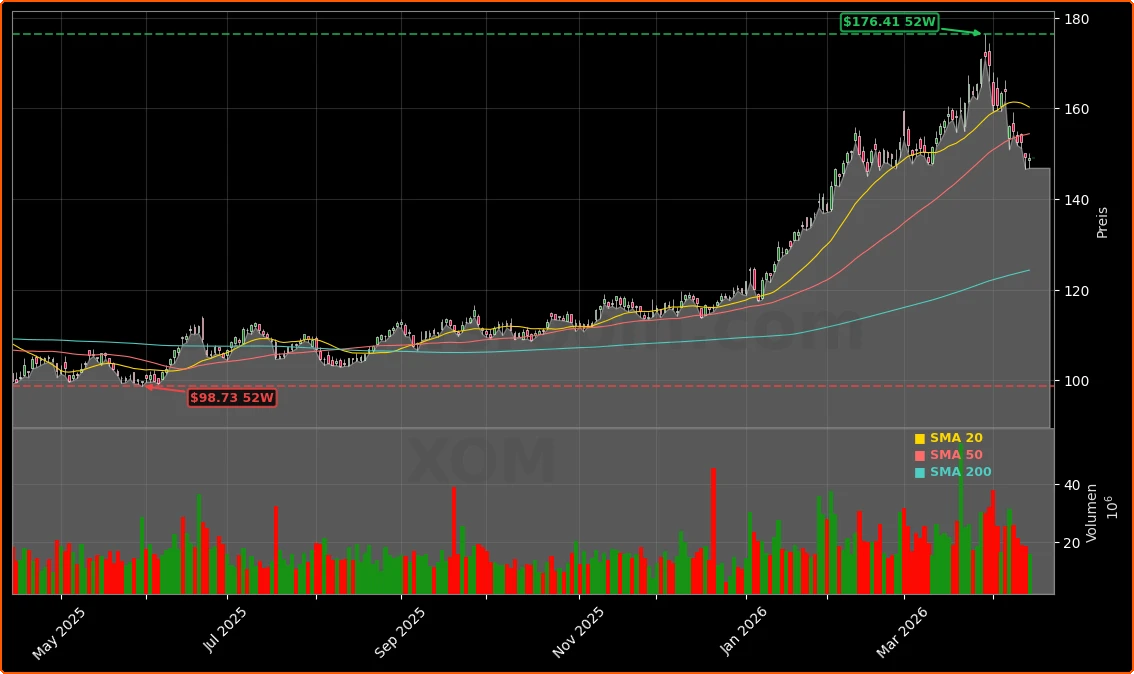
Exxon Mobil Corporation (XOM) is trading around $149 in New York pre-market on Thursday, slightly below Wednesday’s close of $148.90 and well off its 52-week high of $176.41. In Europe, the stock changes hands near 126 EUR, also below its 50-day moving average of 132 EUR, highlighting a technical cooldown after a strong multi-month rally. Over the last five years, Exxon Mobil has delivered an average annual return of almost 22%, turning a $1,000 investment into about $2,638 at today’s prices, meaning it has materially outperformed the broader S&P 500.
Valuation has followed performance. The stock has climbed enough in recent weeks that it now trades at a price-to-earnings multiple similar to high-growth names like NVIDIA, a striking signal that Wall Street is increasingly willing to price traditional energy on par with some technology leaders. For investors, this raises the bar for execution: Exxon Mobil Strategy must now justify a richer multiple through steady free cash flow, disciplined spending and credible long-term growth plans.
What does deepwater Greece mean for Exxon Mobil Strategy?
A key pillar of Exxon Mobil Strategy is expanding its upstream portfolio into politically aligned, resource-rich basins. The latest step is a planned deepwater exploration campaign off the western coast of Greece in the Mediterranean. In a consortium with Energean, the company aims to start exploratory drilling from February 2027, with contract signing expected later this month.
The project’s objective is to boost regional gas supply and reduce dependence on imports, positioning Exxon Mobil as a strategic partner in European energy security. With Brent and WTI prices hovering near $100 per barrel, such capital-intensive offshore projects become more economically attractive, particularly for a major with one of the strongest balance sheets in the sector. If successful, this Mediterranean push could provide long-lived reserves and diversify away from more politically volatile regions—an increasingly important point for U.S. investors watching Middle East risk.
Can profits rise even as production dips?
In the near term, Exxon Mobil faces operational headwinds. For Q1 2026, management expects production to be down roughly 6% versus the prior quarter, largely due to disruptions at Middle East assets that normally account for about 20% of the company’s global output. Despite weaker volumes, higher realized oil prices are set to more than offset the decline, with Q1 profit guided to come in above the previous quarter.
That underscores another core element of Exxon Mobil Strategy: leverage to price over volume. By focusing on high-margin barrels and maintaining capital discipline, the company can still grow earnings and free cash flow without chasing production at any cost. Analysts at major houses such as Goldman Sachs and Morgan Stanley have highlighted the company’s robust cash generation and conservative balance sheet as key reasons it remains a top pick in the energy complex, though official rating changes have been limited in recent weeks as the stock has already rerated higher.
How important are dividends and helium to Exxon Mobil?
Income remains a central attraction. Exxon Mobil has raised its dividend for 43 consecutive years and currently pays a quarterly dividend of $1.03 per share, last distributed in March. At current prices, that equates to a yield of roughly 2.8%, lower than many smaller energy peers but backed by scale, diversification and a track record of paying through multiple oil cycles. For long-term U.S. dividend investors, that consistency is a major anchor in assessing Exxon Mobil Strategy.
Beyond oil and gas, the company is quietly building out niche businesses that can smooth cash flows. One standout is its role as a leading global supplier of ultra-high-purity helium—so-called “Six Nines” helium with 99.9999% purity. This specialized gas is critical for semiconductor manufacturers and advanced industrial processes, tying Exxon Mobil into growth trends driven by chipmakers like Apple and Tesla. Crucially, the helium business is far less correlated with crude prices, giving the group an underappreciated earnings stabilizer that rarely shows up in headline segments but matters for long-horizon investors.
How does Exxon Mobil compare to U.S. peers?
Relative to Chevron (CVX) and other integrated majors in the S&P 500, Exxon Mobil currently ranks as the world’s second-largest energy company by market cap, trailing only Saudi Aramco. It has posted higher cash flow growth than many peers in recent years and has been one of the best total-return stories in the global energy sector. That outperformance, combined with its elevated valuation, means Exxon Mobil Strategy must continue to deliver both on upstream execution and on new business lines, from LNG to specialty gases.
Longer term, the company forecasts an increase in earnings of about $25 billion from 2024 levels by the end of the decade and an additional $35 billion of free cash flow by 2030. Management also sees its total addressable market, including existing and emerging businesses, doubling between 2030 and 2050 to roughly $8 trillion. For institutional investors benchmarking against the S&P 500 and sector ETFs, that growth narrative is key to deciding whether Exxon Mobil deserves an overweight versus other cyclical names or even growth leaders like NVIDIA.
Related coverage on Exxon Mobil and energy risk
Investors who want to understand the geopolitical backdrop to Exxon Mobil Strategy should also look at the recent analysis of the Iran conflict’s impact on the company. The article “Exxon Mobil Iran War: -4.7% Shock and $6.5B Q1 Hit” explores whether recent war-related write-downs and a 4.7% share price shock are a temporary accounting issue or the start of a more persistent drag on production and cash flows. By putting the Q1 hit into context, it helps investors decide if current geopolitical volatility is a buying opportunity or a reason to stay cautious on large-cap energy exposure.
Exxon Mobil Strategy now rests on using high oil prices to fund deepwater projects, niche growth segments like helium and a reliable dividend while managing geopolitical and operational risks. For U.S. investors, the stock’s rerating closer to tech valuations raises the stakes but also underlines confidence in its long-term cash-generation profile. The next few quarters, especially around Q1 and Q2 earnings, will show whether this strategy continues to justify Exxon Mobil’s premium status within the global energy and broader equity markets.