Is the latest Tesla Forecast rally a sustainable AI-driven re‑rating or just a risky bet on chips, robotaxis and Optimus hype?

Is the new Tesla Forecast justified after the UBS turn?
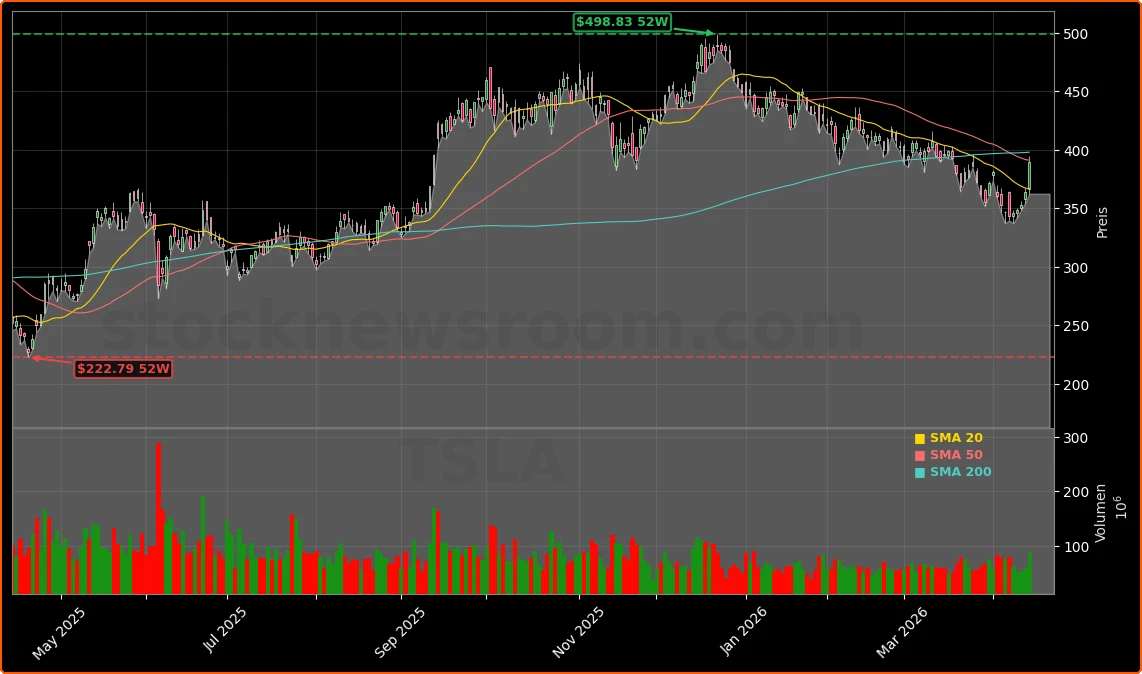
TSLA has rebounded sharply from its year‑to‑date lows, extending a multi‑day rally that has put the stock back in focus across the NASDAQ 100 and S&P 500. On Wednesday it traded around $389.44, well above Tuesday’s $366 close, as options activity and retail flows pointed to renewed risk appetite for the name. The move follows UBS analyst Joseph Spak upgrading Tesla from Sell to Neutral, maintaining a $352 price target and arguing that the current price “more evenly balances” near‑term execution risk with the company’s long‑run opportunity in so‑called physical AI, from robotaxis to the Optimus humanoid robot.
That call helped reset the Tesla Forecast for many short‑term traders: what had been a crowded downside momentum trade is now being reframed as a volatile, sentiment‑driven AI proxy. UBS still flags intense Chinese EV competition, softer U.S. demand and a thin vehicle lineup, but expects eventual progress on robotaxis and Optimus. The bank models just 1.6 million vehicle deliveries in 2026 and 2 million by 2030, far below more bullish houses like TD Cowen, which still rates the stock Buy with a reduced but hefty $490 target.
Tesla Forecast: how big a risk is Terafab?
The rally sits uncomfortably next to a rising concern: what will Terafab actually cost? Barclays analyst Dan Levy reiterated an Equal Weight rating with a $360 price target, warning that updated capital expenditure guidance around CEO Elon Musk’s proposed domestic semiconductor megafab could become the key swing factor for TSLA after the April 22 earnings call. Musk has described Terafab as a “very big fab” spanning logic, memory and packaging to support in‑house AI chips beyond the newly taped‑out AI5 self‑driving processor.
Barclays estimates that a fully built Terafab complex could require capital in the mid‑single‑digit trillion‑dollar range over time, dramatically larger than Tesla’s current $20 billion 2026 capex plan and far beyond last year’s $6.22 billion in free cash flow. The firm argues that, even if the spending is phased, any step‑up beyond already elevated guidance could weigh on the Tesla Forecast for earnings and cash generation through the decade. For now, Tesla’s $44 billion cash pile and relatively low debt‑to‑equity ratio of 0.18 give it room to maneuver, but the scale of the ambition is forcing investors to reprice capital‑intensity risk.
What do FSD and insurance changes mean for TSLA?
While the chip story dominates the high‑level Tesla Forecast, the company is also pushing more incremental levers to monetize its autonomy stack. In North America, Tesla Insurance has updated its Safety Score to version 3.0, granting drivers a perfect 100 score for every mile driven with FSD Supervised engaged in select U.S. states. That change is designed to reward frequent users of the software with lower monthly premiums, reinforcing the narrative that FSD materially improves safety.
The move comes alongside a broader FSD push: a Spring software update made it easier to subscribe to FSD Supervised directly from the in‑car interface and track usage statistics, tightening the link between software engagement and revenue. The approval of FSD Supervised by the Dutch vehicle authority (RDW) has also opened a potential regulatory pathway into Europe, although take‑rates and local approvals remain early. For investors focused on the robotaxi option value, these developments are incremental but important proof points that FSD is evolving from a pure R&D expense into a recurring‑revenue engine.
How does Tesla stack up to other mega‑caps now?
At roughly 322x trailing earnings and 13.6x sales, Tesla still trades at a premium to traditional automakers and even to many high‑growth tech names. Its price‑to‑earnings ratio is more than 14 times the auto industry average, while its price‑to‑book and price‑to‑sales multiples also sit several turns above peers such as General Motors and Ford. Return on equity, at just over 1%, lags the group, reflecting margin pressure from price cuts and slowing vehicle growth.
Yet the company’s operating metrics in energy storage and AI infrastructure look more like a high‑margin tech business than a cyclical carmaker. Tesla’s energy segment delivered $3.8 billion in Q4 2025 revenue with roughly 30% gross margins, outpacing the 15% margin profile of its core automotive operations, and Megapack deployments are directly benefiting from the same AI data‑center buildout that has powered gains in NVIDIA and other chip leaders. On Wall Street, that dual profile explains why TD Cowen can keep a Buy rating even after cutting its target, while more cautious firms such as Barclays and UBS sit at Hold‑type stances and emphasize execution and capex risk.
What are retail traders and competitors signaling?
Retail investors have rotated aggressively back into TSLA over the last week, with strong net buying and classic “dip and rip” intraday patterns pointing to ongoing speculative interest ahead of earnings. Some traders are gaming a potential short squeeze if the stock can sustain momentum back toward prior resistance zones around $400 and, eventually, the $645–$650 area that more aggressive chartists cite as a long‑term target. Others are watching how capital might be redistributed if a future SpaceX IPO offers an alternative way to bet on Elon Musk’s broader empire.
On the competitive front, the narrative that Tesla has a clear runway in robotics and autonomy is being challenged. Chinese firm Unitree Robotics has begun taking preorders on AliExpress for humanoid robots priced as low as about $6,800, while preparing for an IPO after 335% revenue growth in 2025. In robotaxis, rivals backed by deep pockets, including Waymo under Alphabet and Cruise’s would‑be return to the road, are fighting for regulatory and commercial footholds city by city. At the same time, legacy tech giants like Apple remain involved via satellite and software ecosystems, and AI chip names like NVIDIA continue to capture a large share of the direct AI spend that underpins Tesla’s physical‑AI thesis.
Related Coverage
For a deeper dive into how robotaxis and energy storage are feeding into the AI narrative around TSLA, readers can explore detailed coverage of Tesla’s robotaxi vision, FSD rollout and storage boom. That analysis looks at whether today’s software and Megapack gains can realistically power the next leg of the stock’s AI‑driven story and how those dynamics compare to other high‑growth tech and auto plays.
Current price levels more evenly balance Tesla’s near-term challenges against its longer-term physical AI opportunity.— Joseph Spak, UBS analyst
Putting it all together, the current Tesla Forecast leans on a fragile balance: a powerful AI and robotics upside case against a demanding valuation and a potentially massive Terafab capex bill. For U.S. and global investors, the stock remains a high‑beta way to express views on autonomy, energy storage and Musk‑driven innovation, but also on interest‑rate sensitivity and capital‑intensive manufacturing. The next major catalyst will be the April 22 earnings call, where updated commentary on Terafab, FSD monetization and energy margins will show whether this rally has the fundamentals to continue or is setting up the next big volatility spike.