Will the SEC’s overhaul of Robinhood Regulation ignite a new era of retail day trading or just magnify hidden risks?

How does Robinhood Regulation just change?
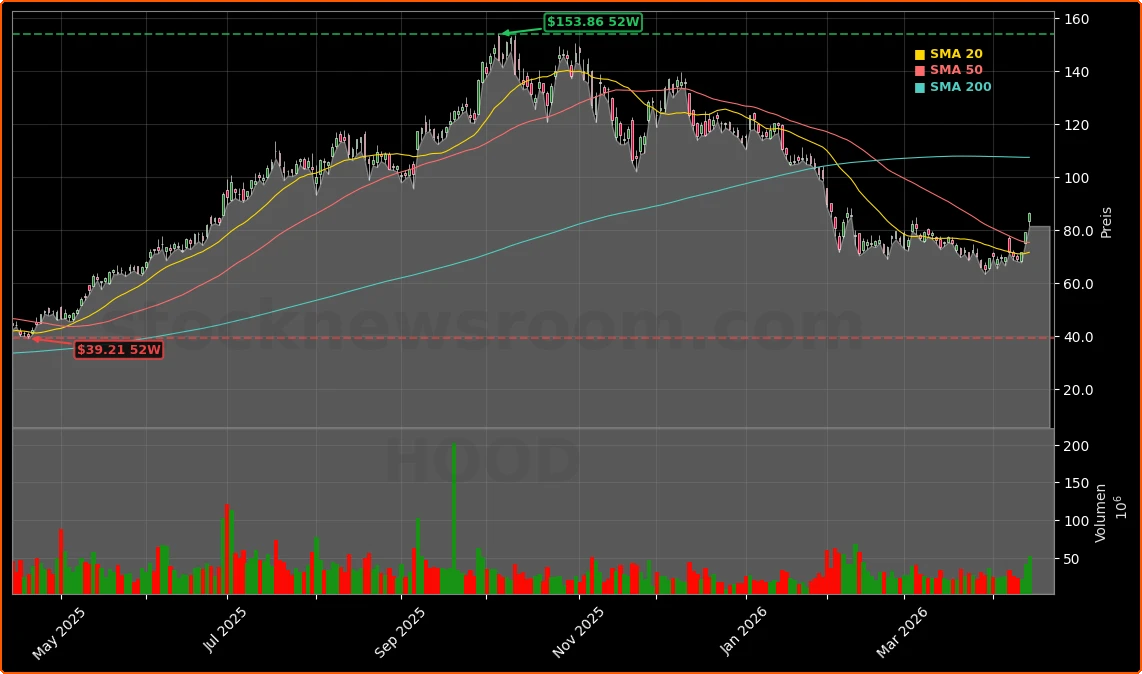
Robinhood Markets, Inc. (HOOD) is rallying again on Wednesday, rising about 9% to $86.30 as of mid-afternoon ET, after the SEC approved a landmark overhaul of day-trading rules for margin accounts. The core shift in Robinhood Regulation is the removal of the old Pattern Day Trader (PDT) framework that forced investors with fewer than $25,000 in equity to limit themselves to three day trades in five business days. That barrier has now been replaced with real-time, risk-based intraday margin requirements that apply to all customers, not just small accounts.
The Financial Industry Regulatory Authority (FINRA) argued that the original PDT rule was designed for a world of high commissions, where overtrading could quickly erode returns. With zero-commission trading now standard across the industry, that logic no longer holds. For Robinhood, whose user base is dominated by smaller, highly engaged retail traders, this regulatory pivot could translate into higher trading volumes, more margin usage and, ultimately, increased revenue from payment for order flow, options and crypto trading.
Robinhood’s chief brokerage officer Steve Quirk called the move a “significant step forward in empowering retail investors,” highlighting that the previous regime was an antiquated barrier to market access. The SEC also indicated that public feedback was overwhelmingly supportive of dismantling the PDT definition and shifting toward risk-based oversight.
What does this mean for Robinhood and rivals?
The Robinhood Regulation shift arrives at a time when online brokers are competing aggressively for active traders. Shares of Webull’s parent also jumped after the decision, underlining that the rule change is effectively a broad industry tailwind rather than a company-specific one. Still, Robinhood has the highest brand recognition among younger U.S. traders and has built a mobile-first interface that tends to appeal to short-term and options-heavy strategies, positioning it to be one of the main beneficiaries.
Under the new framework, a trader can now open an account with roughly $2,000 in equity and execute frequent day trades, as long as margin usage stays within risk-based limits set by the broker. That lower financial threshold could bring in a fresh wave of customers who were previously shut out or constrained by the $25,000 gate. For comparison, more traditional brokers like Charles Schwab and Interactive Brokers have strong active-trader franchises but typically appeal to older, higher-balance clients; Robinhood’s offering is aimed squarely at first-time and smaller investors, many of whom also trade crypto.
The timing also intersects with broader product expansion. Recent reporting has highlighted Robinhood’s push into banking, with over $1.5 billion in deposits gathered in a few months, and its growing presence in prediction and forecasting markets, where annualized transaction volumes have already surpassed $60 billion. If more active trading is layered on top of these newer revenue streams, HOOD’s top line could become less cyclical than in the meme-stock era of 2021.
How does Robinhood Regulation affect risk and oversight?
While the Robinhood Regulation update is being marketed as democratization, it also introduces new risk questions for regulators and investors. More leverage and more intraday trading by small accounts can amplify both gains and losses. Instead of a simple account-balance threshold, brokers will now rely more heavily on real-time risk models to determine how much margin a customer can use during the trading day. That increases the operational and compliance burden for platforms like Robinhood, which has previously faced scrutiny over outages, options risk disclosures and payment-for-order-flow practices.
The SEC’s decision does not remove the need for suitability checks, margin disclosures or best-execution standards. If a surge in small-account day trading leads to higher customer losses or headline-grabbing blowups, Robinhood could find itself under intensified political and regulatory pressure, even though the current Robinhood Regulation change is a clear short-term positive for trading activity. The company’s management has been emphasizing a more mature product roadmap, including long-term investing tools and retirement accounts, to counter perceptions that it exists mainly to turbocharge speculative trading.
On Wall Street, views on HOOD remain mixed. Some bullish strategists point to the combination of this regulatory catalyst, a $1.5 billion buyback program and strong retail engagement in both equities and crypto as reasons the stock could retest prior resistance levels near $100. Others, including more cautious voices featured on Yahoo Finance, highlight that Robinhood was recently downgraded from “Strong” to “Neutral” in one quantitative stock-grading framework, with concerns around valuation, regulatory risk and volatility of monthly trading metrics.
How are institutional investors positioning?
The Robinhood Regulation shift is also intersecting with renewed institutional interest. Ark Invest’s Cathie Wood recently added more Robinhood shares across her innovation-focused ETFs while also buying additional Tesla stock, signaling that some high-conviction growth managers still see HOOD as a long-term disruptor in U.S. retail brokerage. Meanwhile, another key growth driver is emerging through Robinhood’s partnership with BNY Mellon to deliver so-called “Trump Accounts,” tax-deferred investment accounts for children that have already attracted over 4 million sign-ups ahead of a July 4 launch.
These developments support the narrative that Robinhood is evolving from a pure trading app into a broader financial platform, combining brokerage, crypto, banking and retirement products. At the same time, recent target cuts from firms such as Needham, which trimmed its HOOD price target yet still sees upside from current levels, underscore that analysts expect choppy trading in the stock even as fundamentals trend upward.
Today’s 9%-plus move continues a sharp short-term rebound: HOOD has gained double digits over the past two sessions and is now trading near the upper end of its recent range, after previously correcting from peaks around $130 down toward $60. Technical strategists on Wall Street are watching whether the stock can hold above key moving averages in the $70s and $80s, with some eyeing potential resistance in the $90s and around the psychologically important $100 level.
Related Coverage
For a deeper dive into how crypto and banking catalysts are reshaping the stock’s narrative, including the impact of Robinhood’s new banking deposits and crypto trends, see “Robinhood Forecast +10.1% Rally: Crypto And Banking Shock”. That analysis explores whether the latest rebound is the start of a sustainable move or another short-lived spike.
Investors interested in broader innovation and speculative growth themes beyond brokerage should also read “IonQ DARPA Program Soars 16.5% After Defense-Backed Quantum Breakthrough”, which looks at how defense-backed quantum computing projects at IonQ could influence valuations across high-risk, high-reward tech names.
By eliminating antiquated barriers, this change better reflects the modern trading landscape and ensures everyone has the freedom to invest and participate in the markets on their own terms.— Steve Quirk, Chief Brokerage Officer at Robinhood
Robinhood Regulation is clearly entering a new phase: the SEC’s removal of the Pattern Day Trader rule lowers barriers for small investors and could fuel higher engagement, revenue and volatility on the platform. For U.S. portfolios, HOOD is becoming an even more leveraged play on retail risk appetite and market sentiment, both in equities and crypto. The next earnings release and early data on trading behavior under the new rules will show whether this regulatory win marks the beginning of a more durable growth chapter for Robinhood.