Can the latest Robinhood Regulation shift from the SEC really justify HOOD’s sharp rally and the premium investors are now paying?

How does Robinhood benefit from new Robinhood Regulation?
The latest Robinhood Regulation shift – the SEC’s decision to scrap the pattern day trader equity rule – is a fundamental win for the company’s core business model. The rule had effectively locked out smaller accounts from active trading by requiring a minimum $25,000 balance for more than three day trades in five business days. Removing that threshold dramatically lowers the bar for frequent trading, particularly for younger and lower-balance clients who are central to Robinhood’s brand.
That change hits directly where Robinhood is already strongest. Full-year 2025 revenue reached a record $4.47 billion, while paying Gold subscribers surged 58% year over year to 4.2 million. Options revenue alone came in at $314 million in Q4 2025, up 41% from the prior year, underscoring how sensitive the business is to higher trading intensity. With the pattern day trader constraint gone, more of those customers can trade options and equities more often, supporting both commission-free flow and higher subscription and interest income around the platform.
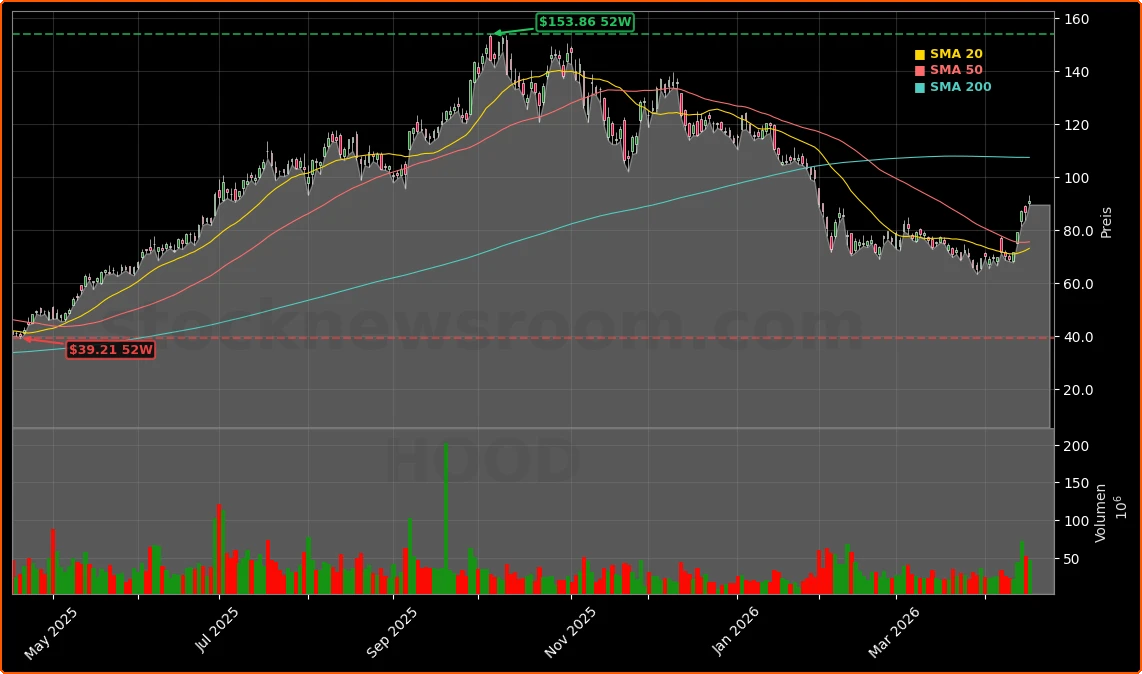
On the technical side, the stock is attempting to push decisively above its 200-day moving average on the daily chart, with traders watching the $100 level as the next major resistance. If HOOD approaches that zone quickly, the RSI could move beyond 70, a classic overbought signal that might invite a pullback in a cooler risk environment.
Is the macro risk-on rally amplifying Robinhood’s move?
The timing of the Robinhood Regulation tailwind coincides with a powerful macro shift that is driving high‑beta assets higher. Iran’s announcement that the Strait of Hormuz will remain fully open during a ceasefire has eased energy supply fears and sent crude sharply lower, with WTI dropping more than 14% and Brent sliding about 10%. Cheaper oil has helped fuel a broad equity rally, pushing the S&P 500 to fresh record highs and extending gains in the Nasdaq‑100.
For Robinhood, that risk-on backdrop matters almost as much as the regulation itself. Lower macro stress and rising index levels have historically pulled more retail traders into stocks, options and crypto. Robinhood’s trading volumes have already been showing a shift toward equities and options even as crypto notional volumes weakened in March. The market is increasingly treating HOOD as a proxy for speculative appetite, similar to how it often trades names like Tesla or crypto‑sensitive platforms.
Year to date, the stock has been volatile – at $90.75 it remains well below its early‑year price near $113, but it has also been one of the best performers in the S&P 500 this week with a roughly 35% surge as investors reprice its growth runway under the new rule set.
What are analysts and big investors saying about Robinhood?
Wall Street’s view on HOOD remains broadly constructive despite recent turbulence. The stock carries a consensus Buy rating, with an average price target around $118. Firms including Bernstein, Truist Securities and Citizens have reiterated bullish stances in April: Bernstein rates Robinhood Outperform with a $130 target, Truist Securities keeps a Buy rating with a $100 target, while Citizens maintains a Market Outperform at $155. Separately, Piper Sandler also maintains a Buy rating, highlighting ongoing strength in customer engagement and product breadth.
Not every voice is unambiguously positive. Louis Navellier’s Stock Grader recently shifted Robinhood from Strong to Neutral, reflecting concerns about valuation and institutional buying trends. The trailing P/E multiple around 42x implies a premium to many traditional brokers and fintech peers, leaving less room for execution missteps, especially if trading enthusiasm cools or regulatory scrutiny on newer products like prediction markets intensifies.
Large thematic investors continue to lean in. ARK Invest, led by Cathie Wood, recently added HOOD shares alongside increased exposure to Tesla, signaling confidence in Robinhood’s long‑term role in the retail investing ecosystem despite ongoing regulatory battles and competition.
Does the broader strategy justify the Robinhood Regulation premium?
The bull case on HOOD extends beyond the immediate lift from Robinhood Regulation. Management is pushing to turn the app into a full‑fledged financial super app that combines brokerage, crypto, banking and new lines such as prediction markets. Robinhood Banking has already gathered more than $1.5 billion in deposits from nearly 100,000 customers in under six months, a strong early proof of concept for broader financial services.
The company also secured a major “Trump Accounts” contract alongside BNY Mellon to build and support tax‑deferred investment accounts for children, with more than 4 million signups reported and a launch planned around July 4. That deal underscores how Robinhood can leverage its user‑friendly interface and brand recognition in white‑label arrangements that expand reach beyond its own retail app.
At the same time, competition is heating up. Charles Schwab is pushing into crypto trading, adding pressure on Robinhood’s still‑volatile crypto revenue stream, and E*Trade is reportedly leading the race to front the retail slice of the highly anticipated SpaceX IPO. Tech and AI heavyweights like NVIDIA and consumer platforms like Apple are also competing for retail investor dollars, even if indirectly, as they dominate index and options activity.
Related Coverage
For a deeper dive into how the SEC’s surprise decision reshaped sentiment earlier this week, including intraday price action and options flows, read “Robinhood Regulation +10.4% Surge on SEC Day-Trading Shock”. If you want to compare Robinhood’s regulatory and growth story with another high‑beta tech name leveraged to secular trends, the piece “Broadcom AI Strategy Rally: Record Boom or Risky Heat?” puts the current chip and AI momentum into context for active traders.
Any time I see the government backing a broker, I say buy, buy, buy.— Jim Cramer
In conclusion, the latest Robinhood Regulation shift from the SEC and the sharp turn toward a global risk‑on environment have combined to create a powerful near‑term catalyst for Robinhood Markets, Inc.. For investors, the key question is whether this mix of structural and macro tailwinds supports the stock’s premium valuation as it approaches heavy resistance around $100. The upcoming April 28 earnings report and management’s execution on its super‑app ambitions will be crucial in determining whether HOOD’s rally has durable legs or merely reflects another burst of speculative enthusiasm.