Is the Broadcom AI Strategy building a durable growth engine or just inflating another overheated chip rally?

Is Broadcom’s AI rally running too hot?
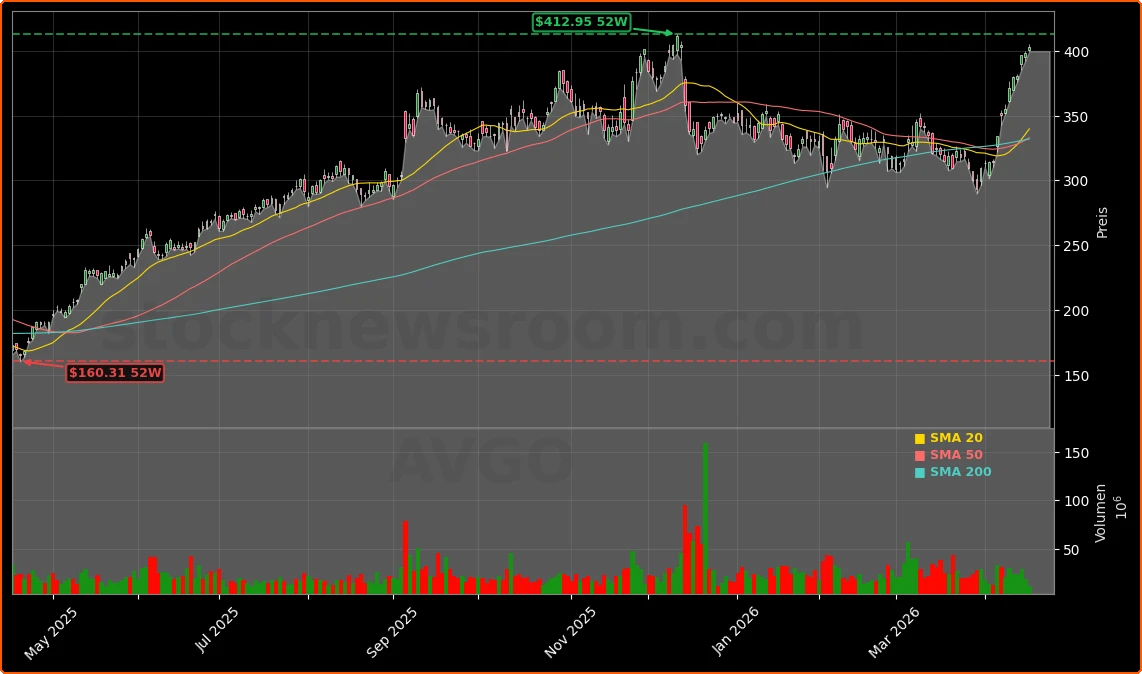
Broadcom Inc. (AVGO) traded around $402.98 in Friday’s session, up roughly 1.1% on the day and less than 3% below its all‑time closing high of $412.97 from December 2025. The stock is riding a nine‑session winning streak, up more than 28% over that stretch and over 30% month‑to‑date, outpacing much of the NASDAQ and even key AI names like NVIDIA over the past year. Technically, AVGO is extended, sitting well above its 20‑day and 100‑day moving averages with an overbought RSI in the high 70s, which raises the risk of a short‑term pullback even as the underlying AI thesis strengthens.
Despite that froth, Wall Street remains broadly constructive. Oppenheimer’s Rick Schafer recently reiterated Broadcom as a top semiconductor pick heading into earnings season with a $450 price target, arguing that sustainable growth and cash returns are backed by core networking, wireless, broadband, server/storage and software franchises. Mizuho’s Vijay Rakesh is similarly bullish with a $480 target and an Outperform rating, highlighting robust demand across custom chips and networking plus a powerful software free‑cash‑flow engine. Consensus estimates imply a rich forward P/E in the high 70s, but bulls argue that the Broadcom AI Strategy justifies a premium to many legacy chip peers.
How do Anthropic and Google reshape Broadcom AI Strategy?
The centerpiece of the current narrative is a rapidly expanding pipeline of custom AI processors and infrastructure for leading model developers and cloud giants. Broadcom is building a major portfolio of application‑specific integrated circuits (ASICs) and accelerator designs for customers such as Anthropic and OpenAI, with at least one flagship Anthropic deal expected to ramp meaningfully around 2027. That long‑dated visibility is a key reason analysts model Broadcom at about 22x forecast 2027 earnings, still below the average multiple for many pure‑play AI chip names.
A three‑way collaboration between Broadcom, Anthropic and Google underscores the scale of this push. Google contributes its TPU accelerators, Anthropic brings its Claude models, and Broadcom provides a massive 3.5‑gigawatt compute infrastructure footprint to tie the system together. This kind of gigawatt‑scale deployment is emblematic of the Broadcom AI Strategy: focus on custom, power‑efficient hardware and the underlying networking, not on competing directly with GPUs. For investors seeking diversification away from GPU concentration risk, that model offers exposure to the AI buildout without relying solely on one architecture or vendor.
What role does Meta play in Broadcom’s AI roadmap?
Meta Platforms has emerged as another anchor customer in the Broadcom AI Strategy. The two companies recently extended their AI silicon and infrastructure partnership through 2029, with Broadcom helping Meta ramp its in‑house accelerators as it seeks to reduce dependence on third‑party GPU suppliers. This alignment with a $1.7 trillion mega‑cap platform gives Broadcom multi‑year revenue visibility and validation that its custom chip approach is resonating with top‑tier hyperscalers.
Meta’s own AI expansion plans, including more efficient ad targeting and future mixed‑reality and generative experiences, require enormous inference capacity. That in turn supports Broadcom’s networking and ASIC franchises, positioning AVGO in the middle of the transition from AI training to large‑scale deployment. Other U.S. tech leaders like Apple and Tesla are also investing heavily in proprietary silicon stacks, reinforcing the broad industry move toward custom accelerators rather than off‑the‑shelf solutions alone.
Can VMware setbacks derail the Broadcom AI Strategy?
Beyond chips, Broadcom’s VMware acquisition remains a lightning rod. The company targets high‑single‑digit to roughly 10% annual growth in the VMware software business, with operating margins near 80%. Mizuho’s Rakesh estimates that, over time, this segment could help generate more than $54 billion in annual free cash flow, giving Broadcom ample capacity to fund AI capex, buybacks and dividends. That cash machine is a critical financial backstop for the Broadcom AI Strategy, especially as custom chip projects require heavy up‑front investment.
However, not all customers are happy. Western Union, for example, is migrating workloads off VMware and onto Nutanix, citing pricing and service changes under Broadcom’s ownership. Such moves highlight the risk that aggressive monetization of VMware could push some enterprises to rival platforms. For now, though, the scale of Broadcom’s installed base and the stickiness of mission‑critical virtualization suggest that churn is manageable, and analysts like Bernstein’s Stacy Rasgon still rate the stock a Buy with a $525 target, seeing VMware as more of a cash‑flow engine than a growth bottleneck.
How are Wall Street and ETFs amplifying the move?
Analyst conviction and ETF flows are amplifying Broadcom’s AI momentum. Morgan Stanley recently raised its AVGO target to $470 with an Overweight rating, while Rosenblatt Securities reiterated a Buy and a $500 objective. Even with a recent downgrade to Neutral from Seaport Global’s Jay Goldberg, who flagged the hefty cost of the Anthropic build‑out and potential near‑term margin pressure, the broader Street still skews bullish with an average target around the mid‑$400s.
Broadcom is also a top holding in major semiconductor ETFs, including the VanEck Semiconductor ETF, iShares Semiconductor ETF and ProShares Ultra Semiconductors, each with weights above 8%. That means incremental inflows into AI‑focused funds can translate into automatic buying of AVGO, further supporting the uptrend. At the same time, market commentators like Jim Cramer have called out Broadcom as a key AI name to watch, particularly given its outsized market cap and deep integration into next‑generation data center builds relative to rivals like NVIDIA. For U.S. investors, the Broadcom AI Strategy now sits at the intersection of custom chips, networking, and software cash flows, making AVGO a central debate in any AI‑heavy portfolio.
Related Coverage
For a deeper dive into how custom ASICs underpin Broadcom’s next growth leg, readers can explore Broadcom AI Inference Supercycle: How Custom ASICs Drive the Next Leg of Growth, which examines the company’s positioning as AI shifts from training to deployment. Investors interested in the broader AI infrastructure and mobility theme may also want to read Uber Delivery Hero Acquisition Boom Meets $10B Robotaxi Bet, highlighting how autonomous and delivery platforms are driving another front in the AI investment wave.
In conclusion, the Broadcom AI Strategy built around custom processors, hyperscaler alliances and VMware‑funded cash flows is powering a powerful stock rally back toward record highs. For U.S. investors, AVGO offers a differentiated way to play AI infrastructure that complements, rather than replaces, pure GPU exposure. The next earnings report in early June and the execution on Anthropic, Google and Meta roadmaps will show whether Broadcom can convert today’s enthusiasm into sustained multi‑year returns.