Can the Broadcom Meta Partnership lock in a new era of hyperscale AI spending and rewrite the growth story for AVGO?

How did the Broadcom Meta Partnership move AVGO?
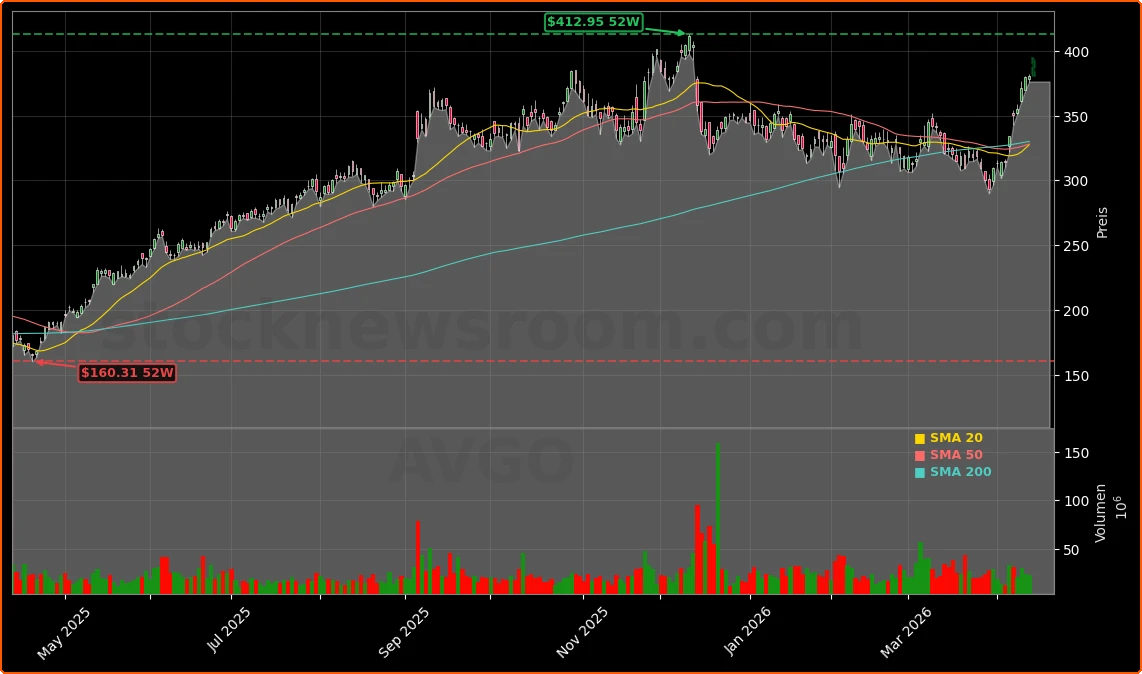
AVGO closed Tuesday’s regular session on NASDAQ at $380.78, up 0.27% on the day, before surging to about $394.32 in after-hours trading, a gain of roughly 3.6%. That move came even as the broader tech complex was already strong, with the Nasdaq Composite up 0.88% and the S&P 500 higher by 0.67% in regular trading. Broadcom shares are trading near the upper end of their 52‑week range, though still below the recent 52‑week high around the $414 area, so the reaction is powerful but not yet a new high.
Technically, AVGO remains extended: the stock sits around 16.9% above its 20‑day simple moving average and roughly 11.3% above its 100‑day SMA. Its relative strength index near 73 points to overbought territory, which often precedes choppier price action or short pauses. Still, the after-hours rally on the Broadcom Meta Partnership underscores how aggressively investors are willing to pay for AI infrastructure exposure.
What exactly is Meta buying from Broadcom?
The centerpiece of the Broadcom Meta Partnership is a multi-year roadmap to support Meta’s in‑house Meta Training and Inference Accelerator (MTIA) chips. Broadcom will deliver custom accelerator technology and advanced Ethernet networking that form the backbone of Meta’s next-generation AI data centers. The initial commitment exceeds 1 gigawatt of compute capacity and marks the first phase of a planned multi‑gigawatt rollout through 2029.
Meta is partnering with Broadcom to roll out what the companies describe as the industry’s first 2‑nanometer AI compute accelerator, designed to power real-time generative AI and what Mark Zuckerberg calls “personal superintelligence” across WhatsApp, Instagram, Facebook and Threads. The collaboration is built on Broadcom’s XPU custom accelerator platform, which tightly couples logic, high-bandwidth memory and high-speed I/O to optimize both performance and total cost of ownership at hyperscale.
On the networking side, Broadcom will supply high‑radix Ethernet switches, optical connectivity products, PCIe switches and high‑speed SerDes, enabling scale‑up, scale‑out and scale‑across architectures across tens of thousands of MTIA nodes. The goal is to eliminate congestion in Meta’s AI clusters and keep low‑precision inference workloads running at near‑zero latency.
Why does this matter for Broadcom versus rivals?
For U.S. investors comparing AI leaders like NVIDIA, Apple and Tesla, the Broadcom Meta Partnership highlights a different lane in the AI race: custom silicon and networking for the largest hyperscalers. CEO Hock Tan recently projected that Broadcom’s AI chip revenue could exceed $100 billion in 2027, driven by custom accelerators and networking sold to major customers including Alphabet’s Google, OpenAI, Anthropic and Meta.
Unlike GPU vendors that sell more standardized accelerators into cloud and enterprise, Broadcom is leaning into co-designed, application-specific chips and Ethernet fabrics that are tightly integrated into each customer’s data center blueprint. Securing high-bandwidth memory and advanced-node capacity at Taiwan Semiconductor Manufacturing through 2028 further reduces supply risk and strengthens Broadcom’s bargaining position as AI demand scales.
The breadth of Broadcom’s AI exposure is also diversifying. Beyond MTIA, the company recently introduced its Arcot Smart Ruleset, a machine‑learning powered 3‑D Secure engine for e‑commerce fraud prevention. That underscores a wider strategy: monetize AI not just in data center accelerators, but also in security and software infrastructure where Broadcom already has deep enterprise relationships.
How is Wall Street reacting to Broadcom’s AI story?
Analysts on Wall Street have been steadily marking up their expectations for AVGO as the AI narrative has strengthened. JPMorgan analyst Harlan Sur reiterated an Overweight rating and raised his price target to $500 from $475, citing strong momentum in Broadcom’s AI business and rising demand for AI networking. Goldman Sachs analyst James Schneider also maintained a Buy rating and lifted his target to $480 from $450, pointing to improved visibility into multi‑year AI demand.
Rosenblatt’s Kevin Cassidy stayed bullish with a Buy rating and a $500 target, emphasizing Broadcom’s leadership in AI ASICs and networking and the clearer demand visibility into 2027. Benchmark analyst Cody Acree kept a Buy rating with a $485 target, flagging Broadcom’s guidance, its expanding hyperscaler customer base and secured supply chain as key supports for the AI growth outlook. Taken together, the consensus target around the low‑$400s implies further upside from Tuesday’s close, even after the sharp 10‑day run that has added nearly 30% to the stock.
From a portfolio construction standpoint, AVGO’s heavy weight in major ETFs—including the VanEck Semiconductor ETF and the iShares Semiconductor ETF—means inflows into AI‑themed and momentum funds can mechanically drive additional demand for the stock. That dynamic could amplify moves in both directions as sentiment around AI shifts.
What changes in governance and risk for investors?
One governance wrinkle tied to the Broadcom Meta Partnership is that Hock Tan will step down from Meta’s board of directors due to the increased scale of the commercial relationship. Instead, he will move into an advisory role, helping shape Meta’s custom silicon roadmap and future infrastructure investments. For investors, that removes potential conflict-of-interest concerns while deepening the strategic alignment between the two companies at an operational level.
Insider selling has picked up amid the rally, with Vice President S. Ram Velaga selling 8,000 shares at an average price of about $370.52 on April 10, leaving him with roughly 57,932 shares directly. Several other executives and directors have also sold stock in recent months, some under pre‑arranged Rule 10b5‑1 plans. While frequent insider sales can raise eyebrows, they have been a consistent feature of Broadcom’s long-term uptrend and do not yet signal a break in the fundamental story.
Related Coverage
Investors looking to put the Broadcom Meta Partnership into a wider AI context may want to revisit the recent analysis “Broadcom AI Forecast +4.7%: Is the AI Boom Just Starting?”, which examines whether Broadcom’s aggressive AI revenue outlook can sustain another decade of hypergrowth or if current prices already discount perfection. That piece is available at Broadcom AI Forecast +4.7%: Is the AI Boom Just Starting? and provides additional detail on valuation and risk scenarios.
For a broader sector angle, the article “Cloudflare AI Security -2.9% Plunge After Wiz And Mesh Push” explores how another key infrastructure name is leveraging AI in cybersecurity even as its stock came under pressure. Readers can find that discussion at Cloudflare AI Security -2.9% Plunge After Wiz And Mesh Push, offering a useful comparison between AI plays focused on security and those, like Broadcom, centered on compute and networking.
Meta is partnering with Broadcom across chip design, packaging, and networking to build out the massive computing foundation we need to deliver personal superintelligence to billions of people.— Mark Zuckerberg, Meta CEO
In the end, the expanded Broadcom Meta Partnership reinforces Broadcom Inc. as a core enabler of hyperscale AI infrastructure and keeps AVGO firmly in the conversation with other mega‑cap AI winners. For long‑term investors in the S&P 500 and Nasdaq, the deal strengthens the case for Broadcom as a structural AI beneficiary rather than a short‑cycle chip trade. The next few quarters of execution on the Broadcom Meta Partnership and AI revenue trajectory will show whether the current momentum can translate into sustained earnings power.