Can Netflix’s ad tier and live sports ambitions really justify the latest rally ahead of the next Netflix Earnings report?

What is priced into Netflix Earnings?
Netflix, Inc. is set to report Q1 2026 results after the close on Thursday. Street consensus clusters around earnings of $0.76–$0.84 per share, roughly 20–27% higher year over year, on revenue of about $12.17–$12.18 billion, up roughly 15%. That would extend the company’s recent pattern of double‑digit top‑line growth after a brief wobble last year when it posted a rare double miss in Q3.
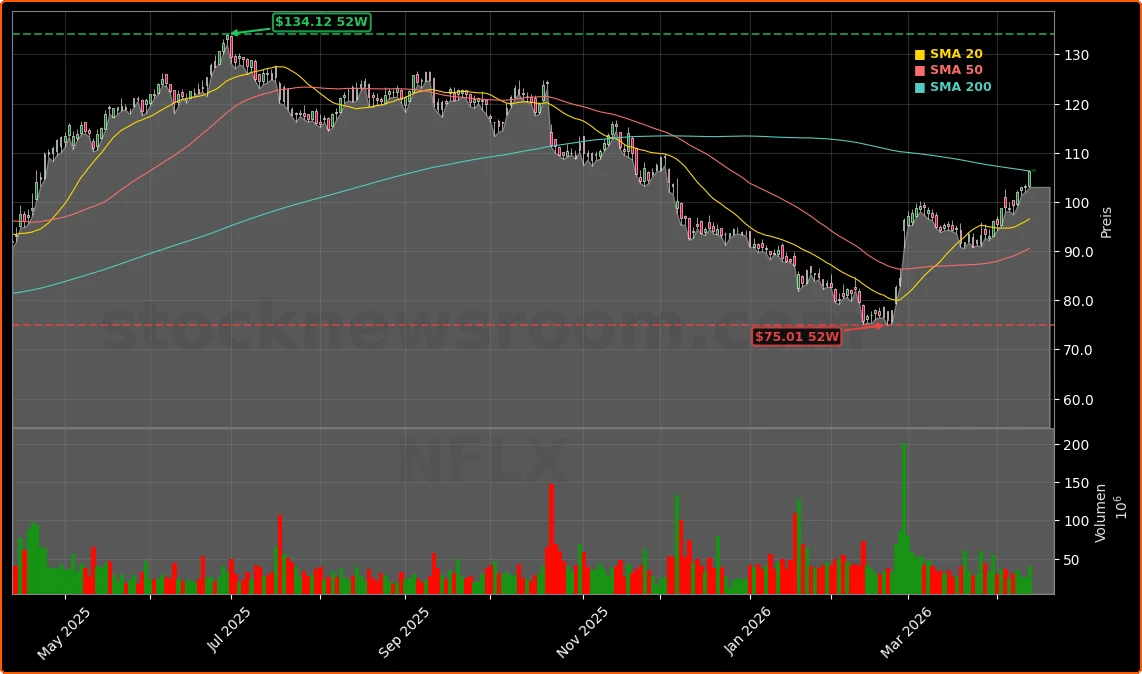
At $106.28, Netflix (NFLX) sits well below its 52‑week high of $134.12 but remains up more than 16% year to date, outperforming much of the broader S&P 500. The move reflects growing confidence that the company’s ad‑supported tier, password‑sharing crackdown and latest price hikes can sustain revenue growth even as streaming competition remains intense from players like Apple, Disney and Amazon.
Analysts expect management to reaffirm or refine its previous full‑year revenue outlook of $50.7–$51.7 billion, with investors laser‑focused on how quickly ad dollars and higher average revenue per user (ARPU) are flowing through to Netflix Earnings and free cash flow.
How are analysts positioning around Netflix Earnings?
Wall Street sentiment has turned more constructive in the run‑up to Thursday’s report. KeyBanc Capital Markets analyst Justin Patterson reiterated an Overweight rating and raised his price target from $108 to $115, citing what he calls a “durable monetization algorithm” and faster‑than‑expected scaling of the ad tier. Patterson also sees upside to longer‑term EPS, forecasting more than $4 per share in 2027 as advertising and buybacks kick in.
Guggenheim’s Michael Morris kept a Buy rating and a $130 target, arguing that this quarter’s call will be crucial for understanding how management deploys its “substantial capital generation capacity” now that the Warner Bros. Discovery pursuit has been abandoned. Evercore ISI likewise reiterated an Outperform rating with a $115 target, saying current revenue and operating‑income estimates look reasonable given the content slate and recent price increases. Deutsche Bank nudged its target higher to $100 while staying at Hold, illustrating that not all firms are in the outright bull camp even as the consensus target hovers around the mid‑$110s.
On the ownership side, institutional investors such as Tower View Wealth Management and AMI Asset Management have sharply increased their Netflix stakes, even as insiders including co‑founder Reed Hastings and CFO Spencer Neumann have sold shares in recent months. For portfolio managers, the key question is whether Thursday’s Netflix Earnings report validates the recent accumulation or exposes the stock as ahead of the fundamentals.
Is advertising now the main growth engine for Netflix?
Across Wall Street, one theme dominates expectations for Netflix Earnings: ad monetization. The company’s low‑priced, ad‑supported plan is now seen as a central lever to drive incremental revenue without sparking mass churn. By offering a cheaper tier supported by ads, Netflix can push premium prices higher while recapturing users trading down rather than leaving the platform entirely.
KeyBanc’s Patterson highlights that the ad tier is scaling faster than initially anticipated, while Guggenheim expects Netflix to aim for a doubling of ad revenue over time. Investors want specifics: ad‑tier user growth, advertising ARPU, and how quickly the business can become a material contributor to margins. Commentary on the latest price increases will also be critical, especially how many customers migrated to the ad tier versus canceling outright.
Stepping back, this monetization focus mirrors strategies pursued by other mega‑caps like NVIDIA and Tesla, which use a core product to build higher‑margin, recurring software or service layers. For Netflix, live sports may ultimately play a similar role to automotive software at Tesla or AI services at NVIDIA, anchoring new, high‑value advertiser relationships.
Will live sports and slimmer content output reshape Netflix?
Another focal point for Netflix Earnings is the company’s evolving content strategy. In Q1, Netflix released just 23 original films, its lowest quarterly output since 2017. Management has framed this as a shift toward “better, not more” content, prioritizing quality and impact over sheer volume. Flagship series like “Bridgerton,” “One Piece,” and “The Night Agent,” plus movies such as “The Rip” and “War Machine,” were among the quarter’s marquee titles.
At the same time, live sports is emerging as a potential growth pillar. Market strategists expect pointed questions about recent NFL game experiments and whether more packages are on the horizon. Live events are particularly attractive for advertisers, offering appointment viewing and brand‑safe inventory at scale. If Netflix secures additional NFL or other major sports rights at disciplined prices, it could meaningfully enhance the long‑term advertising story that underpins bullish Netflix Earnings projections.
For US investors weighing Netflix against other NASDAQ heavyweights like Apple, Alphabet and Amazon, the issue is less about whether Netflix can grow, and more about the trajectory and capital allocation: Will excess cash go to sports rights, selective acquisitions, or accelerated buybacks now that the Warner Bros. Discovery mega‑deal is dead?
Related Coverage
For a deeper dive into how the failed Warner Bros. Discovery tie‑up is reshaping the balance sheet and strategic playbook ahead of Netflix Earnings, see Netflix Merger Shock: Can a Cash Boom Rewrite the Story?. That analysis explores whether walking away from the deal simply killed a mega‑merger dream or quietly set up Netflix’s next phase of cash‑rich, organic growth. The same piece, Netflix Merger Shock: Can a Cash Boom Rewrite the Story?, also places the streamer within the broader media and streaming sector, offering useful context for how rivals may respond if Netflix leans harder into ads and live sports.
In the end, the upcoming Netflix Earnings report will be judged less on headline beats and misses and more on clarity around ads, pricing and capital deployment. For long‑term investors, confirmation that Netflix can convert its global scale into faster earnings and cash‑flow growth would strengthen the case for holding the stock alongside other tech leaders. The next few quarters will show whether Thursday’s update marks the start of a more durable, monetization‑driven phase for Netflix.