Can Rivian’s new energy storage push turn old EV batteries into a strategic edge that Wall Street has been missing?

How does Rivian’s battery project work?
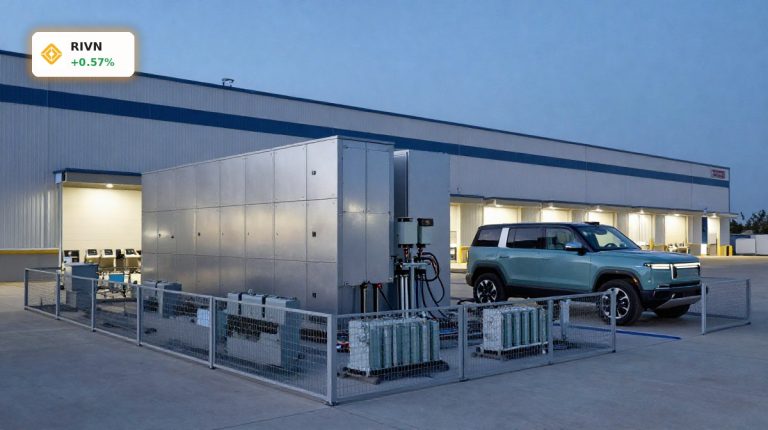
The new Rivian Energy Storage project will repurpose over 100 Rivian battery packs from test vehicles and end-of-life cars into a stationary system at the company’s sole operating plant in Normal, Illinois. Integrated by Redwood Materials, the setup will initially provide 10 megawatt-hours (MWh) of dispatchable energy, roughly comparable to 1,000 residential home battery units combined. Managed by Redwood’s Pack Manager software, the array can discharge during peak demand to lower Rivian’s electricity bill and reduce strain on the local grid.
Instead of sending usable packs straight to recycling, the batteries are redeployed as a mid-life asset. EV packs are engineered for hundreds of thousands of miles, and often retain significant capacity even when a vehicle is retired. That makes them well suited to stationary duty cycles, where weight and volume are less critical than in vehicles. Once the storage value is exhausted, Redwood can still recover critical materials like lithium, nickel, cobalt and copper for new battery production.
Rivian’s CEO RJ Scaringe frames the project as a way to turn its fleet into a long-lived energy resource while bolstering U.S. competitiveness. With electricity demand in the U.S. accelerating on the back of AI data centers, electrification and reshoring, flexible storage near large industrial loads is becoming strategically important for manufacturers and utilities alike.
What does this mean for Rivian and Redwood Materials?
For Rivian, the Rivian Energy Storage partnership is primarily about operating leverage. By shifting a portion of its power use to off-peak hours and discharging during price spikes, the company can reduce its energy costs at Normal and improve the economics of vehicle production. The project also gives Rivian a template it can replicate at future facilities, including its planned Georgia plant slated to open in 2028, and potentially at commercial customer sites down the line.
Redwood Materials, founded by former Tesla co-founder JB Straubel, gains a showcase deployment with a fast-growing EV manufacturer. The company is already building out large-scale recycling and materials processing in the U.S.; demonstrating that retired EV packs can serve as a grid asset before recycling strengthens its value proposition to automakers and utilities. The system in Normal is described as the largest repurposed-battery energy storage project for a U.S. automotive manufacturer so far, giving Redwood a reference point as energy storage demand grows.
Strategically, this aligns Rivian with broader trends in the sector. Energy storage has become a major growth driver for Tesla’s own business, and utilities are increasingly turning to lithium-ion systems to manage peaks instead of constructing gas peaker plants. Rivian Energy Storage does not turn Rivian into a pure-play storage company, but it does position the automaker to participate in this adjacent market with relatively low incremental capital, leveraging assets it already owns.
How does this fit into Rivian’s broader Wall Street story?
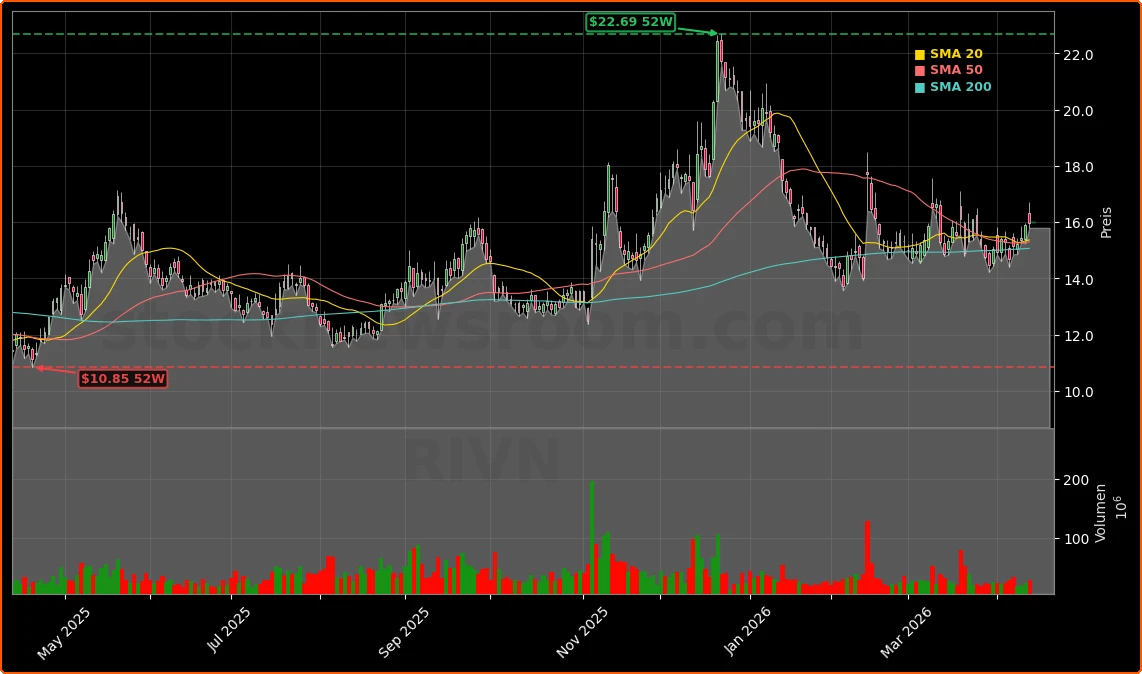
On Wall Street, RIVN remains a high-beta EV name with a volatile narrative. Shares currently trade around $15.99, modestly above DA Davidson’s $14 price target, after the firm upgraded Rivian from ‘Underperform’ to ‘Neutral’ earlier this month. Other coverage has focused on upcoming catalysts such as the R2 midsize SUV, which recently received an EPA certification hinting at a range up to roughly 335 miles, and Rivian’s emerging robotaxi ambitions through its partnership with Uber.
Several analysts, including teams highlighted by Sahm Capital, argue Rivian’s fair value could sit well above the current quote, around the mid-$20s per share, though they also emphasize execution risk, cash burn and potential dilution. Technical strategists on TradingView remain split, with some seeing bottoming patterns and others warning of further downside amid choppy broader EV sentiment on the NASDAQ and S&P 500.
Against that backdrop, Rivian Energy Storage is not a near-term revenue driver but does matter for the investment thesis. It signals that management is thinking holistically about lifecycle economics, total cost of ownership and ancillary revenue streams from software and energy. In a market where investors increasingly reward platforms that monetize beyond initial hardware sales—think NVIDIA in AI or Apple in services—this kind of ecosystem thinking can help differentiate Rivian from less vertically integrated EV peers.
Is energy storage becoming a competitive moat?
The Rivian Energy Storage initiative also speaks to shifting competitive dynamics in autos and clean tech. Large incumbents like Ford and General Motors are already retooling some battery facilities toward grid-scale storage as EV adoption normalizes. Meanwhile, energy storage has turned into the fastest-growing segment for Tesla, which sells systems to utilities, businesses and residential customers worldwide.
If Rivian can prove that second-life packs meaningfully cut factory power bills and deliver reliable performance, the model could be replicated not just at Rivian sites but also at fleet customers, logistics hubs and potentially commercial real estate. Over time, that could open doors to power purchase agreements, shared-savings contracts, or software fees tied to dispatch optimization—areas where Rivian’s in-house software and AI capabilities could become monetized.
For now, management is clear that energy storage is not the core business focus, with vehicles and autonomy still center stage. But Rivian Energy Storage adds an important optionality layer: a way to extend asset life, deepen customer relationships and participate in what could be a multi-hundred-gigawatt-hour U.S. storage buildout by 2030, without massive greenfield capex.
Related Coverage
Investors tracking Rivian’s broader risk-reward profile can find more context in Rivian Forecast Warning as Crucial R2 Launch Meets EV Slowdown, which explores how higher-for-longer interest rates, softening EV demand and the high-stakes R2 rollout interact with the company’s cash needs and valuation. For a sector-wide lens, Tesla Forecast +3.3% Rally After UBS Upgrade Shock examines how AI, robotaxis and energy storage are reshaping expectations for Tesla and, by extension, the entire U.S. EV and clean-tech complex.
Rivian Energy Storage ultimately reinforces Rivian’s positioning as more than just an electric truck maker, highlighting its potential role in the emerging circular battery and grid-services economy. For U.S. and global investors, the key question is whether these strategic moves, alongside R2 and the Uber robotaxi alliance, can translate into sustainable margins and a durable growth story. The next few quarters—especially the upcoming earnings on April 30 and progress on the Normal storage rollout—will be critical in showing whether Rivian can turn innovation into long-term shareholder value.