Can Oklo’s latest leadership overhaul turn a speculative nuclear bet into a credible execution story for long-term investors?

How do Oklo Leadership Changes intersect with the stock move?
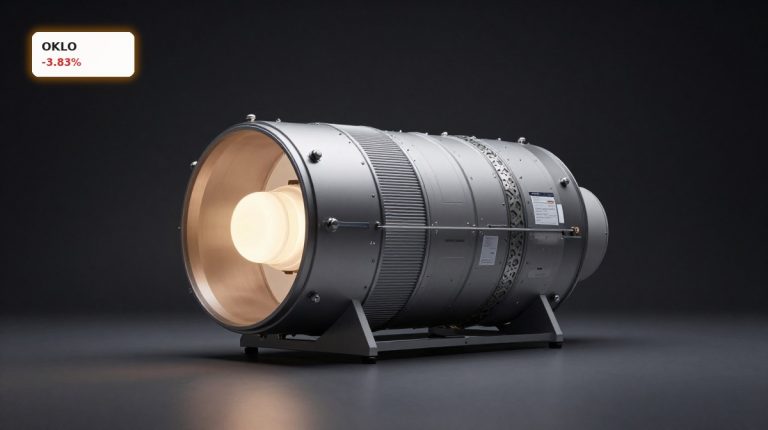
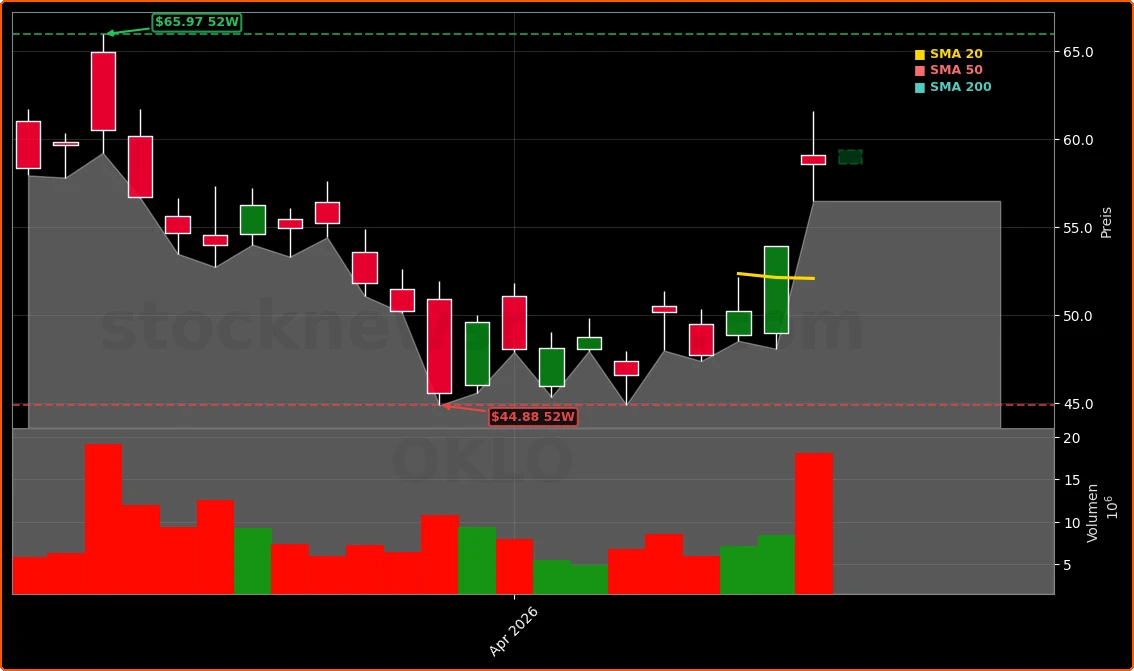
Oklo Inc. (OKLO) shares closed Tuesday at $58.58, up 8.60% from the previous close of $55.25, with after-hours trading lifting the price further to $59.40 (+1.40%) as of late Tuesday evening ET. The rally comes amid renewed enthusiasm for nuclear technology after fresh White House guidance on deploying reactors in space and on the Moon, and it provides the backdrop for sweeping Oklo Leadership Changes unveiled this week.
The company remains pre-revenue and is losing money, with its first commercial revenues not expected until around late 2027, underscoring that the current valuation is built on long-term expectations rather than cash flow. Technical traders note that the stock recently tested a wedge formation on the daily chart near $62.25, with speculation about a potential breakout toward the $80 area if momentum and policy tailwinds persist. Against this backdrop, Oklo is moving aggressively to bolster its governance and operational leadership to convince institutional investors it can execute on its ambitious plan to supply clean power for energy-intensive sectors like AI data centers.
What exactly is changing at Oklo Inc.?
The headline Oklo Leadership Changes center on a significant expansion of the board of directors and a reconfiguration of senior management roles. Effective April 10, 2026, the board increased its size to eleven members and appointed four new directors: Dr. Mark Peters, David Christian, Derek Kan, and David Park. Each has deep experience in nuclear, large-scale industrial projects, or complex regulated industries, aligning with Oklo’s need to move from R&D to deployment.
Dr. Peters, now president and CEO of MITRE, is a recognized nuclear and national security expert and former director of Idaho National Laboratory, where Oklo is developing its first-of-a-kind Aurora powerhouse. Christian brings decades from Dominion Energy, including leadership of its nuclear business and large electric infrastructure operations. Kan, currently a senior executive at Shopify and Vice Chairman of the U.S. Postal Service Board of Governors, adds high-growth tech, AI implementation, logistics, and public policy expertise. Park, CEO of Standard Lithium, contributes energy, industrial, and capital allocation skills, plus early-career nuclear experience.
Oklo emphasizes that these directors were added to support four distinct business units: powerhouses, fuel, fuel recycling, and radioisotopes. Management frames the refreshed board as a way to bring more execution discipline to a company that must simultaneously build advanced reactors, secure specialized nuclear fuels, and develop recycling and isotope production capabilities.
Why does a Lead Independent Director matter for Oklo?
As part of the Oklo Leadership Changes, the board named Michael Thompson as Lead Independent Director, a role often watched closely by institutional shareholders focused on governance. Thompson, who joined the board in 2025 and leads private investment firm Reinvent Capital, is expected to provide independent oversight as Oklo scales and manages risk across its four business lines.
The move comes roughly a year after OpenAI CEO Sam Altman stepped down as Oklo’s chairman, a departure that previously weighed on sentiment because investors saw his involvement as a high-profile endorsement. By elevating Thompson, Oklo is signaling to the market that it wants a more traditional governance structure as it transitions from a venture-backed startup toward a more mature NYSE-listed operator. For portfolio managers evaluating nuclear exposure alongside names like NVIDIA-driven AI beneficiaries, Tesla’s energy business, or grid-relevant giants such as Apple, a strong lead independent director can reduce perceived key-person risk and governance discount.
Oklo stresses that Thompson’s experience helping companies navigate periods of hypergrowth will be crucial as it pushes toward building multiple facilities, from power plants to fuel and isotope operations. For investors, the appointment suggests the board is preparing for a future where capital allocation, risk management, and potential partnerships become as important as technology milestones.
How does the CTO transition fit the execution story?
The final leg of the Oklo Leadership Changes is a shift in the technical organization. Chief Technology Officer Pat Schweiger, a veteran of fast reactor design and construction, will transition from his executive role into a non-executive senior technical advisory position over the coming weeks. The company describes the move as a mutual decision aligned with its effort to update its management structure for the build-out of business-unit-focused teams.
Oklo credits Schweiger’s work with enabling rapid progress on the sodium-cooled fast reactor design underlying its Aurora powerhouse at Idaho National Laboratory. Keeping him as a senior advisor allows Oklo to retain deep domain expertise while creating space to expand operational leadership across deployment, manufacturing, and fuel recycling. From an investor perspective, this helps balance continuity in core technology with increased emphasis on project delivery, supply chain, and regulatory execution—areas that will likely determine whether Oklo can convert its pipeline into revenue by the late 2020s.
The broader context is that advanced nuclear remains a long-duration, high-risk theme compared with cash-generating S&P 500 constituents. Oklo must still navigate an arduous Nuclear Regulatory Commission process, secure high-assay low-enriched uranium and other fuels, and line up financing and offtake contracts. The Oklo Leadership Changes appear aimed at demonstrating that the company understands these challenges and is staffing accordingly.
How does Oklo stack up in the nuclear and AI power race?
On Tuesday, Oklo joined other advanced reactor and nuclear suppliers in moving higher after the White House directed NASA, the Department of Defense, and the Department of Energy to accelerate cost-effective partnerships with private companies to deploy space reactors by 2028 and on the Moon by 2030. Peers in the small modular reactor (SMR) space such as NuScale Power and Nano Nuclear Energy also posted strong gains, while established nuclear suppliers and uranium players saw more mixed trading.
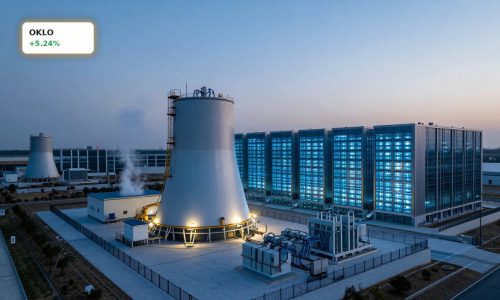
For investors focused on the AI power crunch, Oklo positions itself differently from traditional utilities and uranium miners. The company aims to deliver distributed, fast fission power plants that can serve data centers and industrial customers directly, while also building out domestic fuel recycling and isotope supply chains. This integrated model is higher risk but potentially higher margin than simply selling fuel or wholesale power. Its shares, like other early-stage nuclear names, are more volatile than mega-cap tech leaders or diversified energy majors.
Compared with large-cap momentum names such as NVIDIA, which monetize AI directly, Oklo is a second-derivative play on AI energy demand. Investors considering a basket approach to the theme may pair such exposure with more established clean energy and grid infrastructure companies to balance risk. At current levels, Oklo’s valuation rests on belief that its technology can be commercialized, regulatory barriers can be managed, and that the expanded leadership bench can actually deliver on multi-site deployment.
Related Coverage
For a deeper dive into how Oklo’s technology roadmap ties into soaring AI data center demand, readers can review our recent analysis in Oklo Nuclear Strategy +5.2%: AI Data Power Boom. That article explores whether the company’s fast fission design and integrated fuel strategy can realistically position it as a core power supplier to hyperscale computing over the next decade, and how this opportunity compares with other clean energy options.
To capitalize on the scale of opportunity, we are bringing additional technical and execution experience to our Board and our team.— Jacob DeWitte, co-founder and CEO of Oklo Inc.
In sum, the current wave of Oklo Leadership Changes underscores a strategic pivot from founder-led, technology-centric development toward a more institutional-grade governance and execution model. For investors, the reinforced board, the appointment of a lead independent director, and the CTO’s move into an advisory role collectively aim to de-risk the path from concept to commercial deployment. The next few years of regulatory milestones, project financing, and initial plant construction will show whether this reshaped leadership team can convert policy tailwinds and market enthusiasm into durable shareholder value.