Can the Coinbase Crypto Strategy turn Bitcoin-linked swings into a durable volatility business that finally earns the stock its own identity?

Is Coinbase still chained to Bitcoin?
Five years after its high-profile direct listing on NASDAQ, Coinbase trades far below its euphoric 2021 debut while remaining tightly tethered to Bitcoin’s boom‑bust cycles. Since listing at an initial reference price of $250 on April 14, 2021, the stock is down about 31% even after Tuesday’s rebound, while Bitcoin has also retreated sharply from past peaks. Over the past five years, monthly price moves in Coinbase and Bitcoin have shown a correlation of roughly 0.76 — a striking sign that the market still treats COIN as a proxy for the largest cryptocurrency.
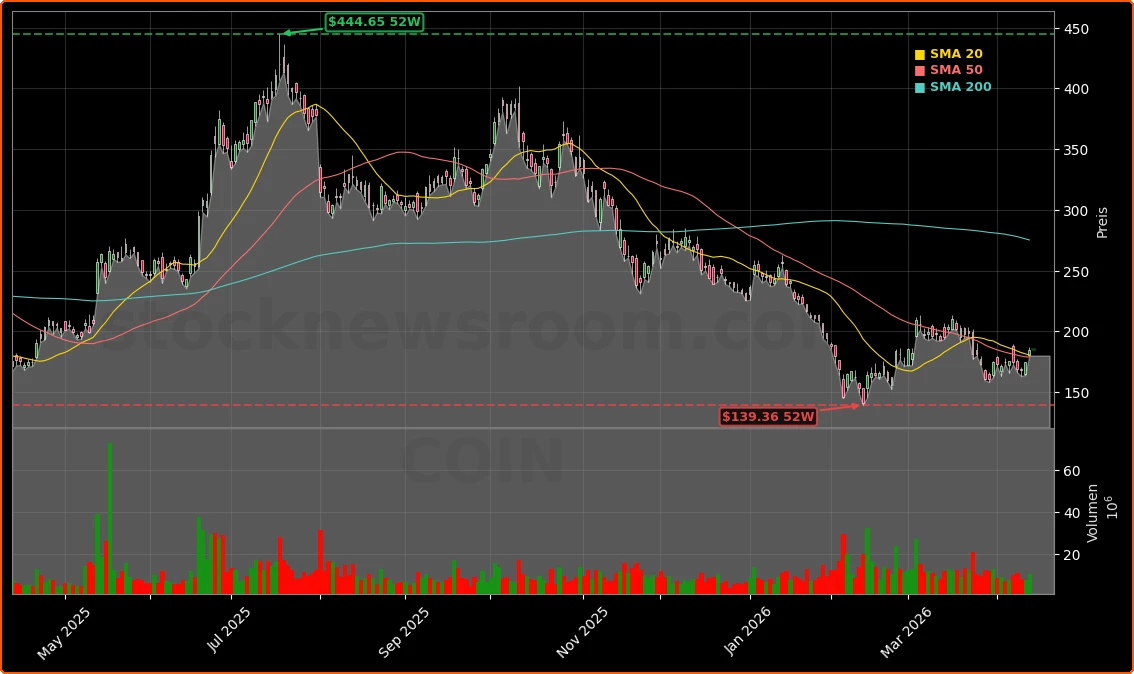
That dynamic was on display again Tuesday. With the total crypto market cap up nearly 5% to around $2.56 trillion and Bitcoin trading above $75,000, Coinbase shares jumped alongside other crypto‑exposed names like Robinhood and MicroStrategy. Hopes for a potential U.S.–Iran ceasefire boosted risk appetite across the NASDAQ and S&P 500, giving high‑beta crypto stocks an extra push. At $184.41, COIN is well below its 52‑week high of $444.64, but the sharp single‑day move underscores how sensitive it remains to Bitcoin sentiment.
How does volatility power the Coinbase Crypto Strategy?
The heart of the Coinbase Crypto Strategy is less about crypto prices and more about crypto activity. Coinbase still earns the majority of its revenue from transaction fees: in 2025, trading fees accounted for about 56% of its $7.2 billion in revenue, down from 96% in 2020 but still the dominant driver. That means volatility itself — not just rising prices — can be good for business, because traders become more active when markets swing.
When Bitcoin rallies, retail and institutional investors pile in, driving up volumes. When it sells off, many of those same investors rebalance, cut losses, or attempt to buy the dip. Each move generates fees for Coinbase, which held more crypto in custody than any other company in 2025. In that sense, Coinbase’s business model increasingly resembles a high‑beta exchange or derivatives venue rather than a simple “bet on Bitcoin” — a nuance the market has not fully priced in.
That setup could become more powerful if forecasts about mainstream adoption play out. Bitwise CEO Hunter Horsley recently argued that by the end of 2026, crypto will be such a mainstream asset class that it becomes “uninteresting,” as large institutions normalize their exposure. As firms like Morgan Stanley roll out low‑fee spot Bitcoin ETFs and expand digital‑asset offerings, a deeper and more liquid crypto market could translate into steadier, higher trading volumes for Coinbase over the long term.
Can Coinbase escape the Bitcoin label?
Management’s broader Coinbase Crypto Strategy goes well beyond trading. CEO Brian Armstrong has spent years pitching an “everything exchange” vision that combines spot and derivatives trading, stablecoins, blockchain infrastructure, custodial services, and even equities. Transaction revenue has already fallen from 96% of total revenue in 2020 to about 57% in 2025, as recurring sources such as stablecoin interest, blockchain rewards, and custodial fees grow.
One of the most important pillars is USDC, the dollar‑backed stablecoin Coinbase co‑founded with Circle. Stablecoin revenue surged 48% to $1.4 billion in 2025, while USDC’s market cap has more than quintupled over the past five years. Visa and Mastercard are testing stablecoins for payments and settlement, BlackRock has quickly grown its iShares Bitcoin Trust, and traditional exchanges like NYSE and Nasdaq are preparing for tokenized stocks. If tokenization and stablecoins move into the financial mainstream, Coinbase’s role as a distributor, custodian, and infrastructure provider could become as important as its trading business.
Coinbase’s Base blockchain network has already joined a small club of at least a dozen internal products generating $100 million‑plus in annual revenue. Large enterprises such as Stripe, JPMorgan Chase, and BlackRock use Coinbase infrastructure to build their own crypto applications, suggesting a path to a B2B platform future that looks more like cloud infrastructure than a pure retail broker. For investors, the open question is how quickly these newer lines can grow large enough to dilute the company’s perceived dependence on Bitcoin cycles.
What about competition and Wall Street sentiment?
The Coinbase Crypto Strategy faces intense competition from both sides of the financial system. On the consumer front, Robinhood Markets and SoFi Technologies have built low‑cost trading apps with integrated crypto, stablecoins, and stock trading, forcing Coinbase to defend its fee structure and user base. On the institutional side, giants like BlackRock, Morgan Stanley, and JPMorgan are building their own digital‑asset rails, potentially capturing high‑margin flows that might once have defaulted to crypto‑native players.
Fee pressure is another risk. As crypto matures and traditional brokers push into the space, zero‑commission trading — already standard for U.S. equities at firms like Robinhood and Charles Schwab — could migrate into crypto as well. That would compress margins on Coinbase’s core business over time, even if volumes stay high. Meanwhile, short interest in COIN is elevated, with more than 12% of the float sold short, reflecting skepticism that the stock can sustain rallies while Bitcoin remains volatile and below its highs.
On the flip side, Coinbase remains a top‑tier way for U.S. investors to get liquid, exchange‑listed exposure to the growth of crypto infrastructure without holding tokens directly. Technical traders on platforms like TradingView are split between near‑term caution — citing the stock’s position below its 100‑day moving average and a December “death cross” — and longer‑term optimism that support around $158.50 could hold if Bitcoin continues to recover. Institutional strategists at firms such as Morgan Stanley and BlackRock are not issuing direct COIN ratings, but their aggressive build‑out of Bitcoin ETFs and tokenization products implicitly supports the broader ecosystem from which Coinbase profits.
Related Coverage: what else should investors watch?
For a closer look at how regulation and global expansion fit into the Coinbase Crypto Strategy, readers can examine how an Australian license could reshape its platform. The article “Coinbase Australia License Boom: AFSL Shock for Rivals” analyzes whether newly granted permissions can turn Coinbase into a more fully regulated “everything platform” across regions and asset classes.
Investors following crypto infrastructure beyond Bitcoin and stablecoins may also want to track developments at Ripple. The piece “Ripple Technology Upgrade: Can ZKP Privacy Make XRP Bank-Ready?” explores how new zero‑knowledge proof privacy features could make XRP Ledger more attractive to banks, highlighting how multiple blockchain networks are racing to become the settlement rails for traditional finance.
In the end, the Coinbase Crypto Strategy hinges on turning today’s Bitcoin‑driven volatility into a durable, diversified revenue engine anchored in trading, stablecoins, and blockchain infrastructure. For U.S. investors, COIN remains a high‑beta, high‑risk gateway to the entire digital‑asset ecosystem rather than a simple bet on one token. The next phase of crypto adoption and regulation will show whether Coinbase can finally trade on its own fundamentals instead of Bitcoin’s mood swings.