
Will the new Ripple Technology Upgrade finally turn the XRP Ledger into a serious settlement rail for global banks and institutions?

How does the Ripple Technology Upgrade change XRP?
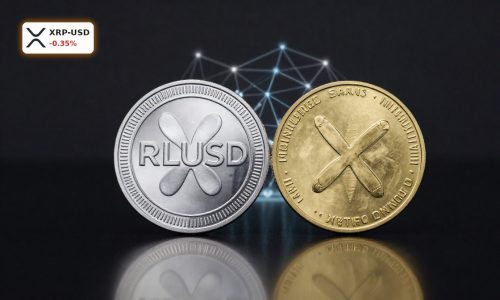
The XRP Ledger has integrated Boundless, a ZKP-based privacy layer that allows “hidden” smart contracts and escrow accounts on-chain. Until now, all XRP Ledger transactions were fully transparent; amounts, senders, and recipients were visible to anyone scanning the ledger. That level of openness is fine for retail users but problematic for banks or large corporates that cannot expose balances, pricing, or counterparties to the public. With the Ripple Technology Upgrade, transaction details for tokenized assets and stablecoins such as RLUSD can be shielded from public view while still being mathematically verified by the network.
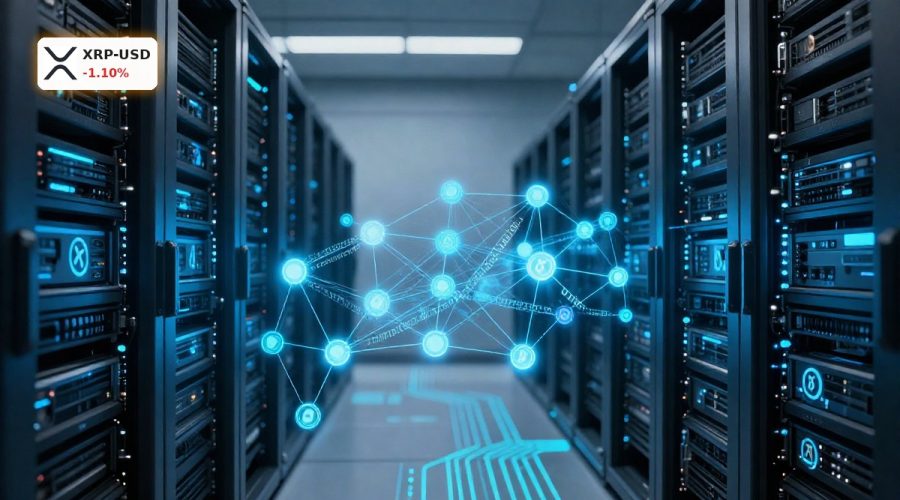
Under the hood, the upgrade introduces a full zkVM (zero-knowledge virtual machine), enabling complex computations to be executed off-chain. Only a compact cryptographic proof is committed to the main ledger, confirming that the computation followed the rules. This mirrors what privacy-oriented projects on other chains are attempting, but here it is wired directly into the XRP Ledger’s existing infrastructure and consensus, rather than relying on a separate rollup or sidechain.
Crucially for compliance-sensitive institutions, the privacy layer is designed to coexist with “blind” verification workflows for KYC and AML. A bank can confirm that a user is not on sanctions lists or that a transaction satisfies regulatory checks, without exposing personal data or full transaction trails to all network participants. That architecture directly targets the pain point that has kept many traditional finance players from touching public blockchains.
Is Ripple now a stronger competitor to Ethereum and Solana?
For U.S. investors used to thinking in terms of Ethereum and Solana, the Ripple Technology Upgrade effectively narrows the feature gap. Ethereum offers rich smart contracts but relatively weak default privacy. Solana focuses on throughput, with privacy generally left to specialized protocols. XRP now combines its long-standing strength in fast, low-cost payments with native ZKP-based privacy and an integrated zkVM, positioning the ledger for use cases like interbank transfers, trade finance, and corporate treasury management.
This is not an attempt to displace Ethereum as the base layer for decentralized finance or to challenge high-performance chains that host consumer apps and gaming. Instead, it is a targeted expansion of XRP’s capabilities to capture flows that today run through opaque bank messaging systems like SWIFT. If large financial institutions begin to move real settlement volumes onto the XRP Ledger, the strategic impact for the broader crypto market could be comparable to moments when NVIDIA’s GPUs became indispensable to AI workloads or when Apple successfully pulled banks into Apple Pay.
The team behind the upgrade is already working on “Smart Vaults” as a next stage, which could bring programmable, privacy-preserving custody structures to the network. For Wall Street-facing custodians and fintechs, that could make XRP infrastructure more attractive as a white-label product than building bespoke private chains from scratch.
What does the Ripple Technology Upgrade mean for XRP’s price?
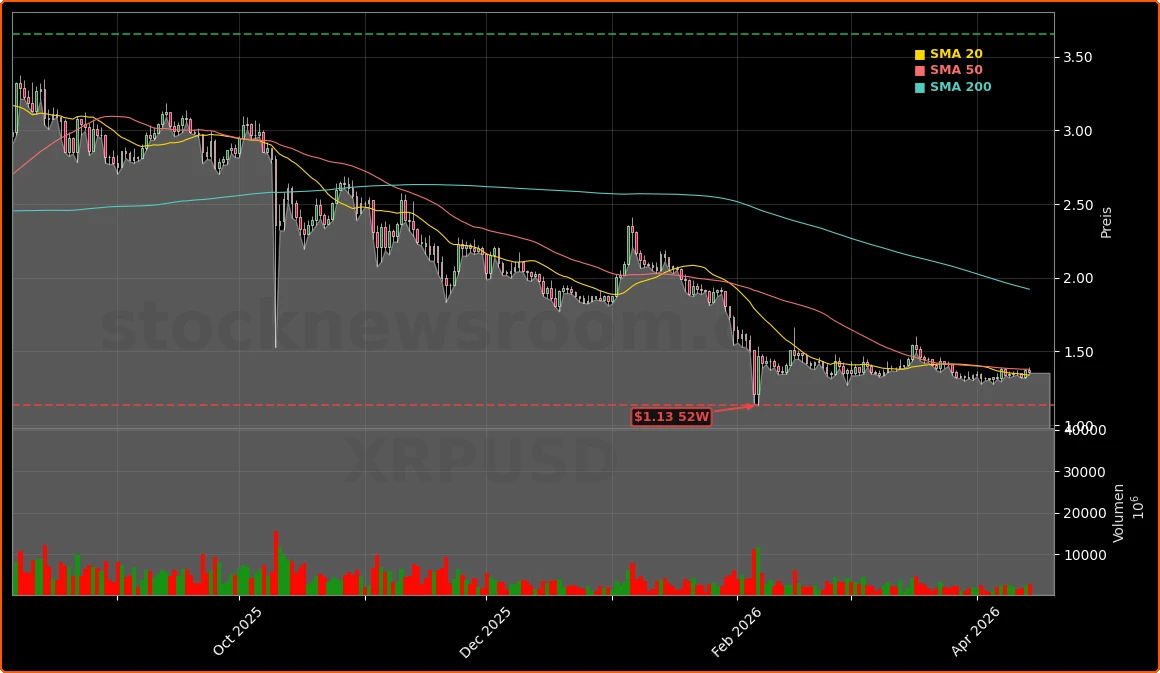
On the market side, XRP trades around $1.36, slightly below the previous close of $1.38, down about 1.1% on the day. Over the past 20 sessions, the token has been locked in a tight range under $1.40, with shrinking liquidity and muted volumes. On Binance, XRP’s 30‑day liquidity index has fallen to its lowest level since 2021, and the 30‑day trading volume—around 3.77 billion XRP—is among the weakest in years. Such conditions often precede a sharper move once new catalysts or capital flows appear.
Exchange-flow data hint at reduced immediate selling pressure: the seven-day average shows withdrawals up to roughly 53% of flows, while deposits have slipped to about 46%, levels last observed before a major 2025 rally. Spot and futures cumulative volume delta both point to fading aggressive selling, while funding rates have turned slightly positive and open interest has climbed toward $769 million. Technically, a daily close above $1.40—aligned with the 50-day moving average—could open a window toward the $1.60–$1.67 area, where an estimated $250–$300 million in leveraged positions are vulnerable to liquidation within a 10% swing in either direction.
Despite the new Ripple Technology Upgrade, mainstream Wall Street research houses like Citigroup, Goldman Sachs, and Morgan Stanley have not published headline-grabbing formal price targets on XRP in the way they routinely do for large-cap equities such as Tesla or megacap tech names. Instead, one of the clearest institutional reference points comes from Standard Chartered, which has floated a bullish—but still more modest—target of $28 for XRP by 2030, assuming the network secures a central role in global payments.
Can XRP really reach $50 in this cycle?
Speculation that XRP could reach $50 in the coming years has spread across investor forums, but the math is stark. At that price, XRP’s market cap would exceed $3.0 trillion—roughly 36.5 times its current valuation and more than double Bitcoin’s present market capitalization. It would also surpass the current total crypto market cap, an outcome that would require an extreme reordering of digital asset hierarchies and unprecedented institutional uptake of XRP as a settlement asset.
Former Ripple CTO David Schwartz has argued that a $50 target cannot be dismissed outright but remains unlikely under normal conditions. His reasoning is rooted in market efficiency: if rational investors truly believed there were even a 10% probability of XRP hitting $50–$100 within a few years, they would not allow the token to trade anywhere near $1.36 today. The market’s current pricing suggests that, in aggregate, investors see a far lower probability of that outcome than social media narratives imply.
More grounded bullish scenarios cluster in the $5–$10 range, tied to regulatory clarity and gradual institutional adoption. In Washington, proposals like the CLARITY Act aim to codify a commodity-like status for certain digital assets, which could materially improve institutional comfort with XRP. Geopolitical risk, especially tensions in the Middle East, still pushes many asset allocators toward gold and U.S. Treasuries instead of high-volatility crypto. A more stable macro backdrop, combined with bank-centric use cases made possible by the Ripple Technology Upgrade, would likely be necessary to sustain a multi-fold move in XRP rather than a speculative spike that quickly retraces.
For now, the core takeaway for investors is that the Ripple Technology Upgrade significantly enhances the XRP Ledger’s institutional appeal at a time when on-chain and derivatives data hint at a potential breakout setup. Whether that translates into a durable re-rating toward double-digit prices will depend less on message-board enthusiasm and more on how quickly real-world payment flows migrate from legacy rails onto XRP.