Can MicroStrategy Bitcoin Financing via STRC keep powering billion‑dollar BTC buys without breaking the stock or the balance sheet?

How does MicroStrategy Bitcoin Financing through STRC work?
MicroStrategy’s latest move underscores how its MicroStrategy Bitcoin Financing model has evolved from traditional convertible notes into a preferred-share funding engine. Between April 6 and April 12, the company sold 10.03 million STRC preferred shares, generating about $1.001 billion in net proceeds. Management then deployed this capital to acquire 13,927 Bitcoin at an average price of $71,902 per coin, without issuing new common stock.
STRC is designed to trade near par at $100 and currently pays an 11.5% annual coupon in monthly installments, making it resemble a high-yield income instrument with indirect exposure to Bitcoin. The security has become MicroStrategy’s primary funding vehicle, with more than $3.8 billion already raised since launch and roughly $21.6 billion of capacity still available in the at-the-market (ATM) program. For investors, this structure shifts dilution risk away from common shareholders and onto preferred investors who accept yield plus Bitcoin-linked volatility.
The company now controls about 781,000 BTC, up from roughly 762,099 BTC at the end of March. That places the firm within striking distance of BlackRock’s IBIT spot Bitcoin ETF holdings and cements its position as the largest corporate Bitcoin owner globally. In effect, MicroStrategy Bitcoin Financing via STRC allows equity holders to maintain leverage to BTC upside while preserving share count, a core part of CEO Michael Saylor’s playbook.
What did the latest STRC volume spike signal?
On Monday, STRC recorded a new all-time high daily trading volume of about $1.1 billion, easily surpassing the previous record of $746 million set on March 12. The surge came just ahead of Wednesday’s dividend cutoff date, a period when institutional buyers often accelerate purchases to secure the upcoming 11.5% annualized cash payout. This pull-forward in demand typically feeds directly into the following week’s Bitcoin purchases, creating a self-reinforcing capital-raise-and-deploy cycle.
For Wall Street traders, the pattern is becoming clearer: heightened STRC activity into a dividend record date often foreshadows another sizable BTC acquisition. With an estimated $21.6 billion still unused in the STRC ATM shelf, there is ample room for the company to repeat this cycle multiple times if Bitcoin prices and investor appetite remain supportive. That potential pipeline is one reason MSTR is frequently used as a high-beta proxy for Bitcoin exposure by hedge funds and active traders on the NASDAQ and in European venues such as Milan and Luxembourg.
At the same time, insider Form 144 filings have shown modest ongoing sales of MSTR Class A shares by executives and affiliates in recent weeks. These disposals are relatively small compared with the firm’s overall capital structure, but they remind investors that governance, compensation, and timing around equity sales deserve scrutiny when a company pursues such an aggressive leveraged strategy.
How is MicroStrategy stock trading versus other tech names?
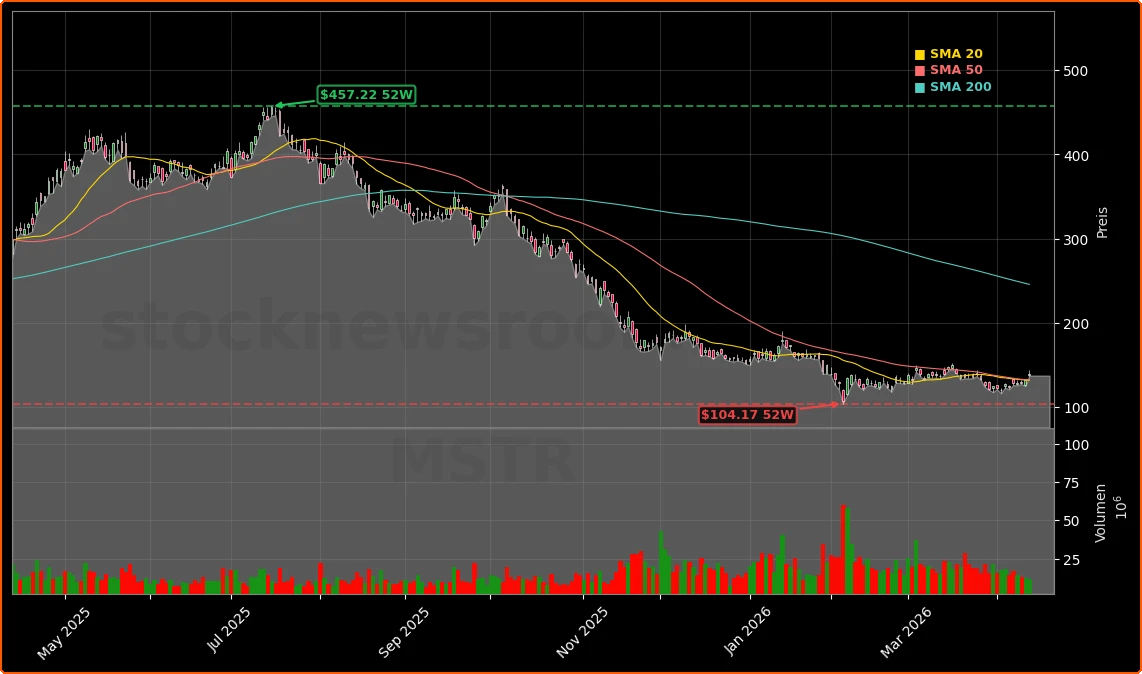
MSTR recently traded around $139.33, up about 5.27% from the previous close of $134.86. The stock has been volatile, moving largely in tandem with Bitcoin rather than with the broader NASDAQ or S&P 500 technology cohort. Unlike mega-cap AI and cloud leaders such as NVIDIA, Apple and Tesla, MicroStrategy’s valuation is driven less by software multiples and more by the market value of its Bitcoin holdings and the perceived sustainability of its financing model.
Research platforms tracking the stock highlight its dual identity as both a business intelligence software company and a de facto Bitcoin holding vehicle. Some analyst commentaries, including buy-rated views from houses like TradingKey’s featured coverage, emphasize strong growth optionality but flag solvency risk if Bitcoin were to experience a deep, prolonged drawdown. While no major U.S. investment bank has recently published a widely cited new target in the public domain, past ratings from Goldman Sachs, Morgan Stanley, and Citigroup have generally stressed the unusually high risk-reward profile compared with more diversified tech peers.
In portfolios, MSTR often sits alongside crypto miners and Bitcoin ETFs rather than next to typical software-as-a-service names. For investors already heavily allocated to AI winners or EV plays like Tesla, adding MicroStrategy is less about software exposure and more about tactical leverage to Bitcoin’s next bull or bear leg.
What should investors expect from upcoming Q1 2026 earnings?
MicroStrategy has scheduled the release of its Q1 2026 financial results for Tuesday, May 5, 2026, after the close of U.S. markets, followed by a live video webinar at 5:00 p.m. ET on Zoom and simulcasts on X and YouTube. Management is expected to discuss the impact of recent Bitcoin acquisitions, the performance of the core analytics software business, and the evolving economics of the STRC program.
Key metrics to watch include the carrying value and fair value of the company’s Bitcoin stack, interest and dividend costs associated with STRC and other instruments, and any updated commentary on regulatory or accounting developments affecting digital assets. Investors will also look for data points on software license growth, cloud migration trends, and AI-powered analytics demand, which remain crucial for supporting the firm’s valuation beyond pure Bitcoin speculation.
Analysts from firms such as JPMorgan, RBC Capital Markets, and Citigroup will likely focus their post-earnings notes on leverage ratios, liquidity, and the break-even Bitcoin price that would keep MicroStrategy’s balance sheet comfortably above water. Any hint of additional MicroStrategy Bitcoin Financing waves via STRC could become a central topic on the call’s Q&A segment.
Related Coverage
Investors who want a deeper dive into the risks behind this aggressive strategy can review the analysis in “MicroStrategy Bitcoin Strategy Record-Sized Risk Warning”, which examines whether the company’s escalating BTC bet is a visionary balance-sheet revolution or a leveraged time bomb. The same article, available at this link, also places MicroStrategy in the broader context of crypto-linked equities and highlights key stress scenarios for equity holders.
MicroStrategy Bitcoin Financing via STRC has now funded another $1 billion Bitcoin purchase, lifting total holdings toward 800,000 BTC while keeping common stock dilution in check. For U.S. investors, the stock remains a high-conviction but high-volatility tool to express a directional view on Bitcoin alongside core tech positions. The next catalyst will be the Q1 2026 earnings call on May 5, where management’s guidance on further STRC issuance and BTC accumulation could determine whether the current rally in MSTR can extend into the next quarter.