Can Cloudflare’s latest AI security push with Wiz and Mesh really move the needle for NET shareholders after today’s price drop?

Why did Cloudflare drop on an AI security day?
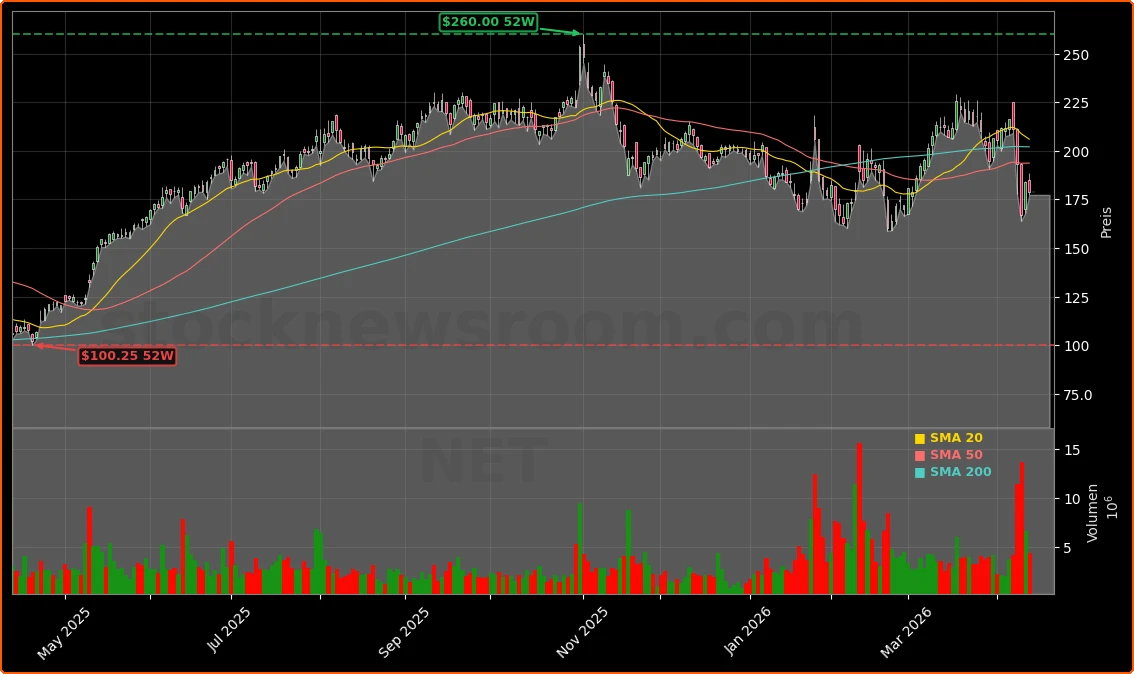
On a day dominated by new Cloudflare AI Security news, the stock moved the wrong way. NET closed at $178.65, down from a previous close of $184.97 (-2.92%), with only a marginal after-hours uptick to $178.68 as of late Tuesday. That weakness stands out against a technology sector that gained about 1% and sits near recent highs on the NASDAQ and S&P 500.
Technically, NET is trading roughly 6.9% below its 50-day simple moving average and 7.2% under its 100-day SMA, underscoring a cooling trend after a strong 12‑month run of about 68%. With the relative strength index near 43, the stock is in neutral territory rather than deeply oversold, suggesting room for additional downside if sentiment deteriorates. Key resistance looms near $203.50, while support around $159 has contained prior pullbacks.
For U.S. investors, the message is clear: even compelling Cloudflare AI Security headlines are not enough on their own in a market that has already priced in heavy AI optimism across leaders like NVIDIA, Apple and other cloud names.
What does the Wiz deal add to Cloudflare AI Security?
The new partnership with Wiz, now part of Google Cloud, is designed to give security teams a single view of all AI-powered applications across their environment. Cloudflare is integrating its Cloudflare AI Security for Apps directly into the Wiz Security Graph, creating what it claims is one of the most complete maps of an organization’s AI footprint.
The combined stack targets problems that CISOs increasingly flag: hidden chatbots, copilots and AI search endpoints that are deployed by developers without security oversight and become “shadow AI” risks. Cloudflare’s edge network inspects every request to large language model (LLM) endpoints, looking for prompt injection, sensitive data leakage and unsafe topics, while Wiz maps where AI models touch critical data stores and production systems.
By synchronizing Cloudflare’s security rules with Wiz’s risk context, teams can prioritize vulnerabilities based on real-world exploitability, not just theoretical exposure. That play aligns directly with spending trends in U.S. cybersecurity budgets, where AI-native protection is starting to move from proof-of-concept into line items alongside traditional endpoint and cloud security tools from players like NVIDIA’s partner ecosystem, Palo Alto Networks and CrowdStrike.
How does Cloudflare Mesh change the AI agent story?
Beyond Cloudflare AI Security for apps, the company is also attacking the networking side of the AI stack with Cloudflare Mesh. Mesh is pitched as a private networking fabric built for AI agents rather than humans, allowing developers to encrypt every connection between people, code and agents without exposing databases or internal APIs to the public internet.
Instead of clunky VPNs or hand-built tunnels, Mesh lets organizations plug laptops, offices and multicloud environments like AWS and Google Cloud into a single, software-defined private network that rides on Cloudflare’s global infrastructure. In that network, every AI agent gets its own identity, enabling fine-grained policies—for example allowing a coding assistant to touch a staging database but blocking access to production finance systems.
Mesh also ties deeply into the Cloudflare Developer Platform, including Workers, Workers VPC and an Agents SDK, giving developers an end‑to‑end lifecycle: write an agent, host it on Workers, grant scoped access via Workers VPC bindings and enforce policies at the network edge. For U.S. software teams racing to deploy internal copilots and workflow bots, the product aims to reduce both operational friction and regulatory risk.
How is Wall Street reading these Cloudflare AI Security moves?
Despite the strategic fit, Cloudflare’s latest Cloudflare AI Security and Mesh announcements have not sparked a fresh rally. Investors appear to be weighing the long‑term opportunity against near‑term valuation and macro risk ahead of the May 7 earnings report.
Street expectations call for Q1 EPS of about $0.12, down from a prior forecast of $0.16, even as revenue is projected to climb to roughly $622.45 million from $479.09 million a year earlier. That mix—fast top-line growth but tighter margins—helps explain why some analysts have recently fine‑tuned their targets rather than aggressively upgrading. Citigroup maintains a Buy rating and lifted its price target to $265 in February, while Jefferies holds a Hold stance with a $225 target. On Monday, Mizuho reiterated an Outperform rating but trimmed its target to $235, a nod to valuation concerns even as it stays bullish on the long-term AI thesis.
For portfolio managers benchmarking against the S&P 500 and NASDAQ-100, the stock’s heavy representation in cybersecurity and mid‑cap growth ETFs such as HACK, MID and WCBR also matters. Large inflows or outflows from those vehicles can amplify moves in NET, especially on catalyst days like this one.
How does Cloudflare stack up against AI infrastructure peers?
Cloudflare’s narrative increasingly sits at the application and networking edge of the AI stack, complementing chip-centric stories at NVIDIA and auto‑scale compute from the large hyperscalers. While Tesla pushes AI into autonomy and robotics, and Apple leans into on‑device intelligence, Cloudflare is positioning itself as the connective tissue that secures how AI workloads talk to data and users across the internet.
That positioning places NET in a different risk‑reward bucket than pure-play SaaS or GPU names: its growth depends on enterprises moving beyond pilots and deploying mission‑critical AI agents and apps at scale, which can be lumpy. The latest Cloudflare AI Security and Mesh initiatives are built to capture that wave once it breaks, but today’s price action shows that Wall Street is waiting for clearer proof that these innovations will accelerate billings and free cash flow.
Related Coverage
For a deeper dive into how competitive pressure is shaping the NET story, including recent volatility around Anthropic’s Claude Code and other rivals, see Cloudflare AI Competition: -12.8% Crash Tests AI Hype, which examines whether recent weakness is just a reset or the start of a broader SaaS repricing. Investors focused on the broader AI trade should also read NVIDIA Quantum AI +3.5% Surge as Ising Models Hit, where we explore whether new quantum‑inspired models can extend the AI chip supercycle that underpins valuations for leaders across the space.
AI agents are a standard in modern developer workflows, but they’re being throttled by a networking model that was designed strictly for humans.— Matthew Prince, Cloudflare CEO
In summary, Cloudflare AI Security and the launch of Mesh reinforce Cloudflare’s ambition to be a core security and networking layer for the AI era, even as the stock digests big past gains. For investors, the key question is whether these products can convert into higher‑margin, recurring revenue fast enough to justify premium multiples. The upcoming May 7 earnings report will be the next checkpoint on whether Cloudflare’s AI security bet is starting to pay off for Wall Street portfolios.