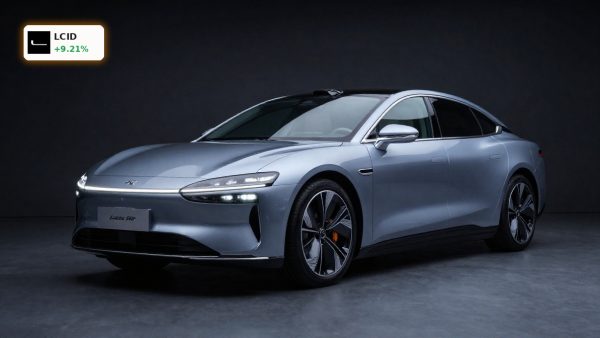
Can the Lucid Strategy of ultra-premium EVs survive mounting losses, recalls and a sharp share-price slide before cash runs thin?

Is Lucid Group’s valuation still defensible?
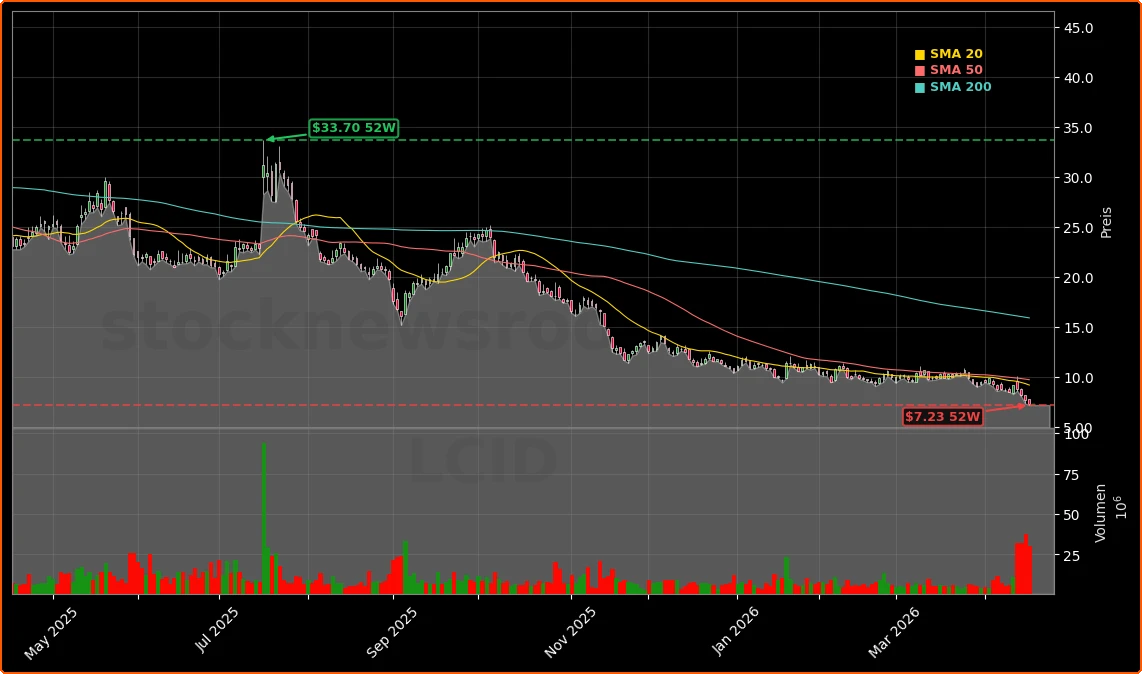
At around $7.30 per share, Lucid Group, Inc. commands a market capitalization near $2.4–$2.7 billion, a fraction of rivals but still high relative to its limited scale. Rivian sits closer to $20 billion, while Tesla exceeds $1 trillion, yet Lucid trades at a higher price-to-sales multiple than many EV peers. Recent trading shows LCID below both its 50‑day and 200‑day moving averages, reflecting persistent selling pressure and a consensus “Reduce” rating among analysts.
Royal Bank of Canada (RBC Capital) recently cut its price target from $10 to $8 and kept a “Sector Perform” rating, explicitly signaling only modest downside but no near-term rerating upside. TD Cowen analyst Itay Michaeli likewise slashed his target from $19 to $10 while maintaining a “Hold” stance, citing execution risk and slower progress. With the stock already below RBC’s new target, the market appears to be discounting the Lucid Strategy more harshly than Wall Street models suggest.
How does Lucid Strategy fit the high-end EV niche?
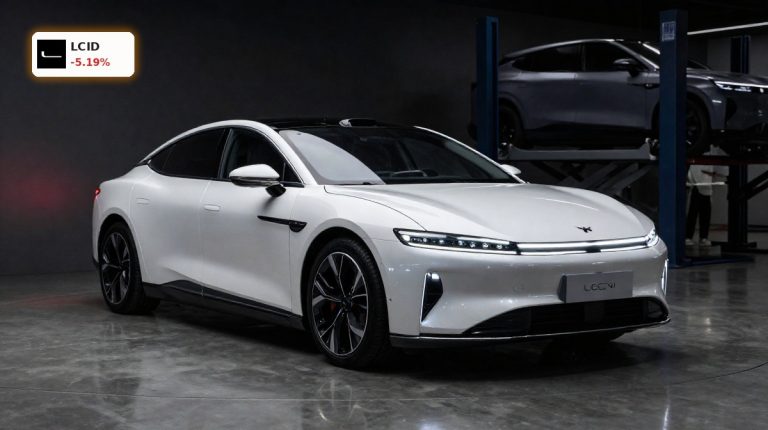
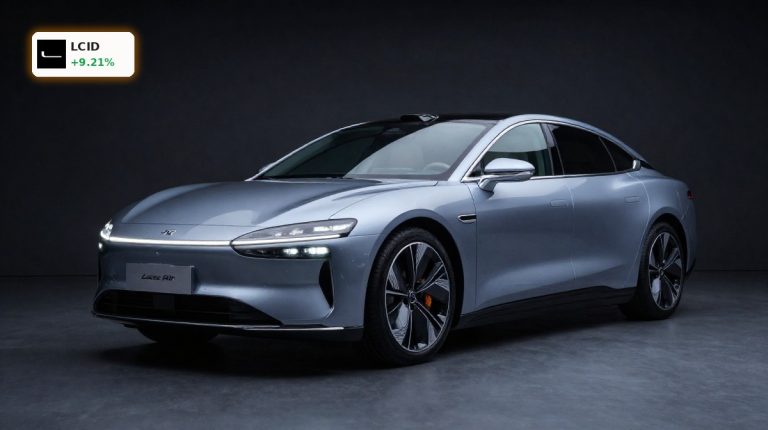
From day one, the Lucid Strategy has been to differentiate with technology and luxury instead of volume. The Lucid Air sedan targets the top end of the market with long range and high performance, followed by the Gravity SUV. On paper, this approach offers strong brand positioning and premium pricing, but it also concentrates risk in a relatively small customer segment while burning large amounts of cash.
Q1 2026 production reached about 5,500 vehicles, with only 3,093 delivered as a temporary supplier quality issue in second-row seats disrupted deliveries, particularly for the new Gravity model. Management reaffirmed full-year production guidance of 25,000–27,000 units, but the gap between production and deliveries — plus the need for recalls — raises fresh questions about operational execution. For U.S. investors, the core concern is whether this Lucid Strategy can ever scale to the kind of volumes needed to cover fixed costs and move toward profitability.
Are delivery issues and recalls eroding trust?
The near-term narrative around Lucid Group, Inc. is dominated by recalls and delivery disruptions. A recent recall of 3,627 Lucid Air vehicles in the U.S. over a drivetrain defect that could cause sudden power loss sparked one of the worst trading days for LCID in a year. This came on top of weaker-than-expected first-quarter deliveries and prior recalls touching both Gravity SUVs and some Air models for issues like rearview camera malfunctions.
These problems are not unusual for young automakers, but they arrive at a time when investors have become far less forgiving of execution missteps across the EV space. Dozens of EV start-ups over the past decade have gone bankrupt or disappeared after failing to bridge the gap from prototype to profitable production. The Lucid Strategy depends on convincing the market that its capital-intensive ramp will be different — but extended stretches of negative gross margins and ongoing recalls make that a tougher sell.
Can Lucid Strategy pivot toward affordable EVs?
A major weak spot in the Lucid Strategy is the absence of a true mass-market vehicle today. Tesla generates the bulk of its auto revenue from models under $50,000, and Rivian plans to launch its first sub‑$50,000 vehicle this summer. By contrast, Lucid has only outlined a roadmap: a mid-sized, more affordable model to be built in Saudi Arabia by late 2026, followed by two additional lower-cost models targeted for 2028 and 2030.
That long-dated timetable worries investors. Scaling a mass-market car is notoriously difficult — Tesla nearly failed during the Model 3 ramp — and Lucid will have to juggle global manufacturing, supply chains and quality control while still funding its premium lineup. Backing from Saudi Arabia’s Public Investment Fund and strategic partners such as Uber provides capital and strategic rationale, but these stakeholders may prioritize industrial or geopolitical goals over near-term shareholder returns. For U.S. portfolio managers, the question is whether to wait years for this pivot or rotate into better-positioned EV names now.
How does Lucid compare to other EV and tech plays?
From a Wall Street perspective, Lucid sits in an awkward middle ground. It lacks the scale, profitability and AI-driven narrative of leaders like NVIDIA or Apple, yet trades at a premium to many auto manufacturers on revenue multiples. Rivian, for example, trades at roughly 3.7 times sales versus about 6 times sales for Lucid, despite Rivian being closer to launching an affordable model and pushing toward operating leverage.
For growth-focused investors, that makes LCID a high-risk, high-uncertainty bet relative to alternatives in both the EV and broader tech complex. Until the Lucid Strategy delivers clearer proof of demand, cost control and a credible mass-market product roadmap, many U.S. investors may prefer diversified exposure through the NASDAQ or S&P 500, or direct stakes in better-capitalized EV leaders.
Related Coverage
For a deeper dive into whether LCID’s latest slide represents a value trap or a chance to buy the dip, readers can explore this Lucid Group forecast analysis, which weighs downside risk against long-term upside scenarios. To better understand the competitive backdrop, including how autonomous driving and chips could reshape the EV landscape, it is also worth reading about Tesla’s latest AI push in the Tesla Robotaxi and AI5 chip rally, which highlights how software and semiconductors may determine the next phase of EV winners.
In summary, the Lucid Strategy of leading with luxury while promising future affordability is under real pressure as the stock trades near 52-week lows, analysts cut targets and operational missteps accumulate. For U.S. investors, LCID now represents a speculative turnaround story rather than a core EV holding, with a rich valuation that demands flawless execution. The next few quarters of deliveries, recall management and concrete progress toward mid-priced models will be critical in showing whether the Lucid Strategy can regain Wall Street’s confidence.