Is the latest NVIDIA Forecast finally catching up with reality, or are Wall Street’s trillion‑dollar AI bets still too cautious?

Is the NVIDIA Forecast still conservative?
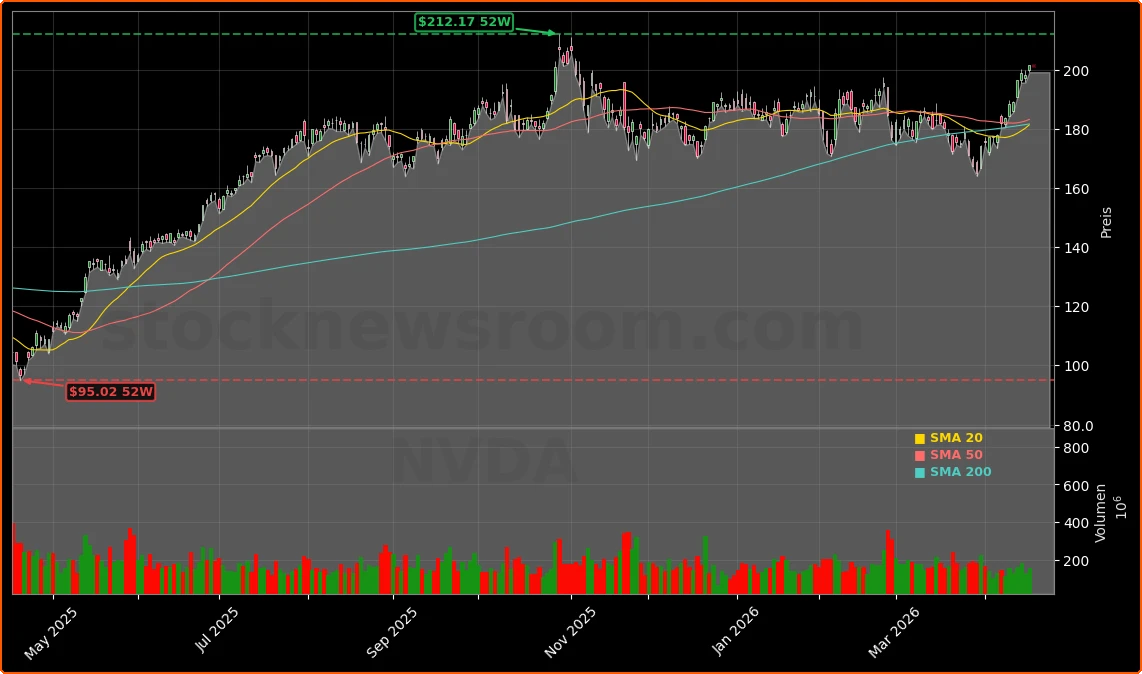
Shares of NVIDIA (NVDA) finished the regular session at $201.68 on Friday, up 1.68%, before slipping modestly in after‑hours trading to $200.96. Even after a relatively flat six‑month stretch, the stock has climbed again in recent weeks and remains one of the heaviest weights in the S&P 500, Nasdaq 100, and major ETFs like QQQM and SMH. Data‑center chips now drive more than 90% of revenue, tying the NVIDIA Forecast tightly to enterprise AI spending and hyperscaler capex.
Rosenblatt Securities recently rebuilt its long‑term model after management meetings and lifted its Nvidia price target to $325, one of the highest on Wall Street. Analyst Hans Mosesmann’s team (via Rosenblatt) values NVDA at roughly 25x fiscal 2028 EPS of $13, backed by over $1 trillion in combined Blackwell and Rubin revenue potential through 2027 and at least another $25 billion from Rubin Ultra and Vera in late fiscal 2028. Zacks Investment Research currently rates NVDA a #1 “Strong Buy,” with a forward P/E around 24.5 and a PEG ratio near 0.6, implying PEG‑adjusted undervaluation versus the broader semiconductor group despite headline sticker shock.
Buffalo Business & Estate Services and Western Financial Corp CA both added to NVDA positions in Q4, even amid notable insider selling, underscoring how institutional portfolios continue to treat the name as core AI infrastructure exposure rather than a tactical trade. Multiple MarketBeat‑tracked managers now list NVDA as a top‑three holding, and consensus price targets cluster around $275, well below Rosenblatt’s call but still implying double‑digit upside from current levels.
How strong is the near‑term growth runway for NVIDIA?
The bull case in the current NVIDIA Forecast begins with the recent blow‑out quarter. For Q4, NVIDIA Corporation posted $68.13 billion in revenue, up 73% year over year and ahead of the Street by nearly $2 billion, with non‑GAAP EPS of $1.62 versus expectations of $1.53. Data‑center revenue surged 75% to $62.3 billion, and purchase commitments jumped 90% sequentially to $95.2 billion, signaling that hyperscale and sovereign AI customers are locking in capacity well into 2027.
Management guided Q1 fiscal 2027 revenue to around $78 billion, roughly 7% above prior consensus. Street models summarized by Zacks point to more than 60% annual revenue growth and triple‑digit EPS expansion in the upcoming report, as Blackwell ramps and legacy gaming and professional visualization segments recover. Analysts at firms like Bank of America, Truist, Raymond James, and Wolfe Research, whose price targets run from the mid‑$200s to $300, largely agree that GPUs remain supply‑constrained, not demand‑constrained, at least through 2026.
At the same time, competitive pressure is intensifying. Advanced Micro Devices (AMD) is aggressively pushing its Instinct accelerators into data centers, seeking to carve out AI share with potentially lower total cost of ownership, while cloud giants from Alphabet and Amazon to Microsoft and Meta are designing in‑house AI silicon to reduce their long‑run dependence on NVDA. The NVIDIA Forecast now has to assume a world where NVDA keeps a premium performance lead but no longer owns every incremental dollar of AI inference spend.
NVIDIA Forecast vs. edge and quantum AI strategies
To blunt those risks, NVIDIA is clearly looking beyond cloud training. Jensen Huang has repeatedly framed the next battlefield as edge AI—local inference on PCs, smartphones and humanoid robots rather than in remote data centers. While rumors that NVDA might acquire a PC maker such as Dell or HP were quickly denied by the company, the strategic logic behind the speculation reflects a real concern: whoever controls the chip inside client devices could control the next era of AI usage.
Today, Apple dominates silicon inside its own hardware, while Qualcomm and others supply much of the Windows and Android ecosystem. That leaves NVIDIA focused on reference designs, RTX‑powered PCs, and software stacks like CUDA, TensorRT, and Omniverse to pull client vendors into its orbit without sacrificing its high‑margin profile. Meanwhile, Wall Street is already starting to treat NVDA as the “brain” supplier for emerging humanoid robotics platforms, further expanding the long‑term TAM priced into the NVIDIA Forecast.
Another piece of the forward strategy is quantum. NVIDIA Corporation has begun offering open AI models tailored for quantum computing and using its GPUs as quantum simulators, giving developers a bridge to gate‑based quantum systems that are not yet commercially mature. That approach positions NVDA as the software and tooling layer even if future quantum hardware ends up being built by others. Critics from quantum‑first firms argue that today’s GPU‑driven AI is too energy‑hungry, but for now, NVDA’s role as the orchestration layer across classical and quantum resources could deepen its moat.
What are the risks for U.S. investors now?
Despite the optimism embedded in the prevailing NVIDIA Forecast, caution flags are visible. The stock is heavily owned across U.S. retirement accounts, major index funds, and thematic AI ETFs; one strategist recently joked that America’s pension system is “levered to NVIDIA,” a shorthand for how concentrated modern portfolios have become. If AI capex normalizes faster than expected or regulatory and geopolitical shocks hit data‑center spending, NVDA’s sheer index weight could amplify downside in the S&P 500 and Nasdaq.
Valuation is another pressure point. Even with a sub‑sector forward P/E, NVDA trades at a significant premium to peers like Micron and AMD on sales and free cash flow multiples. Some analysts see better 12‑month percentage upside in second‑tier AI hardware and optical networking names now benefitting from the same build‑out that NVDA sparked. Still, for long‑term investors who believe in a decade‑long shift toward AI‑native infrastructure, NVDA’s combination of chips, software, and ecosystem lock‑in remains unmatched.
Related Coverage
For a deeper dive into how quantum efforts could reshape the NVIDIA Forecast, including autonomous Ising labs and their impact on AI infrastructure, see “NVIDIA Quantum AI Boom: Ising Labs Shock the Quantum Race”. Investors comparing NVIDIA’s premium to other AI names may also want to review “Palantir Valuation +2.5% Rally: How Much Risk Now?”, which examines how far AI multiples can stretch before sentiment turns.
Ultimately, the current NVIDIA Forecast hinges on whether AI data‑center spending can compound into the 2030s while edge and quantum strategies open new profit pools. For U.S. investors, NVDA remains a cornerstone AI exposure but with index‑level risk attached. The next few earnings reports and product cycles will show whether this trillion‑dollar narrative continues to justify staying overweight the stock.