Can NVIDIA Quantum AI’s autonomous Ising labs really pull quantum computing forward years—and rewrite the AI infrastructure race in the process?

Is NVIDIA Quantum AI changing the quantum timeline?
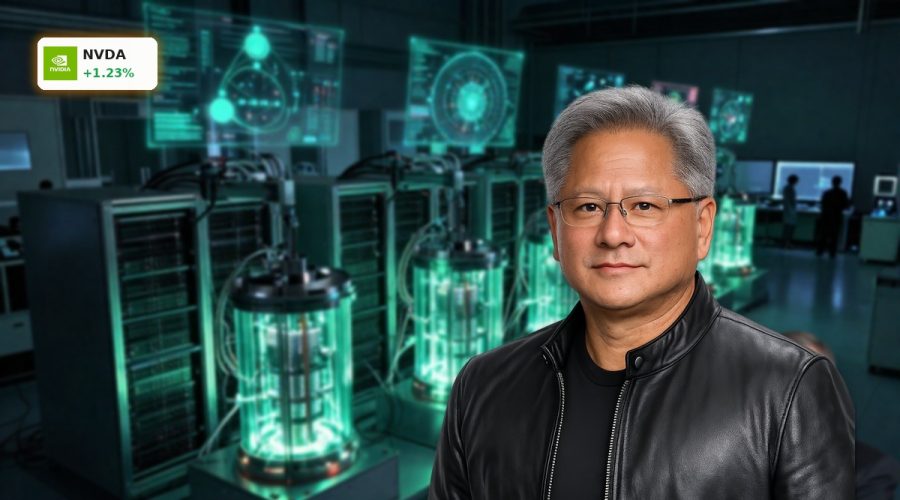
The newest catalyst for NVIDIA Quantum AI comes from a working prototype of an autonomous quantum computing laboratory built around the company’s open‑source Ising models. Quantum start‑up EeroQ and orchestration specialist Conductor Quantum have linked EeroQ’s electron‑on‑helium quantum processor directly to NVIDIA’s Ising quantum AI stack, allowing AI agents to run, monitor, and tune experiments in real time using natural‑language prompts. The system successfully executed advanced quantum protocols such as electron manipulation and detection with minimal human oversight, demonstrating that AI can act as a de facto operating system for quantum hardware.
Ising is designed to tackle foundational quantum problems like processor calibration and error correction, long‑standing bottlenecks that have slowed efforts by Rigetti, IonQ and others to scale systems. NVIDIA’s CEO Jensen Huang has argued that the Ising approach can correct quantum output errors up to three times faster than traditional methods, a step toward large‑scale, reliable quantum computers that enterprise customers will actually pay to use. That prospect has helped ignite a four‑day rally in listed quantum names, as traders bet that NVIDIA Quantum AI will accelerate commercialization across the sector, not just on NVIDIA’s own balance sheet.
How does NVIDIA’s quantum push fit the AI supercycle?
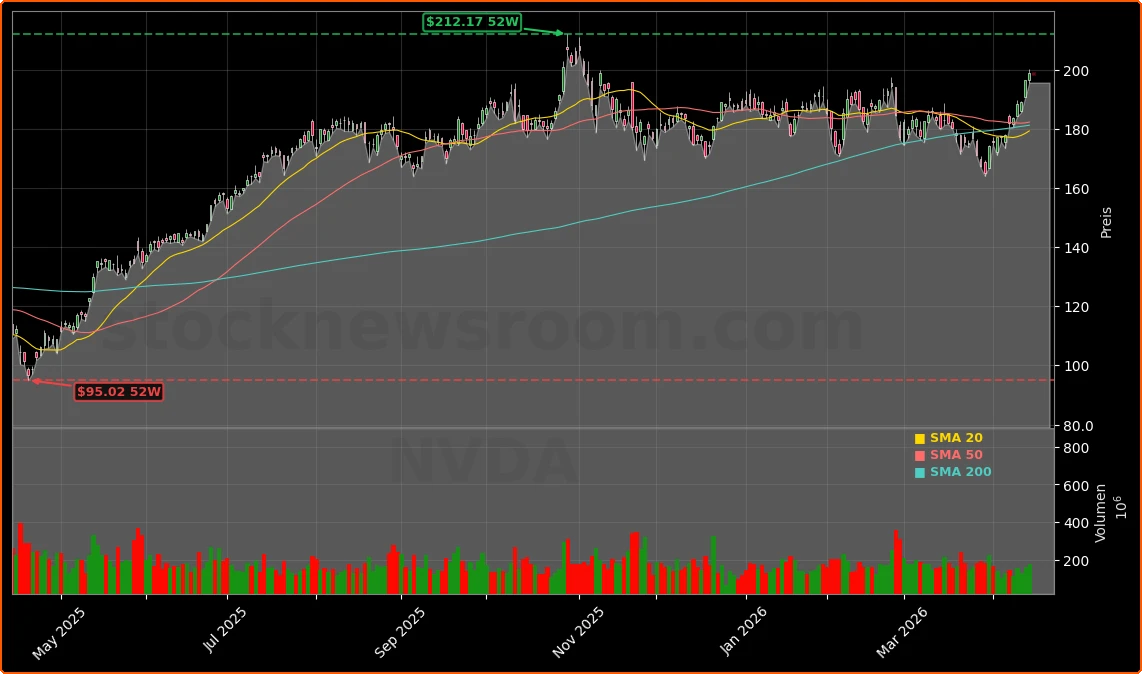
The quantum move lands in the middle of a broader AI infrastructure boom that continues to underpin NVDA’s equity story. Despite a choppy start to 2026 for growth stocks, NVIDIA has reported accelerating revenue growth, with year‑over‑year gains near 73% in the last quarter and Wall Street expecting 79% growth in Q1 2026 and 85% in Q2. That is extraordinary for what is now the world’s most valuable publicly traded company by market cap, worth around $4.8 trillion and recently the first to cross the $5 trillion mark before a modest pullback.
BlackRock recently highlighted a potential 80% earnings surge across the semiconductor complex into 2026, naming leaders like NVIDIA and AMD as primary beneficiaries of sustained AI infrastructure spending. BNP Paribas echoes that optimism, reiterating a bullish stance on NVDA with a price target of $270—roughly 40% upside from current levels—arguing that the “AI party isn’t over” as next‑generation platforms like Blackwell and Vera Rubin ramp and supply bottlenecks ease. At less than 23 times forward earnings, many institutional investors still view the multiple as reasonable relative to the growth profile.
Where does NVIDIA sit versus AMD and other rivals?
In GPUs, AMD remains a distant number two, hoping its upcoming MI450 accelerators and ROCm software can chip away at NVIDIA’s CUDA‑centric moat. AMD is touting higher‑bandwidth memory configurations to compete with NVIDIA’s future Rubin chips, and hyperscalers from the NASDAQ‑100 are increasingly pursuing multi‑vendor strategies to negotiate pricing and reduce dependency on any single supplier. Meta’s AI investments, for example, have flowed toward both Broadcom and AMD even as NVIDIA still commands the lion’s share of AI accelerator budgets.
Yet the ecosystem advantage continues to favor NVIDIA. Cadence Design Systems has just expanded its partnership with the company to accelerate semiconductor and physical AI system design, using NVIDIA CUDA‑X, Omniverse libraries and the Cadence Millennium M2000 supercomputer to deliver up to 100x faster engineering simulations. Cadence is also integrating its physics engines with NVIDIA’s robotics AI models to speed robot training—another adjacency where NVIDIA Quantum AI‑style workflows and digital twins can eventually extend from bits to atoms, including quantum devices.
What are the risks for NVIDIA investors now?
Not everything in the NVIDIA story is one‑way upside. Warranty costs for the GPU business surged to roughly $894 million in 2025, about a tenfold increase year over year, as VRAM prices rose and warranty expense climbed from 0.1% to 0.9% of revenue. While manageable against a rapidly expanding top line, such figures remind investors that scaling complex hardware at breakneck speed carries operational and reputational risks. Any repeat of quality problems in a future generation could weigh on margins and sentiment.
There is also macro and concentration risk. Semiconductor ETFs like SMH and SOXX have returned over 120% in the past year, heavily powered by NVIDIA’s outsized weightings; in some funds, NVDA alone accounts for more than 10–13% of assets. A sharp correction in NVIDIA or fellow AI bellwethers such as Apple and Tesla would quickly feed through to passive vehicles and retail portfolios. Hedge funds including Citadel have warned that geopolitical shocks—such as a disruption in the Strait of Hormuz—could pressure global supply chains and data‑center capex, directly impacting NVIDIA’s order book.
How big could NVIDIA Quantum AI become?
The strategic bet is that NVIDIA Quantum AI will ensure the company remains central even if compute gradually migrates from classical GPUs to hybrid and fully quantum systems in the 2030s. By embedding Ising‑style AI agents into quantum experiment loops today, NVIDIA is positioning its software, libraries and accelerated computing stack as indispensable across both domains. For long‑term investors, that acts as an additional call option on top of the existing AI data‑center thesis.
Analysts are already modeling aggressive hardware sales, with Jensen Huang projecting $1 trillion in processor revenue from the Blackwell and Vera Rubin lines across 2026 and 2027 alone. If revenue growth stays elevated and valuation multiples hold anywhere near current levels, NVDA’s market cap could double again by 2030, with quantum‑aligned software and tools—driven by NVIDIA Quantum AI—providing incremental upside.
Related coverage
For a deeper dive into how the Ising model launch initially moved the stock, readers can review NVIDIA Quantum AI +3.5% Surge as Ising Models Hit, which examines the first market reaction and the implications for the ongoing AI chip supercycle. Investors interested in the broader competitive landscape around hyperscaler capex should also read Meta AI Strategy Boom: Broadcom and AMD Bets Shake Up AI Chips, detailing how Meta’s chip sourcing strategy with Broadcom and AMD may shape the next phase of AI infrastructure spending.
This demonstration is just the beginning of what’s possible when combining AI with next-generation quantum hardware.— Nick Farina, CEO and Co-founder of EeroQ
With Ising models enabling autonomous quantum labs, hyperscalers still ramping AI spending and major houses like BNP Paribas calling for further upside, NVIDIA Quantum AI keeps NVDA firmly at the center of both today’s AI build‑out and tomorrow’s quantum era. For U.S. portfolios, that combination of current cash‑flow strength and optionality around quantum computing remains hard to match, even amid elevated volatility and execution risks. The next few quarters of earnings and quantum‑related milestones will show whether NVIDIA can sustain this momentum and translate its early lead into durable, cross‑generation dominance.