Is Wall Street finally revaluing the Microsoft AI Strategy after months of doubt and a sharp pullback from its 2025 peak?

Is Wall Street Repricing Microsoft’s AI Risk?
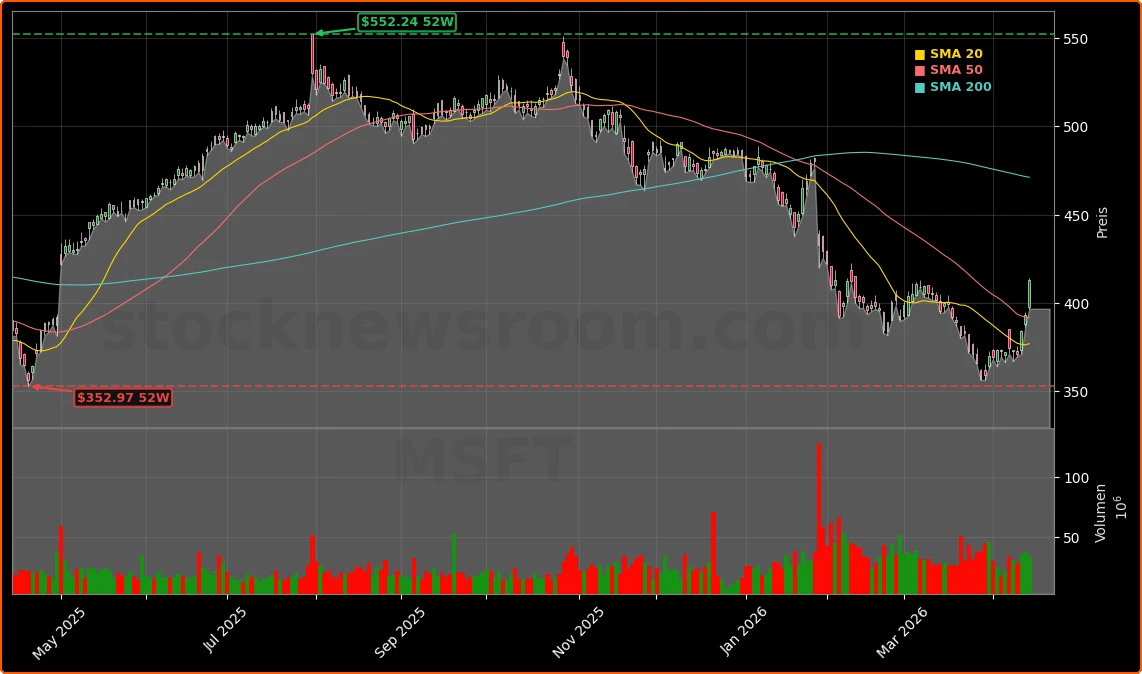
Microsoft climbed 5.11% on Wednesday to $413.07, extending a multi‑day rebound that has seen software and AI bellwethers snap back after a difficult start to 2026. The stock remains roughly one‑third below its October 2025 closing peak near $542, reflecting months of worry that artificial intelligence could erode demand for legacy software subscriptions.
Those fears are starting to look overdone. A recent survey of IT and cybersecurity executives by KeyBanc showed strong adoption and satisfaction with Microsoft’s Copilot assistants, Azure cloud AI services and security tools, suggesting AI is reinforcing rather than replacing the company’s software footprint. KeyBanc maintains an Overweight rating and a $600 price target on the shares, implying meaningful upside from current levels if the Microsoft AI Strategy delivers on its monetization potential.
On a fundamental basis, the stock trades at about 24.6x earnings and 9.6x sales, both slightly below the software peer averages in a recent industry comparison, while still generating a double‑digit return on equity. That combination of growth, profitability and only modest premium pricing is one reason institutional and even political investors — such as U.S. Senator John Boozman, who disclosed MSFT purchases in March — continue to treat Microsoft as a core holding.
How Aggressive Is Microsoft’s AI Spending?
CEO Satya Nadella has pushed the Microsoft AI Strategy into high gear, with the company now spending roughly $30 billion per quarter on AI‑related infrastructure, chiefly Azure data centers, accelerators and networking. Nadella has compared the current transition to the early PC era, warning that AI‑driven displacement across job categories is inevitable and urging workers to upskill, particularly in software development, one of the areas he expects to be reshaped fastest by generative tools.
A key part of this investment wave is securing and optimizing compute. Microsoft is repurposing capacity planned for OpenAI into its own facilities, including a planned high‑power data center project in Narvik, Norway, where expanded work with local partner Nscale will support European AI demand. At the same time, Microsoft is rolling out its in‑house Maia 200 AI accelerator and Cobalt 200 CPU, aimed at running large‑scale AI workloads and improving general cloud efficiency inside Azure. These chips are designed to reduce dependence on external suppliers such as NVIDIA over time and improve unit economics as AI usage scales.
Demand backdrop looks supportive. Industry forecasts for AI inference servers call for a jump from roughly $25 billion in 2024 revenue to more than $130 billion by 2034. Microsoft has already locked in multiyear AI infrastructure and cloud deals, including a multibillion‑dollar commitment from Nebius and long‑term AI partnerships with hyperscalers and customers ranging from enterprise software vendors to autonomous driving startups.
Where Does Microsoft Stand Versus Software Peers?
Within the software universe, Microsoft’s financial profile remains formidable. EBITDA of about $58 billion and gross profit above $55 billion tower over the industry averages, reflecting the scale of Windows, Office, Azure and LinkedIn. Recent revenue growth of 16.7% slightly outpaces the broader software group, even after the stock’s drawdown pulled valuation multiples back toward the sector mean.
Debt metrics also look conservative. A debt‑to‑equity ratio of roughly 0.15 leaves Microsoft in a stronger balance‑sheet position than many large peers like Oracle and ServiceNow, giving it flexibility to keep funding AI infrastructure through the cycle. That matters for U.S. investors comparing AI platforms: while newer pure‑play names often carry higher growth expectations and richer multiples, they usually lack Microsoft’s free‑cash‑flow engine and diversified revenue base.
The market is already acknowledging this resilience. Technology and communication services now lead the S&P 500 sector performance on several strong sessions, with Microsoft, Apple and other “Magnificent Seven” names helping to drive the NASDAQ 100’s longest winning streak since 2021. Yet the group’s forward P/E around 22.5x — now in line with defensive consumer staples — suggests the market is no longer paying a huge premium for mega‑cap growth.
Can the Microsoft AI Strategy Turn Users Into Profits?
The real test for the Microsoft AI Strategy is monetization. The company has more than 450 million commercial users across email, documents and workflows, and over 3.7 million businesses rely on its software stack. Almost 486,000 organizations run workloads on Azure, including about 85% of the Fortune 500. That embedded base gives Microsoft a direct path to upsell Copilot, AI security and automation features on a per‑workload basis, even if AI reduces the number of traditional per‑seat licenses over time.
Early signs of this shift are emerging. Cloud revenue recently surpassed $50 billion in a single quarter, up 26%, with AI‑driven services a growing piece of the mix. Microsoft is also testing new Copilot security features for corporate clients, similar to OpenClaw‑style protections, that could be unveiled at the Microsoft Build conference in June — another potential catalyst for usage‑based pricing.
For Wall Street, the question is whether this massive installed base, plus custom silicon and a global data center footprint, allows Microsoft to thrive while more narrowly focused SaaS vendors struggle with AI cannibalization. Some growth managers now see Microsoft as positioned to benefit from AI disruption rather than fall victim to it, even as they look for higher‑beta opportunities in names like Tesla or AI infrastructure partners such as Arista Networks.
Related Coverage
Investors who want a deeper dive into long‑term cloud and AI monetization can read “Microsoft AI Strategy Boom: Can a $625B Cloud Bet Pay Off?”, which analyzes how Azure’s backlog and Copilot upsells could drive the next decade of profits. For a sector comparison, “ServiceNow Forecast +7.7% Rally: Is the AI Boom Still Safe?” looks at how another major software platform is navigating AI‑driven volatility and what that might imply for broader enterprise IT budgets.
In summary, the Microsoft AI Strategy combines heavy quarterly infrastructure spending, proprietary chips and a deeply entrenched enterprise base at a valuation that has reset closer to the market average. For U.S. investors, that mix of scale, balance‑sheet strength and AI optionality makes Microsoft a central test case for whether mega‑cap tech can turn generative AI from a perceived threat into the next leg of earnings growth. With multiple product catalysts ahead and sentiment already shifting, the next few quarters should show whether this strategy can fully re‑ignite the stock’s long‑term uptrend.