Is Palantir’s soaring AI valuation a glimpse of the future of defense data or a textbook case of bubble pricing?

Is Palantir Technologies now priced for perfection?
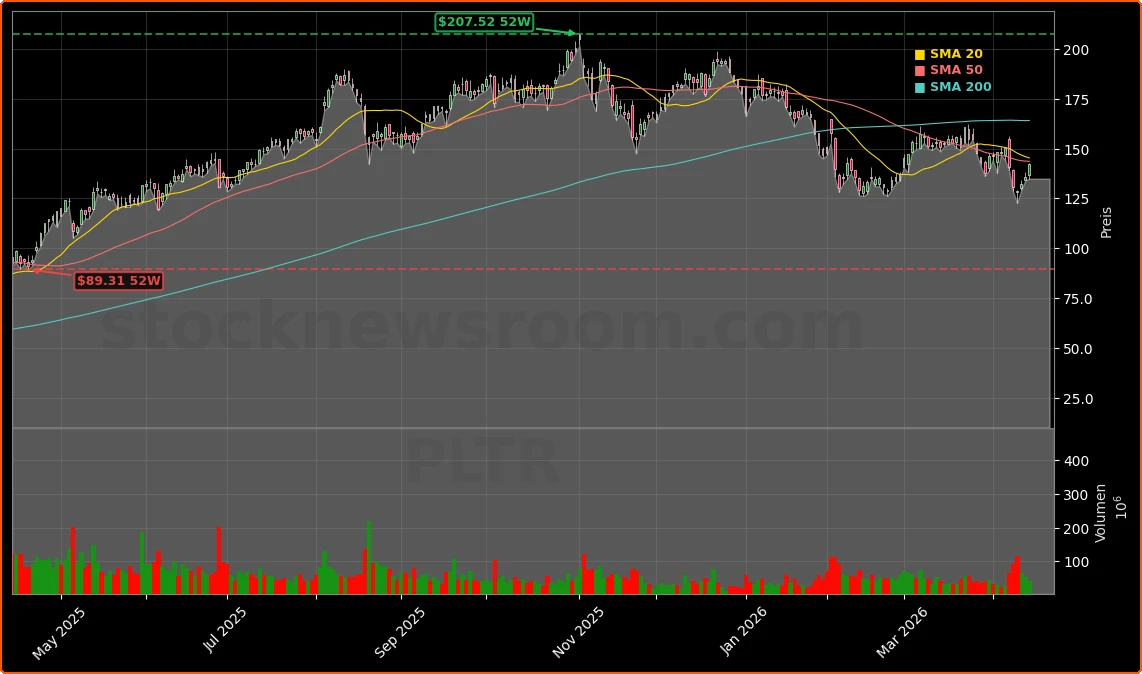
Wall Street’s latest leg of the tech rebound has pushed high‑beta AI names back into focus, and Palantir Technologies Inc. is near the center of that trade. The stock is up roughly 3,000% from early 2023 lows at one point, before pulling back about 35% from its all‑time high. Even after that correction, Palantir still trades at a trailing P/E of 215 and a price‑to‑sales (P/S) ratio of 77.8, towering above a software peer average P/E of 66 and P/S of 8.3.
Those numbers explain why Palantir AI Valuation has become a flashpoint. Bulls argue that 70% year‑over‑year revenue growth to around $1.4 billion last quarter, expanding profit margins at 32% over the last 12 months, and surging U.S. commercial demand—up 137%—justify a structural premium. Bears counter that even optimistic scenarios leave little room for error at today’s price, particularly as AI competition intensifies and large customers scrutinize software budgets.
In the broader context, software and AI have been leading a rebound in the Nasdaq 100, with a major software ETF up more than 6% in just two sessions and mega caps like NVIDIA and Microsoft also rebounding. Palantir’s 6% gain over the same stretch shows how quickly momentum money is returning to high‑growth AI stories.
How stretched is Palantir AI Valuation versus peers?
On almost any traditional metric, Palantir screens as one of the most expensive software stocks in the world. Its P/E of 215.4 is about 3.25 times the sector average, while its price‑to‑book of 43.9 is roughly 4.5 times peers. The P/S multiple near 78 is more than nine times the industry mean, and dramatically higher than other high‑quality compounders like Adobe, Salesforce or Intuit, which trade in the single‑digit P/S range.
There are offsetting positives beneath those headline multiples. Return on equity stands at 8.7%, above the software group’s 7.2%, and Palantir’s revenue growth of 70% dwarfs the roughly 22% average. The balance sheet is also conservative, with a debt‑to‑equity ratio of just 0.03, meaning the company relies far less on leverage than many large‑cap tech peers.
Yet profitability metrics still lag. EBITDA of about $580 million and gross profit of $1.19 billion are both below industry averages on an absolute basis, even as the market assigns Palantir a higher enterprise value than many better‑established franchises. That disconnect lies at the heart of the Palantir AI Valuation debate: investors are paying today for a scale and margin profile that may be many years away.
Growth runway: defense, space and commercial AI
Palantir’s core pitch is that it sits at the intersection of AI, data analytics and national security. Its Gotham and Foundry platforms power mission‑critical decision‑making for Western‑aligned governments and Fortune 500‑scale enterprises, and its newer Artificial Intelligence Platform (AIP) aims to help organizations safely deploy AI on sensitive data—a niche where generic models like those from Anthropic or OpenAI may not suffice.
The company is leaning into fast‑growing defense verticals such as counter‑drone intelligence, where it is one of several players building AI systems to combine video and radio‑frequency signals for threat detection. It is also a visible presence at major industry events like the Space Symposium, where defense contractors, space firms and AI companies increasingly overlap—evidence of Palantir’s positioning as infrastructure for the digital battlefield and space economy.
On the commercial side, remaining deal value in that segment has swelled to roughly $4.4 billion, and Palantir recently signed 61 contracts of at least $10 million each in a single quarter. Management and some bullish investors see a path from roughly $4.5 billion in annual revenue toward $10 billion or more over the next several years as AI adoption spreads beyond early adopters in finance, healthcare and manufacturing.
What are the key risks behind the premium?
Even bulls acknowledge that the total addressable market may be more constrained than for horizontal cloud platforms run by Apple or Tesla‑scale consumer ecosystems. Palantir remains a specialist in high‑end AI analytics for large enterprises and governments, a space that may not support hundreds of billions of dollars in annual spend. That raises questions about how long revenue can compound at current rates before growth inevitably slows.
Valuation math underscores the concern. If revenue eventually reached $20 billion with an exceptional 40% net margin, annual net income would total $8 billion—implying a forward P/E of about 39 on today’s market cap. That outcome would require years of flawless execution, continued shareholder dilution for stock‑based compensation and minimal competitive disruption. Any disappointment on growth, margins or contract renewals could compress multiples quickly.
Investor behavior also hints at caution. Short interest has been rising in defense‑heavy ETFs where Palantir is a major holding, signaling bets that valuations in the group have run too far. One prominent trader recently highlighted heavy insider selling—roughly $460 million by management around the $140–$150 band—and flagged technical resistance in that zone, maintaining a tactical short with a target near $110–$120. Meanwhile, option‑income ETFs tied to Palantir and structured notes bundling the stock with names like Netflix and Tesla suggest Wall Street is monetizing volatility rather than betting unanimously on further upside.
Related coverage
For a deeper dive into how Palantir’s blowout quarter is feeding directly into this debate, including the latest 70% earnings surge and AI‑driven contract wins, see Palantir Earnings +70%: Record AI Boom vs. Rich Valuation. If you want to compare Palantir AI Valuation with a more mature mega‑cap AI story, our look at Microsoft’s recent rebound in Microsoft AI Strategy Soars +5.1% in Surprise Rally explores how Wall Street is re‑pricing large‑scale AI platforms across the NASDAQ 100.
Palantir is being priced today as if its niche in AI analytics can support megacap‑level economics for years to come; that makes execution risk and competitive dynamics far more important than any single quarter.— Maik Kemper, Editor in Chief, stocknewsroom.com
Ultimately, Palantir AI Valuation reflects a market that is willing to pay up for scarce, fast‑growing AI infrastructure tied to defense and critical industries, but also one that is increasingly sensitive to overextension after a massive run. For U.S. investors, the stock remains a high‑beta way to express conviction—or skepticism—about the longevity of the current AI super‑cycle. The next few quarters of contract wins, margin trends and political scrutiny over issues such as federal tax payments will be crucial in determining whether today’s premium multiple proves sustainable or sets up the next major reset.