Is Palantir’s soaring valuation a durable AI winner’s premium or a fragile bubble priced for perfection?

Is Palantir Technologies now priced for perfection?
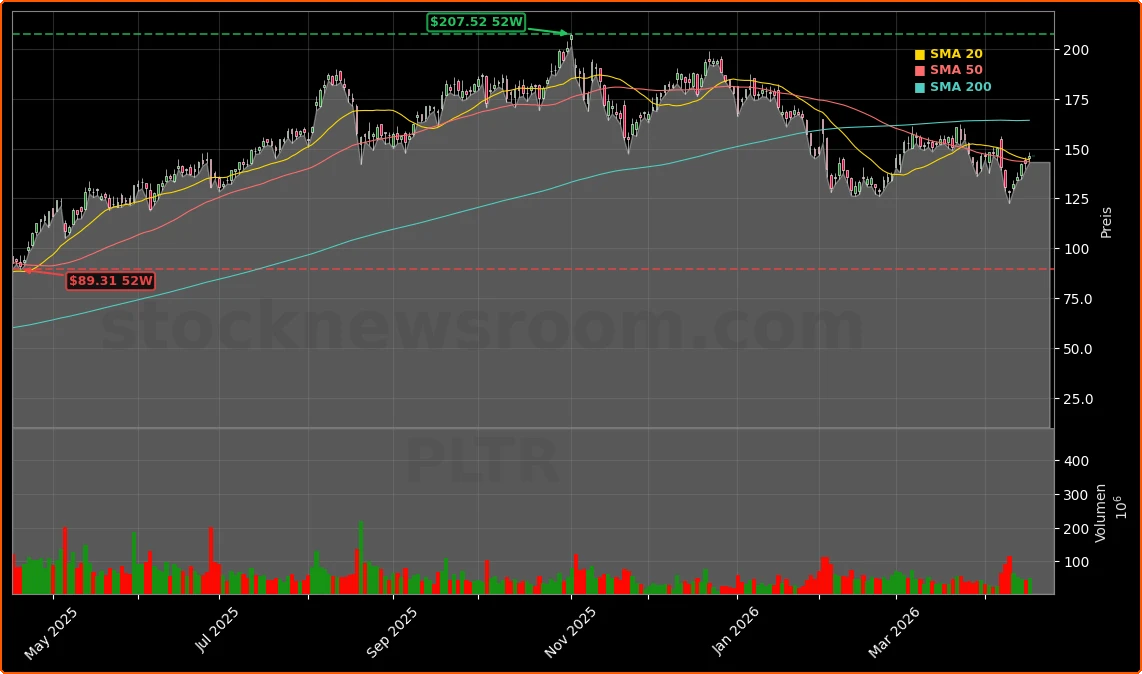
At $146.39, Palantir’s market capitalization embeds a growth story that few software names can match. The company’s AI‑driven decision‑intelligence platforms have helped it scale revenue to about $4.4 billion last year, a 56% increase, while turning sustainably profitable with earnings per share of $0.63. Wall Street projections see EPS roughly tripling by 2027 and revenue potentially surpassing $10 billion soon after, driven by demand from defense, intelligence, and commercial customers.
Yet the flip side of this success is a Palantir Valuation that looks stretched even by high‑growth tech standards. Based on trailing 12‑month earnings, the stock trades at roughly 180 times profits, compared with a sub‑25 multiple for the S&P 500. Even using optimistic forecasts around $2.50–$2.60 EPS in 2028, the current price still implies a forward P/E above 50, leaving little margin for error if growth slows or sentiment cools across the broader NASDAQ tech complex.
Morgan Stanley analyst Sanjit Singh recently highlighted what he calls a “strong setup heading into earnings,” citing resilient demand and rising adoption among large U.S. customers. Morgan Stanley sees a credible path toward $10 billion in annual revenue and has a $205 price target on the stock with an “Equal‑Weight” (Hold) rating, roughly in line with a “Moderate Buy” consensus and an average target near $194. While those targets suggest upside from current levels, they also imply Wall Street expects future gains to be significantly more modest than the explosive rally of the past five years.
How does Palantir Valuation compare with big AI peers?
On a simple earnings multiple, Palantir is more expensive than many large‑cap AI beneficiaries. Chip leader NVIDIA (NVDA), whose GPUs power much of the generative AI boom, trades at a rich but lower forward P/E. Mega‑caps like Apple (AAPL) and Tesla (TSLA) also command premium valuations for their growth and brand power, but their multiples are generally well below Palantir’s triple‑digit trailing P/E.
This gap reflects that Palantir is still earlier in its scaling journey, particularly on the commercial side, and that investors are assigning a scarcity premium to its defense‑AI positioning. The company’s visibility at events such as the Space Symposium 2026, where it appeared alongside names like SpaceX and L3Harris, underscores how deeply embedded it is in the evolving space and defense tech stack. That strategic relevance supports a lofty Palantir Valuation, but it does not eliminate execution and competitive risks.
Options‑based ETFs tied to PLTR, such as the YieldMax PLTR option income strategy ETF, are also proliferating. These vehicles aim to harvest premium from Palantir’s elevated volatility and rich option pricing, paying out sizable distributions to investors willing to trade away some upside. Their popularity is another sign that the stock has become a favorite among traders who are trying to monetize short‑term swings in a high‑valuation name, adding to potential near‑term turbulence.
Could competition and defense cyclicality hit Palantir?
While Palantir dominates the decision‑intelligence niche today, the barriers to entry for tech giants like Microsoft and Alphabet are relatively low. Both already operate massive cloud and AI infrastructure, and advances in quantum computing and large‑scale data processing could make it easier for them to push deeper into Palantir’s core markets. Smaller specialists such as BigBear.ai and established consultancies like Booz Allen Hamilton are also vying for slices of U.S. defense AI spending, targeting many of the same Pentagon and intelligence budgets.
The broader defense sector has recently seen pockets of profit‑taking as investors reassess wartime premiums. Rising short interest in defense ETFs with heavy Palantir exposure shows some on Wall Street are starting to question whether defense‑AI leaders have run too far, too fast. If geopolitical tensions ease or government budgets shift, growth rates for defense‑oriented software contracts could cool, pressuring the lofty Palantir Valuation and magnifying any disappointment relative to consensus expectations.
At the same time, bullish investors argue that the modern military’s dependence on software, data fusion, and AI‑enhanced decision‑making structurally benefits players like Palantir and NVIDIA. As more of the Pentagon’s spend migrates from hardware to digital infrastructure, Palantir’s platforms could become even more mission‑critical, supporting both revenue resilience and pricing power over time—key ingredients if the stock is to grow into its current multiple.
What should U.S. investors watch next on Palantir Valuation?
For American portfolios, Palantir now sits at the intersection of AI, defense, and high‑beta growth. The most important variables for the next leg of the story are clear: sustaining 30%+ revenue growth, expanding commercial penetration beyond government, and defending margins as competition intensifies. Any signs of slowing deal volume, weaker cloud‑related spending, or pricing pressure could trigger a rapid reset in Palantir Valuation given how much optimism is already in the price.
Short‑term trading sentiment remains mixed. Technical analysts on platforms like TradingView are split between those calling for further downside based on bearish chart patterns and those who see the recent pullbacks as attractive entry points ahead of upcoming earnings. Meanwhile, leveraged and income‑oriented PLTR‑linked ETFs, such as the GraniteShares 2x Long PLTR Daily ETF, underline just how popular Palantir has become among retail and momentum traders.
For long‑term investors, the calculus is more straightforward but demanding: Palantir must execute almost flawlessly, proving that its decision‑intelligence software can compound earnings fast enough to justify today’s elevated Palantir Valuation. That leaves little room for macro shocks or strategic missteps, but also offers meaningful upside if the company can convert its early‑mover advantage into a durable, cash‑generating AI moat.
Related Coverage
For a closer look at how defense contracts and AI deployments are driving sentiment in the name, read “Palantir AI Defense +70% Boom: Can This 2.5% Surge Last?”, which analyzes whether recent gains are the start of a sustained move or a sign of bubbly speculation. If you want to compare Palantir’s setup with another legacy software giant pivoting hard into AI, check out “Oracle AI Investments: 25% Rally Shock for Investors”, which breaks down how Oracle’s AI investments are reshaping expectations for mature tech stocks.
Ultimately, Palantir’s story remains one of exceptional growth wrapped inside an exceptional price tag. The current Palantir Valuation bakes in years of strong execution and continued dominance in defense and commercial AI, leaving investors with a classic high‑risk, high‑reward proposition. The next earnings prints and large contract wins will be crucial in showing whether the company can grow fast enough to make today’s multiple look reasonable rather than reckless.