Can Oracle AI Investments really justify a 25% weekly rally, or is Wall Street underestimating the risks behind the hype?

Why did Oracle surge more than 25% this week?
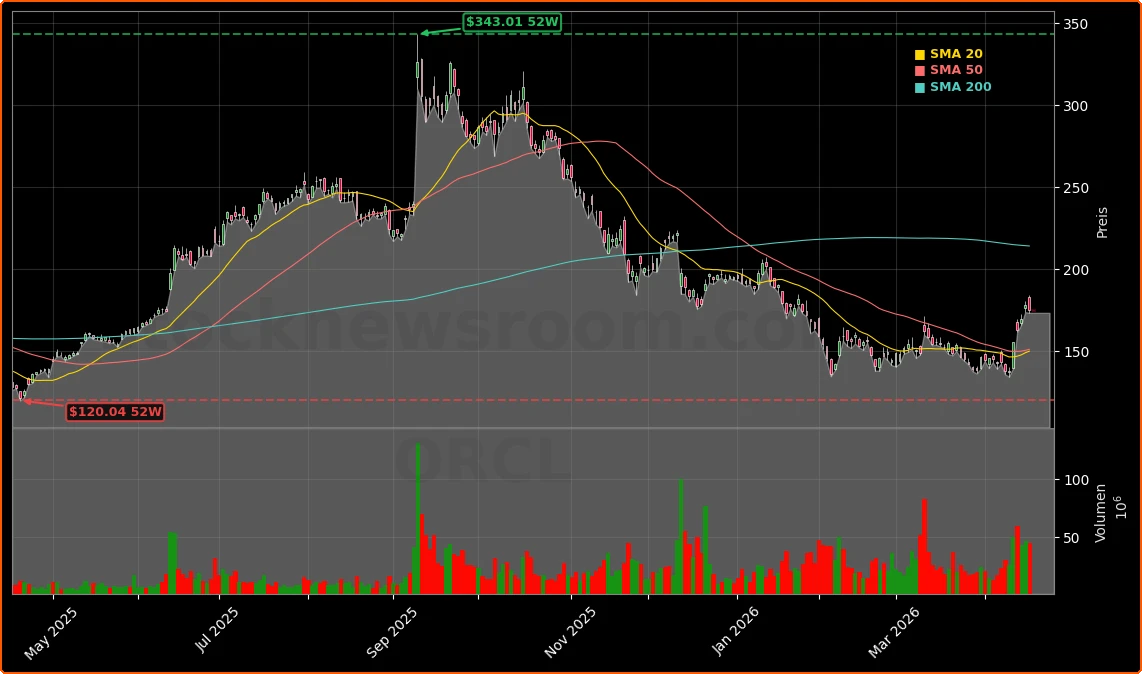
Oracle Corporation (ORCL) has been one of the standout movers in the software space, with the stock up roughly 25–27% on the week even after a mild pullback to $175.06 on Friday’s close and a small after-hours dip to $174.61. The rally comes as software as a group logged its strongest week in decades, helped by names like Oracle and Microsoft as tracked by major tech-focused ETFs. Investors are piling back into large-cap software and AI beneficiaries after a choppy first quarter for the NASDAQ and S&P 500 technology sector.
The move reflects a reset in expectations around Oracle AI Investments: markets had been spooked by how much capital companies such as Oracle, Microsoft and Alphabet were pouring into data centers, power and AI infrastructure with little immediate profit. With the latest contract momentum and AI database launches, investors are now giving Oracle more credit for potential long‑term cash flows, even as inflation and recession fears keep volatility high.
How are new contracts supporting Oracle’s AI story?
The latest leg of the rally has been underpinned by a string of high-profile contracts that directly reinforce Oracle AI Investments. One headline deal is Oracle’s expanded partnership with Bloom Energy, under which Oracle secured 2.8 gigawatts of Bloom’s fuel cell systems to power its AI infrastructure. This off‑grid, high‑efficiency power capacity is intended to sidestep congested utility grids and keep pace with surging AI workload demand, showing how deeply Oracle is committing capital to physical infrastructure.
On the customer side, Mizuho Bank, one of Japan’s top financial institutions, has selected Oracle Autonomous AI Database on Oracle Cloud Infrastructure (OCI) to modernize its core database operations. By automating security, management and disaster recovery, Mizuho expects lower operating costs and better resilience for AI‑enabled services. Wins like this increase OCI’s credibility against hyperscale rivals and help justify the heavy AI‑related capex.
Oracle has also positioned itself at the center of the multicloud trend. A newly announced collaboration with Amazon Web Services will provide high‑performance private connectivity between OCI and AWS, allowing enterprises to move data and run applications across both clouds more seamlessly. This is crucial for AI modernization strategies, as many large enterprises want to train and deploy models across multiple environments instead of locking into a single provider such as NVIDIA-centric GPU clouds or rivals like Apple’s in‑house stacks.
What makes Oracle AI Investments different from rivals?
Unlike some peers that emphasize consumer AI or advertising, Oracle is framing its AI push squarely around mission‑critical enterprise workloads. The new Oracle AI Database 26ai, with Platinum and Diamond availability tiers, aims to bake security and resiliency directly into the database, rather than bolting it on later. That approach targets banks, governments and large enterprises that can’t afford downtime or security gaps in agentic AI systems.
This focus pits Oracle directly against Tesla-style vertically integrated strategies (in their own industries) and hyperscalers such as Amazon, Microsoft and Google Cloud that are all bidding for large, regulated customers. For investors, Oracle AI Investments look more industrial and infrastructure-heavy than those of some software-only peers: from fuel cell power deals to data center expansion, the company is committing to a capital‑intensive model similar to what’s happening around AI chips at NVIDIA.
That also explains why parts of the market remain cautious. Dividend-focused investors are again weighing whether Oracle’s cash returns and current valuation justify the risk of an AI spending cycle that may not fully pay off for years. With fears that lingering inflation could still tip the U.S. economy toward recession, some portfolio managers prefer steadier dividend payers over aggressive growth stories, even when they involve blue chips like Oracle.
How are Wall Street products and analysts reacting?
Structured products are starting to lean into the volatility around Oracle AI Investments. Bank of Montreal is marketing $12.22 million in autocallable barrier notes linked to the performance of Microsoft (MSFT) and Oracle (ORCL). The notes offer a contingent 4.50% quarterly coupon (18% annualized) and can be called early if both stocks trade above preset levels, but investors risk principal losses if either stock trades below 50% of its initial level at maturity. This kind of structure shows demand for yield tied to Oracle’s AI‑driven narrative, but also underlines that Wall Street sees meaningful downside risk if expectations reset.
On the equity side, major brokerages including Citigroup, Morgan Stanley and Goldman Sachs have highlighted large-cap AI and software names — Oracle among them — as prime beneficiaries when the Federal Reserve eventually cuts interest rates. Lower yields would typically favor long-duration growth stories like AI infrastructure, which rely on future cash flows. While recent commentary has been broadly positive, investors should watch for any change in tone if Oracle’s capex outpaces free cash flow or if AI‑driven cloud growth slows.
Related Coverage: What other AI shifts matter?
Readers following Oracle AI Investments may also want to look at how its own risk profile is evolving. Our in‑depth piece “Oracle AI Risks +5% Rally: Debt and Cash Burn Warning” examines whether Oracle’s AI‑fueled surge can outrun a heavier debt load, negative free cash flow and its exposure to OpenAI‑driven workloads. For a broader sector lens, “Meta AI Layoffs +1.7% Surge as Efficiency Shock Hits” explores whether Meta’s AI‑related job cuts mark the start of a leaner, more profitable AI supercycle or signal early fatigue after record spending across the industry.
Overall, Oracle AI Investments have turned the stock into one of Wall Street’s most closely watched software names this month. The combination of new multicloud deals, power‑heavy infrastructure commitments and enterprise AI databases offers significant upside if demand remains robust. The next few quarters will show whether Oracle can convert its costly AI build‑out into durable growth and cash generation, and long‑term investors will be watching those metrics closely as they decide how much room to make for Oracle in AI‑tilted portfolios.