Can Oracle’s massive AI energy bet really rewrite its growth story on Wall Street, or is this just another hype-fueled spike?

How big is the Oracle AI Energy Deal?
Oracle Corporation has secured up to 2.8 gigawatts of fuel‑cell capacity from Bloom Energy in a master services agreement aimed squarely at powering AI and cloud data centers in the United States. An initial 1.2 GW tranche is already under contract and in deployment, with the first build‑out phase set to run into 2027. Industry forecasts that data‑center electricity demand could rise more than 200% by 2030 help explain why this Oracle AI Energy Deal, valued at roughly $21 billion over its lifetime, is drawing intense attention from AI‑focused investors.
To deepen the partnership, Bloom granted Oracle a warrant to purchase up to 3.53 million Bloom shares at $113.28 per share, a position with a notional value of about $400 million. With Bloom’s stock jumping roughly 15% after hours toward $203, Oracle is already sitting on a substantial paper gain versus the exercise price. For Oracle, the combination of long‑term power access and equity upside in a key supplier underlines how strategic the Oracle AI Energy Deal is for its data‑center roadmap.
What does this mean for Oracle on Wall Street?
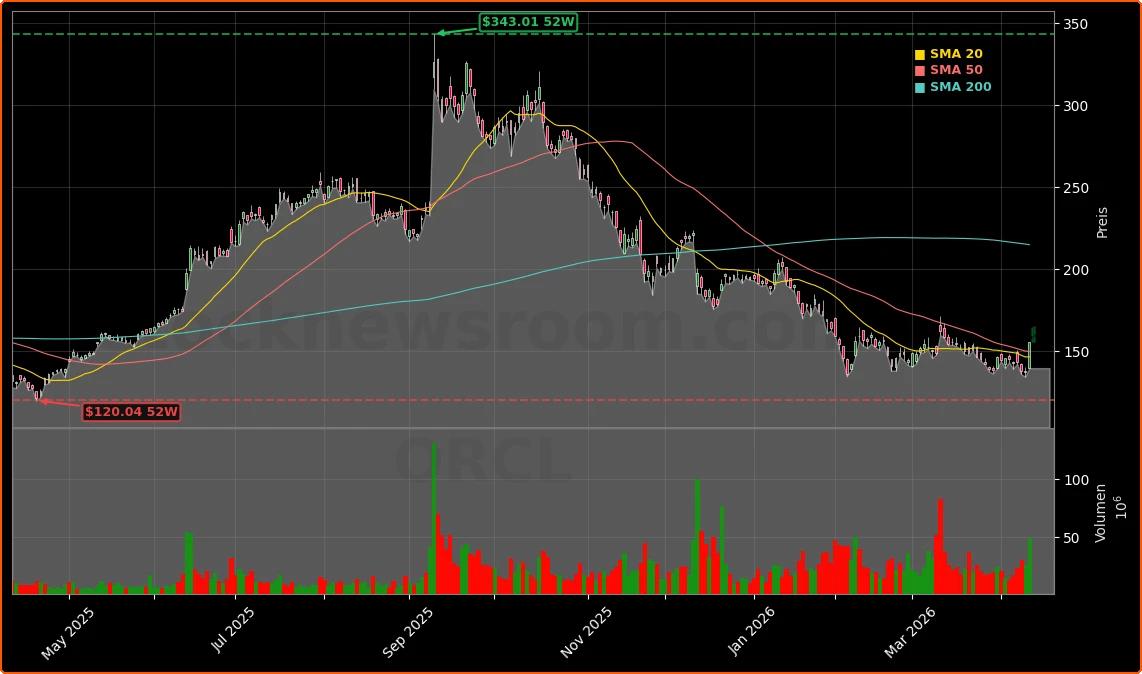
On Monday, Oracle stock closed at $155.62, up 12.69% on the day, making it one of the top performers in the S&P 500 and helping to spark a broader rebound in software names. Pre‑market indications around $164.46 (+5.68%) suggest momentum is continuing in Tuesday’s session. Despite the sharp move, the share price remains well below its 52‑week high of $345.72, leaving room for a re‑rating if the market gains confidence in the durability of Oracle’s AI earnings power.
Trading desks reported dip‑buying in large‑cap software and a rotation back into AI infrastructure plays after recent valuation fears. Oracle’s sizeable role in key technology ETFs amplified the move as passive flows chased the rally. While some investors see the Oracle AI Energy Deal as a long‑duration capital commitment, others view it as a necessary precondition to compete against hyperscale leaders like NVIDIA‑powered cloud providers and integrated ecosystems around Apple and Tesla that are also racing to secure dependable power and compute capacity.
How does Oracle’s AI push extend beyond energy?
Oracle is pairing its energy pivot with a string of AI‑heavy product announcements. At its Edge Customer Summit, the company unveiled AI‑enabled capabilities for Primavera Unifier, designed to help capital‑project owners and contractors prioritize work, automate workflows, and maintain audit‑ready data trails. AI‑driven summaries can condense complex change orders and issue logs into concise narratives, aiming to cut review times and reduce project‑delivery risk.
In parallel, Oracle Financial Services launched an expanded agentic AI platform for corporate banking. Pre‑built AI agents can extract loan data from lengthy contracts, standardize financial statements, validate inputs, and even draft first‑pass credit memos. Additional agents target trade finance workflows, such as validating bank guarantee applications or configuring supply‑chain finance programs. This suite is pitched as a way for banks to navigate credit risk and regulatory scrutiny while moving faster than traditional systems allow.
Is the Oracle AI Energy Deal changing analyst views?
Analysts on Wall Street have been steadily warming to Oracle’s AI narrative. Trading commentary from firms such as Goldman Sachs and Morgan Stanley has highlighted the stock’s repositioning from a mature enterprise‑software name toward a capital‑intensive AI and cloud infrastructure play. Several houses, including Citigroup, have reiterated bullish ratings in recent notes that emphasize Oracle’s growing AI product breadth and underappreciated cloud backlog, even as they flag execution risk around large data‑center investments.
The Oracle AI Energy Deal with Bloom is likely to feed into updated models, particularly around capex, depreciation, and long‑term operating margins. While the contract locks in a pathway to reliable, behind‑the‑meter power — potentially a key competitive advantage as the grid strains under AI demand — it also signals higher fixed commitments. Compared with asset‑lighter software rivals, Oracle is pushing closer to the playbook used by hyperscalers and chip‑centric leaders like NVIDIA, where scale and integration can outweigh balance‑sheet conservatism.
How does Oracle stack up against other AI players?
Investors increasingly view Oracle as part of the broader AI infrastructure stack rather than just a database and ERP vendor. Its Utilities Industry Suite now includes AI tools that help power and utility companies forecast consumption and optimize maintenance, while its Aconex and construction solutions target project‑management efficiencies for the very data‑center builds fueling AI demand. This creates a flywheel: Oracle software helps utilities and builders manage the AI build‑out, while the Oracle AI Energy Deal ensures its own data centers have the power to run AI workloads.
Against high‑growth cloud and AI names, Oracle still trades at a discount on many valuation metrics, reflecting skepticism about growth durability and concern over recent layoffs and restructuring tied to a shift toward AI and cloud. Nonetheless, with new public cloud regions coming online, including in emerging markets, and an expanding AI portfolio touching infrastructure, banking, construction, and utilities, the company is positioning itself as a diversified AI platform rather than a single‑segment bet.
Related Coverage
For a deeper dive into how Oracle’s balance sheet and capital spending plans intersect with its AI ambitions, readers can explore “Oracle AI Strategy +11.1% Rally: Boom or Debt Trap?”, which analyzes whether recent gains are sustainable or just the by‑product of debt‑fueled data‑center expansion. Investors interested in how AI narratives are reshaping other large software names can also read “Adobe Forecast +6.5% Rally: Can AI Moat Fuel a Comeback?”, where Adobe’s attempt to defend its creative‑software moat offers a useful contrast to Oracle’s infrastructure‑heavy approach.
Capital programs depend on disciplined processes, trusted data across project and enterprise systems, predictive insights, and defensible audit trails.— Mark Webster, SVP, Oracle Infrastructure Industries
In sum, the Oracle AI Energy Deal with Bloom Energy underscores just how aggressively Oracle is leaning into the AI build‑out, from physical power infrastructure to application‑layer AI agents. For investors, the package of long‑term energy security, expanding AI product lines, and a still‑discounted valuation makes the stock a central debate in the next leg of Wall Street’s AI trade. The coming quarters will show whether this high‑stakes strategy translates into durable cloud and AI revenue growth that can re‑rate Oracle shares higher.