
Is Oracle’s aggressive AI infrastructure push a durable growth engine or an early warning sign as smart money turns cautious?

Why did Oracle lag the S&P 500 today?
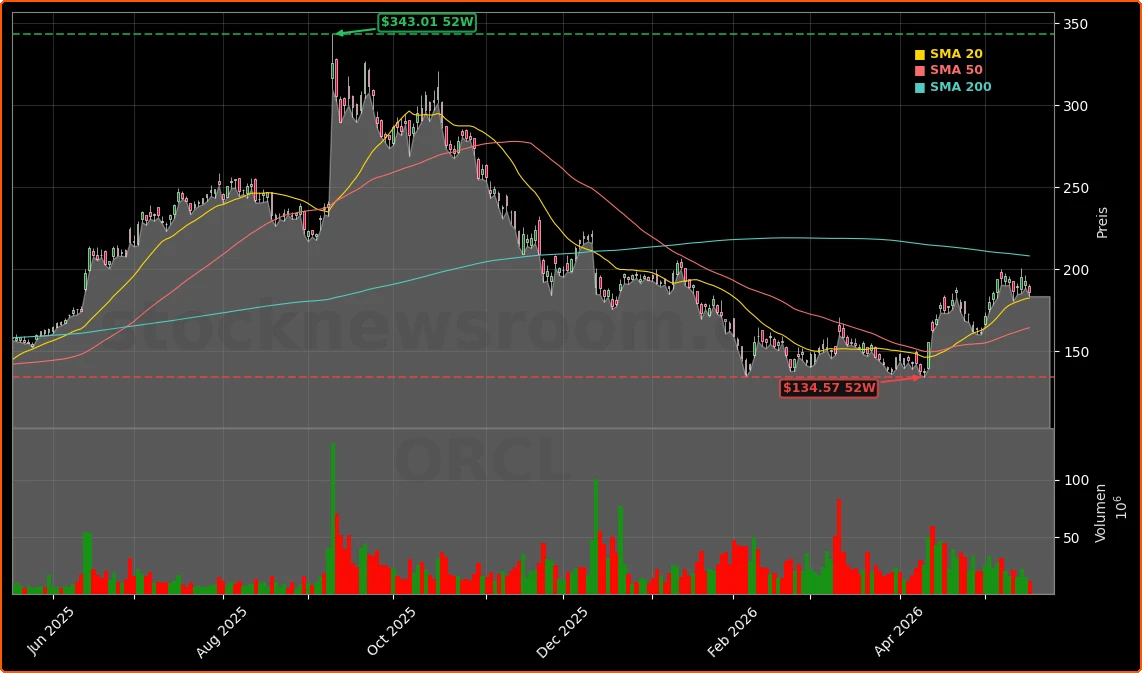
Oracle Corporation traded lower on Monday, underperforming a mixed technology sector and a broadly cautious Wall Street. At around $186, the stock is off its recent highs and down roughly 3% on the day, as investors rotate out of richly valued AI beneficiaries ahead of key semiconductor earnings. Several fund managers have flagged narrow market breadth and stretched valuations across AI leaders, and Oracle is getting caught in that de‑risking despite solid fundamentals.
One additional overhang is the emergence of large put positions on Oracle. AI investor Leopold Aschenbrenner disclosed about $1.07 billion in notional put exposure on Oracle as part of an $8.5 billion complex bet against leading chip and infrastructure names, including big options positions in NVIDIA, Broadcom and AMD. His thesis has shifted from pure AI compute toward power and capacity infrastructure, and the options activity is reinforcing short‑term volatility in Oracle even as Street analysts stay constructive.
Is Oracle AI Infrastructure still a top Wall Street theme?
Despite the pullback, major sell‑side firms continue to frame Oracle AI Infrastructure as a high‑conviction growth story. Oppenheimer recently lifted its price target on Oracle from $210 to $235 and reiterated an “Outperform” rating, naming the stock a top pick in large‑cap software and infrastructure. The firm points to accelerating demand for Oracle’s cloud infrastructure from AI leaders such as OpenAI, Meta, NVIDIA and U.S. federal agencies, as well as signs that Microsoft is outsourcing a portion of its AI training workloads to Oracle’s cloud.
Other institutional investors are voting with their wallets. WealthPlan Investment Management more than tripled its Oracle position in Q4, while RiverFront Investment Group and May Hill Capital also sharply increased their stakes, citing Oracle’s rising relevance in AI workloads. MarketBeat’s compilation of analyst views shows a “Moderate Buy” consensus with multiple firms raising or reaffirming bullish targets as Oracle’s AI and cloud revenue grow faster than its legacy database business.
Oracle’s latest reported quarter underscored that shift: EPS of $1.79 on $17.19 billion in revenue beat expectations, with cloud and AI services driving more than 20% year‑over‑year growth. For many portfolio managers, that makes Oracle one of a handful of hyperscale names – alongside Microsoft, Alphabet, Amazon and Meta – expected to account for the lion’s share of the roughly $1 trillion in capex planned for AI and cloud infrastructure in 2026.
How big are Stargate and Project Jupiter for Oracle?
The next leg of the story revolves around massive physical build‑out. The Stargate project, a partnership between OpenAI, Oracle, SoftBank and MGX, aims to deploy about $500 billion into AI infrastructure across the U.S. over the coming years. While details remain fluid, Oracle is expected to be a key cloud and data‑center backbone for Stargate, giving it a structural role in the training and deployment of frontier models.
In parallel, Oracle’s Project Jupiter – a huge AI data‑center campus in the U.S. – has become a lightning rod for investors hunting for second‑derivative AI plays. The project has already helped fuel a triple‑digit rally in fuel‑cell specialist Bloom Energy as markets anticipate energy‑intensive AI training clusters. For Oracle, Project Jupiter is intended to host hundreds of thousands of GPUs and accelerators, positioning its cloud as a direct alternative to the platforms of Apple’s ecosystem partners and other hyperscalers.
Executives at Oracle have argued that entering the hyperscale race later has spared the company from legacy data‑center designs, allowing it to deploy newer, denser and more power‑efficient architectures. That, in turn, could let Oracle offer faster and cheaper AI compute than some incumbents – a critical differentiator as AI workloads scale and customers become more price‑sensitive.
What risks come with Oracle’s AI spending spree?
The flip side of this aggressive expansion is leverage. Oracle has become a prime example of the high indebtedness of AI hyperscalers, issuing large bond offerings to finance its AI and cloud build‑out. Higher interest rates increase the cost of that debt, and investors are closely tracking how quickly the company can convert its ballooning backlog of cloud and AI contracts into cash flow and margin.
For now, many institutional holders appear comfortable with the balance. Several recent 13F filings show net buying of Oracle shares even as some firms trim around the edges. Oracle’s strong backlog, rising AI‑driven revenue mix and the strategic value of Oracle AI Infrastructure in U.S. and government digital modernization campaigns are central to the bull case.
Still, the emergence of large put positions and the broader debate over an AI valuation bubble inject real uncertainty. If AI capex growth slows, or if new architectures reduce demand for today’s GPU‑heavy data centers, Oracle’s multiyear investment cycle could look overly aggressive. Investors will want to watch how quickly Oracle signs and ramps long‑term cloud commitments, and whether it can keep closing the performance gap to leaders like NVIDIA‑backed cloud offerings while preserving profitability.
Related Coverage
For a deeper dive into how long‑term contracts are reshaping the company’s outlook, readers can explore Oracle AI Contracts Rally: Stock Soars 3.8% on Record Backlog Surge. That analysis examines how a record backlog of AI and cloud deals could underpin sustained growth in Oracle’s infrastructure business, complementing the capex and strategy focus in today’s article.
In summary, Oracle AI Infrastructure is at the heart of both the bull and bear narratives around the stock: massive projects like Stargate and Project Jupiter offer years of potential growth, but also raise questions about leverage and execution. For U.S. investors, Oracle remains a high‑beta way to play the build‑out of AI data centers alongside the more widely owned hyperscalers. The next few quarters of bookings, backlog conversion and capex updates will show whether Oracle can turn today’s ambitious AI promises into durable cash flows.