
Are NVIDIA Earnings about to confirm a trillion‑dollar AI roadmap—or expose how fragile the recent chip boom really is?

How fragile is NVIDIA’s AI-driven rally?
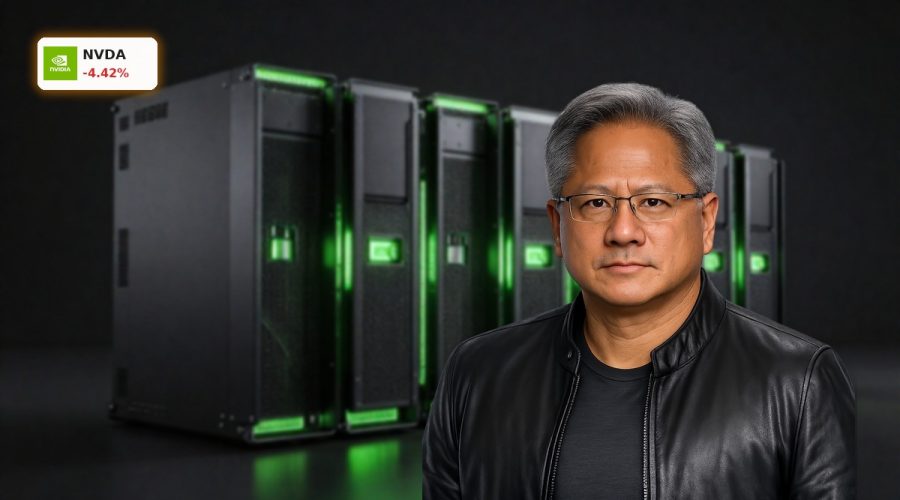
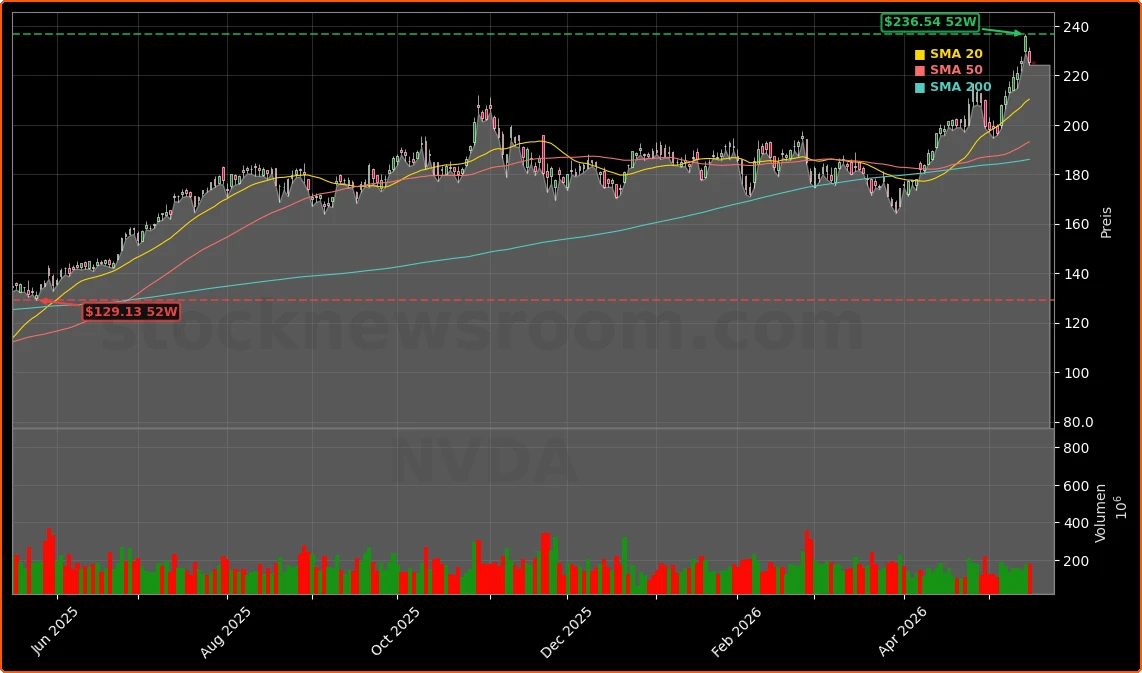
NVIDIA Corporation (NVDA) enters this week’s report after an extraordinary run: revenue grew about 65% last fiscal year, free cash flow hit roughly $96.6 billion, and net income reached $120 billion. Yet the stock slipped 4.42% to $225.32 on Friday and another 0.4% to $224.41 in after-hours trading, erasing about $250 billion in market value amid profit-taking and renewed worries over China. Options markets imply a 5–10% swing around NVIDIA Earnings, underlining how central NVDA has become to NASDAQ and S&P 500 sentiment.
For Q1 FY2027, management previously guided revenue to about $78 billion with gross margin above 74%. Consensus now sits closer to $78.8 billion and $1.77 in EPS, meaning even a small miss or conservative outlook could trigger another sharp move. The bigger question for portfolio managers is whether data-center demand and AI capital expenditure are still accelerating, or merely plateauing at a very high level.
What will NVIDIA Earnings say about Blackwell and Rubin?
CEO Jensen Huang has repositioned NVIDIA as the “AI factory” supplier to the world. The Blackwell GPU platform (GB300) is ramping through the first half of 2026, and Huang recently projected more than $1 trillion in combined Blackwell and Rubin revenue through 2027, up from an earlier $500 billion estimate. Susquehanna analyst Christopher Rolland, who rates NVDA a “Buy,” raised his price target from $250 to $275 and now models roughly $1 trillion in Blackwell and Rubin revenue alone by 2027, citing upside from new systems like Grok LPX and Vera CPU racks.
Rubin, NVIDIA’s next architecture after Blackwell, is already sampling to customers and remains on track for a second‑half 2026 launch. At GTC, Huang went further, outlining a yearly cadence of architectures: Blackwell, Rubin, Rubin Ultra and Feynman. He also unveiled Vera Rubin systems, which combine high-throughput Rubin GPUs with low‑latency Grok technology and Dynamo software, promising up to a 35‑fold performance boost for token‑based AI inference. Investors will listen closely on Wednesday for updated timelines, supply availability and any signs that hyperscalers or cloud players are stretching out deployments.
How critical is China for the next leg of growth?
Geopolitics remain a swing factor for NVIDIA Earnings. Washington has approved exports of modified H200 chips to China, but so far no significant shipments have moved, and Beijing appears more interested in domestic accelerators. Many Chinese customers may instead be waiting on Blackwell-class parts that are unlikely to be cleared for export due to national security concerns. Huang joined a recent high-profile U.S. delegation to meet President Xi, but expectations for a near-term breakthrough are low.
Management has effectively guided to zero data center compute revenue from China, so any positive commentary on H200 or other compliant products could be an upside surprise. Conversely, renewed restrictions would reinforce concerns that some of NVIDIA’s $95.2 billion in long-term supply commitments could be mismatched with final end demand, particularly if alternative routes into China via third countries are tightened.
Can NVIDIA stay ahead of rivals like Alphabet and AMD?
NVIDIA still commands roughly 80% share in AI accelerators, but competition is intensifying. Apple, Microsoft and Alphabet are all investing in internal silicon, while AMD and Cerebras push hard on inference workloads. Alphabet’s TPU roadmap in particular has investors asking whether large cloud customers might gradually diversify away from NVDA’s GPUs. Yet NVIDIA’s moat extends beyond chips to CUDA, NVLink, Spectrum‑X networking and full-stack software, making large-scale switching expensive and risky.
NVIDIA is also widening its reach in software and models. Huang recently announced NemoTron 4, a frontier model family, open agent frameworks like OpenClaw along with the NemoClaw reference stack, and specialized physical AI models such as Cosmos (world simulation), Groot (humanoid robots) and Alpamayo (autonomous vehicles). Partnerships span automakers BYD, Hyundai, Nissan and Geely for robo‑taxis, industrial players like ABB and KUKA for robotics, and an Uber collaboration for autonomous mobility. For U.S. investors comparing NVDA with mega‑caps such as Tesla or Alphabet, these ecosystems highlight that the story is no longer just GPUs, but vertically integrated AI platforms.
Why are institutional flows diverging into NVIDIA?
Fund flows ahead of NVIDIA Earnings show a split picture but net institutional confidence. Citizens & Northern Corp trimmed its NVDA stake by 7% in Q4 yet still holds over 81,000 shares, while Blackstone recently added more than 45,000 shares, signaling ongoing conviction in the AI leader despite valuation risks. The VanEck Semiconductor ETF (SMH) has seen over $600 million in net inflows across five days even as it declined about 3.5% last week, with NVIDIA and Taiwan Semiconductor as core positions. The SPDR S&P 500 ETF Trust (SPY) has also attracted fresh capital, driven in part by enthusiasm around NVIDIA, Apple and Microsoft.
Options activity remains elevated, reflecting both hedging and speculative trading. Some traders are bracing for a downside move given that NVDA has fallen after four of its last five quarterly beats, while long-term holders point to a forward P/E near 26 against revenue growth above 60% as an unusually favorable price‑to‑growth profile for a company of this scale.
Related Coverage
For a deeper dive into the geopolitical overhang, see NVIDIA China Approval: -4.0% Plunge Shocks AI Bulls, which analyzes how export approvals and political risk around China can turn from tailwind to headwind for AI investors. That piece also explores whether regulatory headlines are masking the strength of NVIDIA’s core AI demand or signaling the start of a more volatile phase for the stock.
Ultimately, the upcoming NVIDIA Earnings release will determine whether the company can keep compounding at extraordinary rates as Blackwell ramps and Rubin approaches. For American investors heavily exposed to AI, the print and, more importantly, the Q2 outlook could reset expectations for both NVDA and the broader NASDAQ. If Huang can pair another beat with convincing guidance on China, supply and new platforms, NVIDIA is likely to remain a cornerstone growth engine in long-term portfolios.