
Will high‑stakes Tesla China Talks in Beijing turn Musk’s political access into real advantages for the EV and AI giant?

How could Tesla China Talks move the stock?
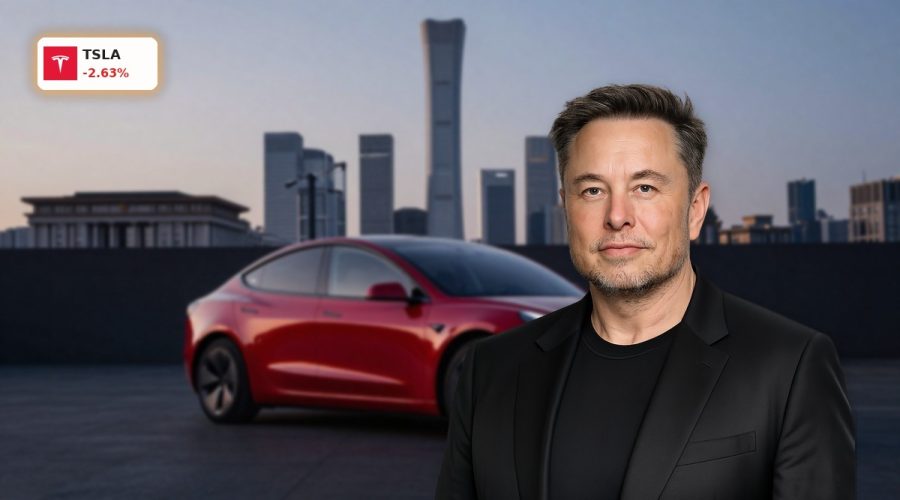
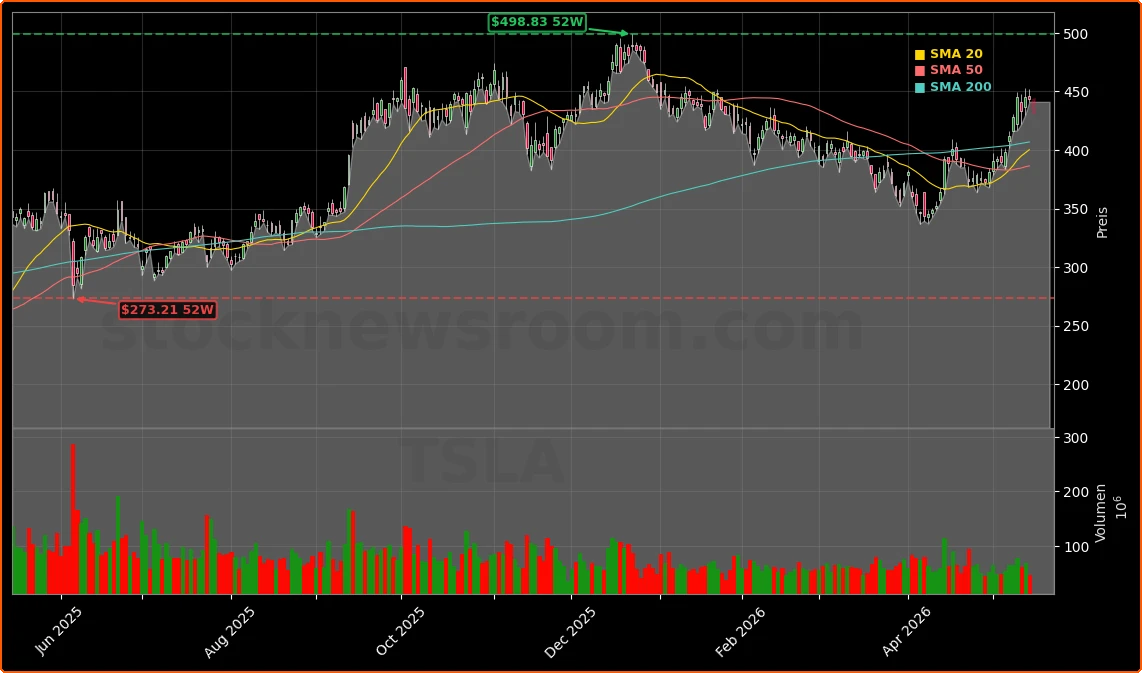
Tesla, Inc. closed Thursday at $443.30, just above the prior close of $442.40, before slipping about 2.6% in pre‑market trade. The pullback comes after a powerful rebound driven by stronger‑than‑expected quarterly results, robust Q2 delivery momentum and renewed enthusiasm for Tesla’s robotaxi roadmap. The Beijing visit adds a new catalyst: any hint that Musk can secure friendlier treatment for Tesla’s Chinese operations or new market access could quickly feed into valuation models.
China remains central to Tesla’s long‑term narrative, even as domestic EV rivals intensify competition. Against that backdrop, Tesla China Talks during Trump’s state visit are being watched as a potential inflection point. Private investors have already piled into the stock in the week through May 13, making Tesla one of the most heavily bought names among retail traders, a sign that speculative interest is back despite recent volatility.
The macro context is complex. The US and China are clashing over export controls, advanced chips, AI, Taiwan and broader trade imbalances. Yet Trump has explicitly framed the trip as an attempt to “open up” China for American companies, giving executives like Musk, Apple CEO Tim Cook and NVIDIA chief Jensen Huang a rare chance to make high‑level asks directly to Beijing’s leadership.
What is Elon Musk doing in Beijing?
Musk is part of a select group of US CEOs standing behind Trump in official photos from Beijing and attending meetings with Chinese President Xi Jinping and Premier Li Qiang. Footage from the capital shows Musk alongside other corporate heavyweights such as BlackRock’s Larry Fink and Citigroup’s Jane Fraser, underscoring Tesla’s status as a flagship US brand operating deep inside the Chinese market.
Chinese state media highlighted Li Qiang’s message that the two countries “can and should continue to be friends and partners,” while Musk reportedly described his conversations with Xi as “awesome.” For investors, the question is whether those warm words translate into tangible wins for Tesla: smoother regulatory pathways for products like Full Self‑Driving (FSD), potential support for new local investments, or assurances on data security rules that have periodically constrained Tesla vehicles in sensitive locations.
At the same time, these Tesla China Talks occur as Tesla ramps capital expenditures aggressively. Management has lifted this year’s capex guidance to about $25 billion, up from $20 billion earlier in the year and just $8.5 billion last year. That surprise jump initially pressured the stock, as Wall Street recalibrated free‑cash‑flow expectations. However, it also signals that Musk is doubling down on manufacturing scale, next‑gen vehicles and AI infrastructure, all of which could benefit from clearer terms of engagement with China.
Is Tesla still gaining ground in global EVs?
Despite fears that the global EV boom is cooling, Tesla has staged a sharp turnaround since being “left for dead” by some traders earlier in 2026. Shares are now positive on the year after rallying roughly 27% over the last month, helped by substantial Q2 delivery numbers and renewed betting on a robotaxi unveiling later this year. Average daily volume has been nearly double the three‑month average in recent sessions, reflecting a resurgence of short‑term trading strategies around TSLA.
Outside China, Tesla is investing heavily to defend and extend its lead. In Europe, the company is putting $250 million into expanding its Berlin‑Brandenburg gigafactory, aiming to lift 4680 battery cell output to 18 GWh annually and boost vehicle production by around 20%. That move follows a rebound in European deliveries after earlier market‑share losses to Chinese EV brands and comes amid a challenging economic backdrop in Germany.
Meanwhile, Musk’s energy and services businesses are sending mixed signals. Reports indicate the high‑profile Solar Roof product is effectively on life support, with the company pivoting toward conventional solar panels after years of underwhelming deployment. By contrast, Tesla’s insurance arm saw premiums surge more than 40% in 2025 as it shifted toward direct underwriting, although loss ratios remained roughly 40 points worse than the broader industry, attracting regulatory scrutiny in key states like California.
How do Tesla China Talks fit into the AI and robotaxi race?
Beyond EVs, the Beijing trip intersects with Musk’s ambition to position Tesla as an AI and mobility‑as‑a‑service leader. Xi and Trump’s agenda includes artificial intelligence, and Nvidia’s Huang is part of the same delegation, highlighting how critical AI supply chains and compute access have become. For Tesla, which increasingly pitches itself as an AI and robotics company, stable access to hardware, data and markets in China could be just as important as vehicle sales.
Robotaxis are another flashpoint. Alphabet subsidiary Waymo recently had to recall nearly 3,800 autonomous vehicles after a software issue led one car to enter a flooded lane in Texas. That incident underscores both the technical challenge and reputational risk in autonomous driving just as Tesla promotes its own robotaxi vision. Any signals from Tesla China Talks that Beijing is open to advanced driver‑assistance or future robotaxi services from foreign players would be a meaningful upside surprise.
At the same time, legacy automakers like Ford are pushing into adjacent profit pools. Ford stock has rallied on the back of stronger earnings and a bullish Morgan Stanley view on its new Ford Energy storage business, which is being framed as a direct competitor to Tesla Energy. In education and workforce development, Tesla is deepening partnerships such as a new program with Houston Community College to train advanced manufacturing workers, feeding talent into facilities like the Megafactory in Texas.
Related Coverage: What’s next for Tesla in China?
For a deeper dive into how China fits into Musk’s robotaxi ambitions, investors can read “Tesla China Warning as Robotaxi Boom Faces Demand Test”. That analysis explores whether a robotaxi rollout can reignite Tesla’s Chinese growth engine or whether local EV rivals are steadily eroding its advantage, an issue that will remain front and center as the latest Tesla China Talks unfold.
Tesla China Talks now sit at the intersection of geopolitics, capex‑heavy expansion and the race for autonomous mobility, giving the Beijing trip outsized importance for TSLA’s next leg. Investors will be watching for concrete outcomes that clarify Tesla’s regulatory footing, market access and AI ambitions in the world’s largest EV market. With sentiment rebounding and volatility elevated, the next major data points – from any Beijing announcements to the upcoming earnings call – will show whether these Tesla China Talks become a real catalyst or just diplomatic theater.