
Can Tesla’s aggressive battery expansion and China FSD push really justify its trillion‑dollar valuation after today’s sharp pullback?

How does the Tesla Battery Expansion change the bull case?
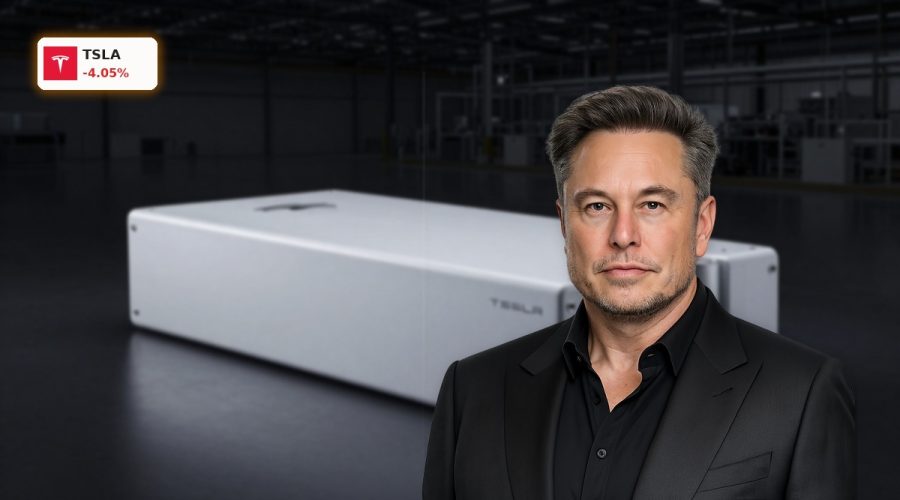
Tesla will invest roughly $250 million to expand battery cell production at its Gigafactory Berlin-Brandenburg in Grünheide, lifting planned capacity from about 8 GWh to 18 GWh per year by around 2027. Management’s goal is a fully integrated site “from battery cell to electric vehicle,” which would make Grünheide one of Europe’s few locations where cells and cars are built end-to-end. The company expects more than 1,500 employees in battery manufacturing alone over the medium term, on top of roughly 10,700 staff currently at the plant and 1,000 new auto jobs already announced for mid‑2026.
The Tesla Battery Expansion is strategically aimed at reducing reliance on imported cells from the U.S. and Asia and shoring up a supply chain still constrained by pack capacity. At full run‑rate, an 18 GWh output could support hundreds of thousands of midsize EVs annually, depending on pack size, and help backstop volume ramps for vehicles like Model Y and future mass‑market models. For Europe, where local cell production lags Asia, this move positions Tesla as a key industrial anchor and leverages prior commitments by CEO Elon Musk to build one of the world’s largest battery factories near Berlin.
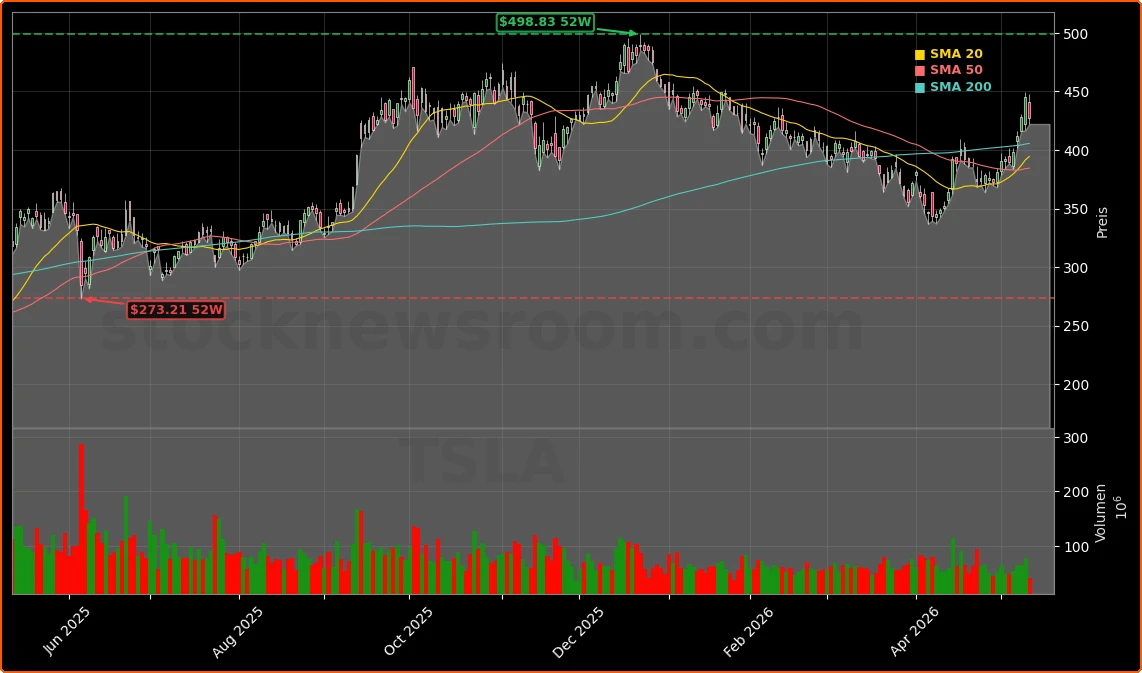
However, this bigger footprint comes at a cost. CFO Vaibhav Taneja has already guided to more than $25 billion in capital expenditure through 2026 and negative free cash flow for the rest of this year, largely tied to AI infrastructure, robotics, and battery plants. Today’s slide from a prior close around $444 to about $427.06, roughly -4%, reflects investor unease that the Tesla Battery Expansion and broader capex surge may not translate into earnings quickly enough to support a market cap around $1.6 trillion.
What does Musk’s China trip mean for FSD and growth?
In parallel with the European manufacturing push, Musk is joining President Trump’s delegation to Beijing, alongside fellow heavyweights like Apple CEO Tim Cook and executives from Boeing and major financial firms. The trip is framed around trade, technology, and artificial intelligence, with Musk seen as a commercial bridge thanks to Tesla’s highly efficient Shanghai Gigafactory and deep exposure to the Chinese EV market.
For shareholders, the key storyline is FSD approval. Musk is expected to lobby Beijing and regional regulators to allow Tesla’s latest FSD software to operate more broadly in China, potentially unlocking a lucrative subscription base in the world’s largest auto market. FSD subscriptions already climbed to about 1.28 million globally in Q1 2026, growing 51% year over year and forming a crucial pillar of the company’s AI and software narrative. Any progress in China could turn that narrative into tangible recurring revenue and help defend sky‑high multiples that assume robotaxis, Cybercab, and Optimus robotics eventually become meaningful profit centers.
Wall Street research remains split. Piper Sandler recently reiterated a $500 price target on TSLA, arguing that the core EV and energy businesses justify around $400 per share and that the market is effectively getting Optimus and other AI optionality “for free.” That optimistic stance collides with more cautious consensus numbers, where the average analyst target near $412 implies modest downside from current levels and embeds skepticism that the China FSD push or autonomous services will ramp smoothly.
Is valuation outpacing the Tesla Battery Expansion?
Fundamentals have improved, but not enough to silence critics. Q1 2026 revenue rose about 16% year over year to $22.4 billion, with automotive gross margin rebounding to roughly 21% from the mid‑teens a year ago. GAAP operating income more than doubled to about $941 million and EPS of $0.41 beat expectations. Services and other revenue grew around 42%, and FSD adoption continued to compound, all aiding the case that Tesla is evolving from a carmaker into an AI and software platform.
Yet full‑year 2025 results showed revenue contracting nearly 3% and net income cut almost in half, underscoring how dependent the story is on unproven businesses like robotaxis and humanoid robots. At roughly $427 per share, trailing P/E hovers near 400 and forward P/E above 200, leaving little room for delays in turning projects like Optimus, Cybercab, or the Tesla Battery Expansion into hard cash flow. Prominent insiders, including director Kathleen Wilson-Thompson and CFO Taneja, have sold shares in recent months, a data point bears cite as evidence that management sees current pricing as rich.
Compounding the tension, new product execution remains bumpy. The Cybertruck, already criticized for quality issues, is now subject to a recall of 173 rear‑wheel‑drive units after U.S. safety regulators flagged a defect that can cause wheels to detach, forcing Tesla to replace components at no cost to owners. While the recall is numerically small due to low sales volumes, it reinforces concerns about manufacturing discipline just as investors are being asked to finance massive new factories and the Tesla Battery Expansion in Europe.
How does Tesla stack up against U.S. tech and EV peers?
TSLA’s one‑month gain of nearly 25% before today’s pullback outpaced the S&P 500 and most mega‑cap techs, even names like NVIDIA that are central to the AI boom. On a one‑year basis, the stock’s roughly 50% advance has beaten the SPDR S&P 500 ETF but left it still below its 52‑week high near $499, highlighting both past volatility and remaining headroom if AI and autonomy pay off. By contrast, traditional automakers and newer EV entrants trade at a fraction of Tesla’s earnings and sales multiples, signaling that the market still categorizes Tesla closer to high‑growth software than Detroit metal.
For U.S. portfolios, the risk‑reward is finely balanced. Bulls argue that vertical integration — from battery cells in Grünheide and Shanghai to energy storage and AI‑rich FSD — creates an ecosystem rivals will struggle to copy, especially as Tesla opens its Supercharger network and pilots new features like digital waitlists for EV charging queues. Bears focus on valuation gravity around the $400 level, negative free cash flow guidance, and the possibility that a future SpaceX IPO could siphon “Musk premium” away from TSLA.
Near term, the tape will trade on two axes: news out of Beijing on FSD licensing and further details on capex returns from projects like the Tesla Battery Expansion. Any sign of faster monetization from software or clearer evidence that Grünheide’s cell output decisively eliminates battery bottlenecks could re‑energize the bull case; weaker Q2 deliveries or added execution stumbles could instead reinforce the argument that the stock is priced for perfection.
Related Coverage
Investors looking to connect today’s news with Tesla’s broader risk profile may also want to review recent analysis of the company’s safety and regulatory backdrop. A detailed breakdown of how improved crash-test results and rising China sales are feeding into TSLA’s premium valuation can be found in “Tesla Safety Test +3.3% Surge: Is Safety the New Moat?”. That piece explores whether safety leadership can become as important as software in sustaining the multiple now being asked to underwrite initiatives like the Tesla Battery Expansion.
The bottom line for Wall Street is that the Tesla Battery Expansion in Germany and Musk’s China FSD diplomacy both push the company deeper into high‑stakes, capital‑heavy bets that must eventually translate into durable cash flows. For long‑term investors, TSLA remains a conviction call on batteries, AI, and autonomy rather than a simple EV play. The next catalysts — from Beijing headlines to Q2 delivery data — will show whether this combination of industrial scale‑up and software optionality can keep justifying Tesla’s position among the market’s most richly valued names.