Can Tesla’s record-breaking compensation package for Elon Musk really align shareholders with AI ambitions without blowing up governance in the process?

How unusual is the new Tesla Compensation plan?
The latest proxy filing reveals the first installment of Musk’s new multi-year CEO Performance Award, approved by shareholders in November, with a maximum fair value of roughly $132 billion plus an interim component that pushed total reported Tesla Compensation for 2025 above $158 billion. At the same time, Tesla notes that realized compensation for Musk was $0 because the award vests only if ambitious market-cap, delivery, and AI-related milestones are met over the coming decade.
The package is structured around ultra-long-term targets, including lifting Tesla’s market capitalization from roughly $1.2 trillion today to as high as $8.5 trillion, delivering 20 million vehicles annually, and deploying one million robotaxis and one million humanoid robots. If every milestone is achieved, the award could ultimately be worth up to $1 trillion in stock, making it the largest incentive scheme ever granted to a public-company CEO.
This approach continues Tesla’s history of tying Musk’s pay to aggressive growth thresholds rather than cash salaries or bonuses, a design that supporters argue directly aligns management with shareholder value creation. Critics counter that the sheer size of the potential payout concentrates power in Musk’s hands and could encourage risk-taking in pursuit of extreme valuation goals.
What does zero realized pay really mean for investors?
For 2025, the company reported that no market-cap or operating targets were met, so none of the new equity tranches vested and Musk effectively earned no Tesla Compensation for the year. The interim award of about $26 billion was explicitly forfeited after Musk regained access to a separate 2018 package that had been temporarily frozen in court. Tesla also disclosed that Musk currently controls about 15% of the vote, but that his stake should rise to roughly 20.3% after exercising options he has committed to use by mid-August.
Investors are parsing whether this structure genuinely limits dilution. On paper, the zero realized pay underscores that Musk must drive enormous, sustained performance before cashing in. In practice, the grant-date accounting still reflects a massive theoretical transfer of value from existing shareholders to Musk if Tesla delivers on its AI and robotics roadmap.
Another governance angle: the filing shows that Musk holds around 207.5 million Tesla shares as potential collateral, and that related-party dealings among Musk-controlled entities are increasing. In 2025, Tesla generated about $573 million of revenue by selling vehicles and battery systems to SpaceX and xAI, while simultaneously investing roughly $2 billion into those private companies and paying them for services. That growing web of internal transactions is intensifying concerns about conflicts of interest and resource allocation between the listed business and Musk’s private empire.
How does the Tesla Compensation story intersect with AI and capex?
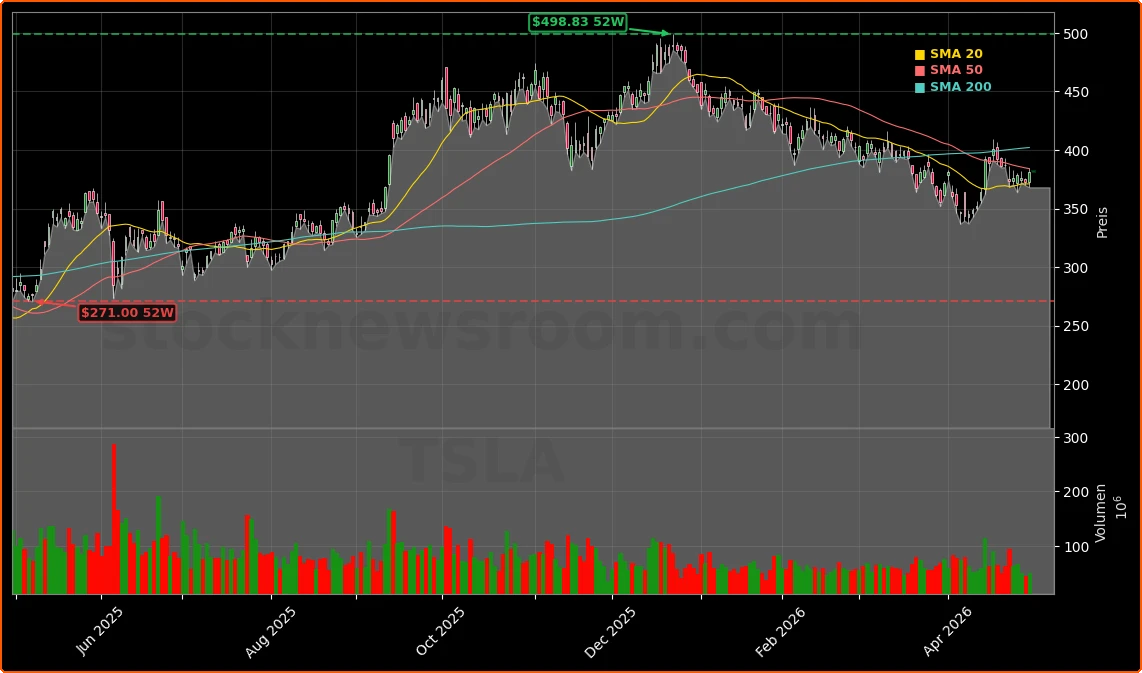
The market’s reaction to the new Tesla Compensation disclosures is tightly linked to broader questions about AI execution. The stock is up about 2.4% to $381.63, with pre-market indications near $382.26, but shares remain down double digits year to date despite a sharp rebound over the past month. Tesla now trades at an eye-watering P/E multiple above 350 on trailing earnings and around 180 times next-12-month estimates, far richer than traditional peers like General Motors or Ferrari.
Morgan Stanley recently reiterated an “Equal Weight” rating with a $415 price target, calling out 2026 capital expenditures expected to exceed $25 billion as Tesla builds out its Semi truck, Cybercab robotaxi platform, Megapack 3 storage line and the Optimus humanoid robot. Morningstar likewise kept its fair value estimate at $400, judging the stock fairly valued after Q1 results and noting that free cash flow could be negative this year as AI and robotics investments accelerate.
Those same AI projects underpin many of Musk’s compensation milestones. Tesla has begun limited commercial robotaxi operations in Texas and is ramping high-volume production of the all-electric Semi and Megapack systems in 2026, while also planning a large battery recycling facility in Austin in partnership with Broadstone Net Lease. But execution has been slower than early promises, leaving investors waiting for concrete monetization of “physical AI” instead of just narrative-driven valuation.
What are the risks around governance and conflicts?
The combination of a gigantic Tesla Compensation package, concentrated voting power, cross-company transactions and soaring security costs around Musk is sharpening governance scrutiny. Tesla’s spending on Musk’s personal security rose to about $4.8 million in 2025, up from $2.8 million in 2024, reflecting heightened concerns about threats to high-profile executives. While that figure still trails the security budgets at companies like Meta and Apple, it underscores how central Musk has become to Tesla’s perceived value – and how costly it could be if he were to step back.
On the capital markets side, Barclays analysts have highlighted Tesla as one of the weaker members of the so-called “Mag 7,” citing an expensive valuation and less attractive free cash flow profile versus mega-cap peers such as NVIDIA and others in the AI complex. Tesla is trading at a premium on price-to-sales and price-to-book metrics compared with auto manufacturers, even as return on equity lags the industry average and cash usage climbs with each new factory and AI initiative.
At the portfolio level, this means investors are effectively betting not only on EV adoption and battery economics, but also on Musk’s ability to deliver on a multi-trillion-dollar AI and robotics vision without overextending Tesla’s balance sheet or siphoning innovation into his private ventures. That bet is now formalized in the new pay deal’s towering upside.
Related Coverage
For a deeper dive into how autonomy is beginning to translate into revenue, readers can review analysis of the Tesla Cybercab robotaxi boom and its impact on Q1 2026 earnings, which examines whether early ride-hailing revenue can scale fast enough to justify the company’s AI-heavy capital plan and support Musk’s long-term compensation targets.
Ultimately, the latest Tesla Compensation disclosure reinforces just how tightly Tesla’s future is tied to Elon Musk’s execution on extreme AI and growth goals. For U.S. investors, the package is both a high-octane incentive and a major governance risk wrapped into a single security. The next few years of robotaxi rollouts, Semi deliveries and Optimus milestones will determine whether this unprecedented pay deal becomes a case study in shareholder value creation or in the dangers of concentrated power.