
Can Tesla China turn political access and an AI push into a lasting comeback in the world’s most competitive EV market?

Why is Tesla China suddenly center stage?
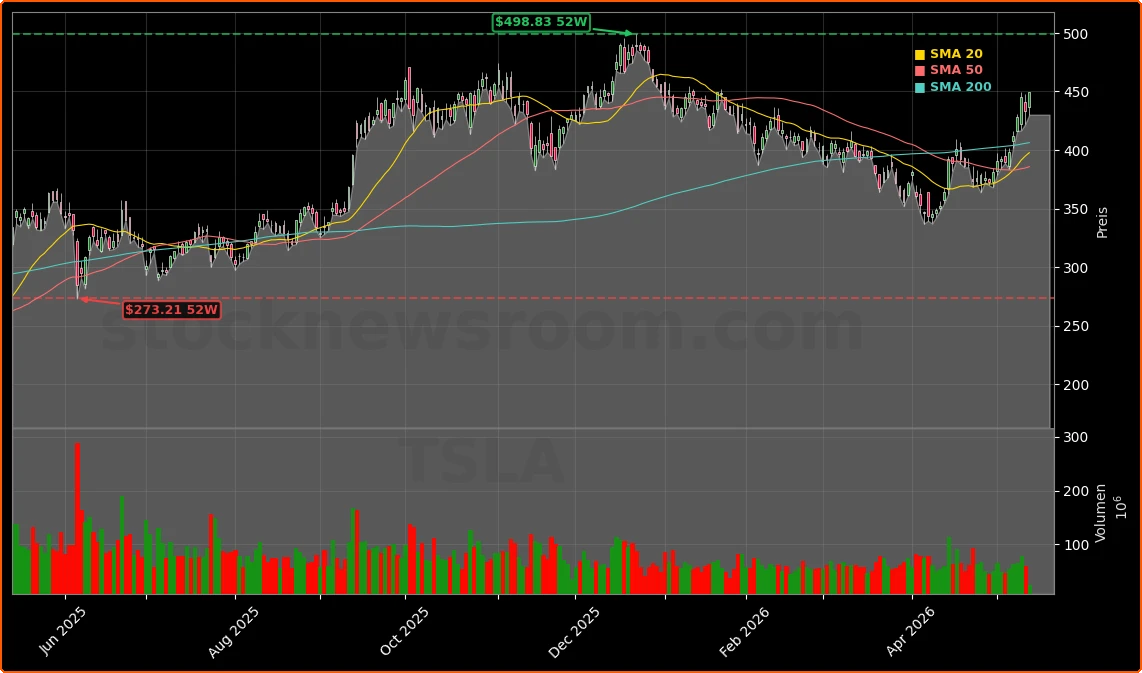
Tesla, Inc. (TSLA) has staged a powerful rebound after a rough start to 2026, with shares climbing roughly 30% over the past month and trading today around $449.34, still below the 52‑week high of $498.83. The latest catalyst is political: Elon Musk is flying to Beijing with President Trump, Apple CEO Tim Cook and NVIDIA chief Jensen Huang as part of a high‑profile business delegation focused on trade, technology and market access. For investors, the trip underscores how critical Tesla China has become to the company’s growth, margin profile and long‑term AI ambitions.
The stakes are high. Chinese rivals such as BYD have already overtaken Tesla in global battery EV sales, while domestic competition and price wars have knocked the company out of the top 10 EV makers in China by recent retail volumes. Against that backdrop, Musk’s presence in Trump’s inner circle on this trip signals a push to secure better regulatory clarity for autonomous driving, easier data rules for Full Self‑Driving (FSD), and perhaps more favorable treatment for Tesla’s Shanghai operations.
How is Tesla responding to China sales pressure?
On the ground, Tesla China has moved aggressively to win back price‑sensitive buyers. The company has launched a new round of affordable financing for Model 3 and Model Y variants, including five‑year loans with sub‑1% annualized interest rates and sharply reduced monthly payments. One widely advertised plan features a 0.9%–0.99% rate, low monthly installments and a balloon payment at maturity, designed to lower the initial hurdle for middle‑class households.
The shift to cheap credit highlights how far demand has cooled. April retail sales for Tesla China dropped sharply year over year and more than 50% versus March, reflecting both slowing EV growth and fierce competition from local brands that undercut Tesla on price. Yet the company insists that its combination of incentives, brand strength and new financing tools will allow it to sustain robust sales momentum in the second half of 2026. For U.S. investors, the key question is whether these measures can stabilize volumes without permanently eroding margins.
What does the Beijing trip mean for Tesla and its AI push?
Musk is not traveling alone. The delegation includes Huang of NVIDIA and Cook of Apple, underscoring that this is as much about AI and chips as it is about cars. Trump has openly said he will ask President Xi to “open up” China so that these executives “can work their magic,” a signal that Washington wants U.S. companies to secure a deeper foothold in areas like autonomous driving, data centers and advanced manufacturing.
For Tesla, the political angle intersects directly with its technology roadmap. The company is ramping AI investments, from in‑house AI5 chips due in 2027 to the Optimus humanoid robot and its Cybercab robotaxi platform. FSD subscriptions already exceed 1.28 million globally and grew 51% year over year in Q1 2026, contributing high‑margin software revenue alongside automotive gross margin expansion to 21.1%. But large‑scale robotaxi deployment in China will require regulatory approval on self‑driving software, mapping data and cloud infrastructure—issues that may well be discussed during this trip.
Analysts at Barclays recently reiterated an Equal Weight rating on Tesla with a $360 price target, arguing that while battery expansion in Europe and AI investments are strategically sound, the stock looks stretched relative to fair value. With shares trading above both Barclays’ target and a separate $420 one‑year target from other Wall Street research, expectations around Tesla China, robotaxis and FSD approvals are now embedded in the valuation.
Is Tesla still more than just an automaker?
Despite falling auto deliveries in late 2025 and lingering issues like a fresh Cybertruck recall in the U.S., Tesla continues to reposition itself as a diversified technology and AI platform. In addition to Cybercab and the Semi entering volume production this year, the company is investing heavily in Optimus production lines in Fremont with a stated capacity target of up to 1 million robots per year. Tesla is also exploring advanced semiconductor manufacturing partnerships, including potential use of cutting‑edge foundry processes for its next‑generation AI chips, which would deepen its vertical integration.
Operationally, the Q1 2026 beat—EPS of $0.41 versus roughly $0.36 expected, revenue up nearly 16% year over year and free cash flow more than doubling to $1.44 billion—shows that cost discipline and software monetization can offset some of the pressure from EV price cuts. Yet valuation metrics remain demanding, with price‑to‑sales multiples in the mid‑teens and a lofty PEG ratio leaving little room for execution missteps in Tesla China, FSD rollouts or Optimus commercialization.
How should Wall Street read the stock action?
Tesla’s share price has become a case study in volatility. After being “left for dead” earlier this year, the stock has not only turned positive for 2026 but also reached a nine‑month high on the back of renewed optimism about AI and robotaxis. Technical gauges classify the name as overbought, with recent RSI readings in the mid‑70s, while leveraged ETFs tied to TSLA are flashing bullish signals. At the same time, options markets and prediction platforms have been pricing in elevated odds of short‑term pullbacks, especially around macro events like today’s inflation data and political headlines from Beijing.
For portfolio managers, that creates a tension: the fundamental story, particularly around Tesla China, AI and software, is arguably the strongest it has been in more than a year, but the tape is crowded and sentiment is exuberant. Some institutions have been adding on weakness—Atlantic Union Bankshares, for example, increased its Tesla stake by 4.3% in Q4—while others prefer to wait for a better entry point if deliveries or margins disappoint in coming quarters.
Tesla China and the wider global chessboard
Tesla’s expansion is not limited to Asia. In Europe, the company is plowing roughly $250 million (about 215 million EUR) into its Berlin‑Brandenburg plant, lifting battery cell capacity from 8 GWh toward 18 GWh and targeting 6,000 vehicles per week as demand recovers in Asia and South America. That factory is set to become a key hub for both vehicle and battery production, reinforcing Tesla’s ability to serve Europe and potentially export to other markets.
Still, the strategic fulcrum remains Tesla China. Success there would not only restore volume growth but also open a giant addressable market for FSD, energy storage and potentially Optimus deployments in factories and logistics. Failure, on the other hand, would leave Tesla more dependent on slower‑growing Western EV markets and expose its premium valuation to a painful reset.
Related Coverage
The entire Musk–Trump trip underscores that China is no longer just another growth market for Tesla; it is the swing factor for whether the company can grow into its AI and robotaxi valuation.— Maik Kemper, Editor in Chief
Investors who want a deeper dive into how battery spending and Chinese regulatory risk feed into the bull and bear cases can read “Tesla Battery Expansion: -4% Plunge Tests the Bull Case”. That analysis examines whether aggressive capacity growth and the push for FSD approval in China truly justify Tesla’s current valuation, or if the market is getting ahead of itself on the AI and robotaxi story.