
Will the NVIDIA China Trip unlock a blocked multibillion‑dollar AI market or expose just how fragile the rally really is?

How is the NVIDIA China Trip moving markets?
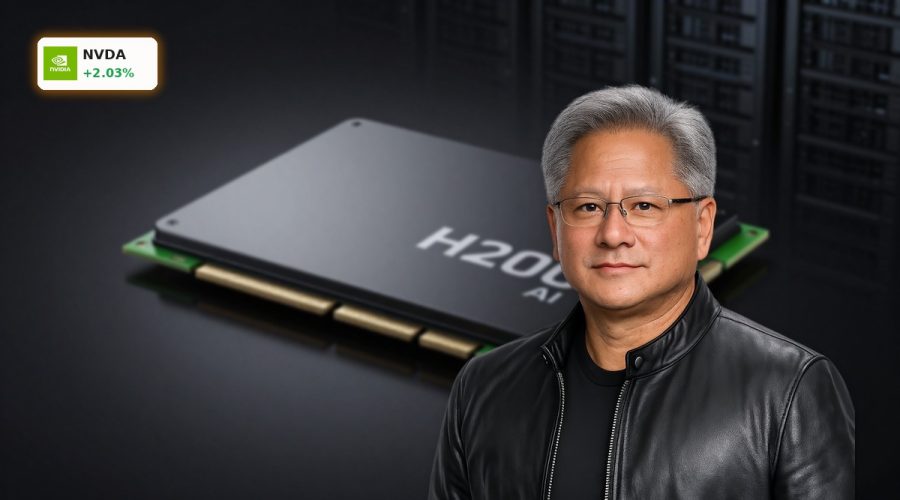
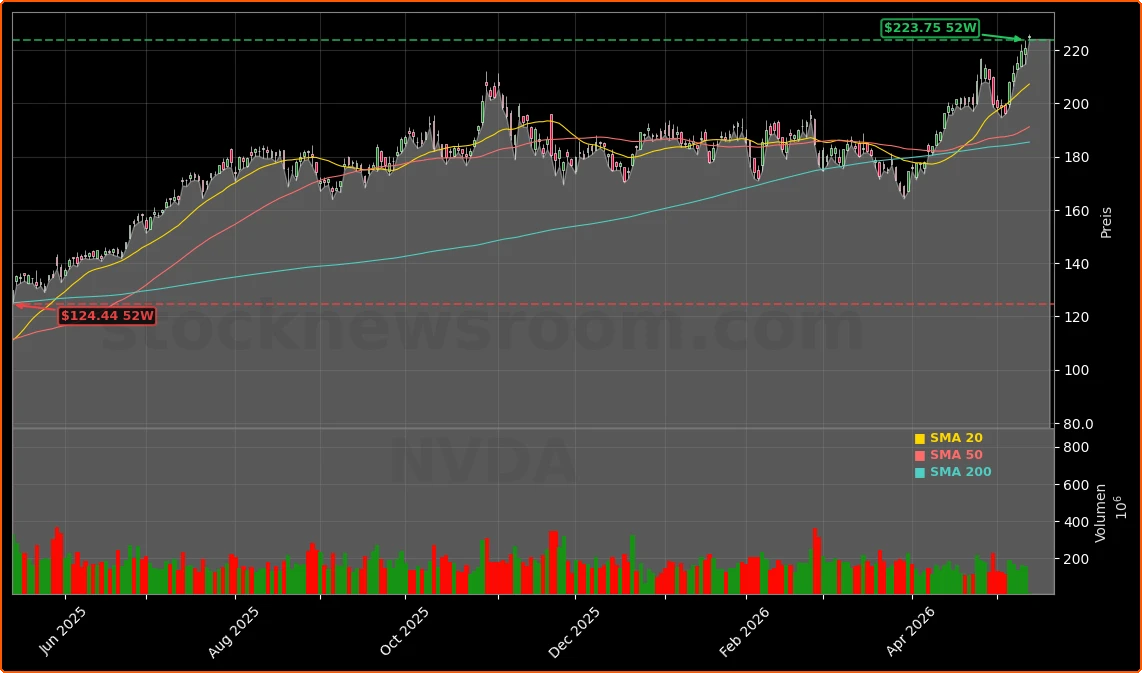
NVDA is trading around $225.15 on Wednesday, up about 2.03% from the prior close of $219.48, and hovering near its all‑time high. The stock’s move stands out because many semiconductor peers showed turbulence earlier this week even as NVDA finally rejoined the sector’s rally. With a market cap north of $5.3 trillion, NVIDIA now accounts for roughly 8% of the S&P 500’s weight, making the stock’s reaction to any China headlines systemically important for Wall Street portfolios.
Traders reacted quickly once it became clear that Huang had in fact joined Trump’s delegation after initially being left off the guest list. In pre‑market trading, NVDA briefly tagged a new high near $225 as investors speculated that Huang would lobby for approvals to sell H200 AI accelerators into China. Chip names from memory suppliers to foundries ticked higher, with Chinese AI developers and high‑bandwidth‑memory partners like SK Hynix also catching a bid.
The NVIDIA China Trip comes against a backdrop where NVDA’s China data‑center revenue has effectively fallen to zero because export‑controlled H‑class chips have either been blocked or left in limbo by Beijing. For a company that once derived roughly one‑fifth of its data‑center sales from China, even partial normalization could move the needle on forward estimates.
What exactly is at stake in Beijing for NVIDIA?
Trump has said he plans to ask President Xi Jinping to “open up” China so American firms can “work their magic,” explicitly naming executives such as Elon Musk of Tesla, Tim Cook of Apple and Jensen Huang. For NVDA, the concrete issue is simple: Washington now formally allows sales of modified H200 chips to China, but Chinese regulators have not yet granted local firms permission to buy.
Huang has argued publicly that conceding a market the size of China “doesn’t make a lot of strategic sense,” warning that U.S. export policy has pushed Chinese developers toward domestic alternatives like Huawei’s Ascend accelerators. Industry estimates suggest current H200 and related restrictions are suppressing NVDA revenue by roughly $5 billion per year, and could ultimately impact a $10–20 billion addressable opportunity when Blackwell and Vera Rubin platforms come into play.
Still, expectations for the NVIDIA China Trip remain tempered. Former U.S. Commerce Secretary Carlos Gutierrez has cautioned that the two sides remain far apart on AI export rules, and national‑security hawks in Washington are openly critical of any move that would significantly expand China’s access to top‑tier AI compute. Even a narrow outcome—such as streamlined approvals for existing H200 rules, without touching future Blackwell‑class chips—would likely be viewed as a win by equity investors.
How strong are NVIDIA’s fundamentals heading into May 20?
Regardless of what Beijing delivers, NVDA’s near‑term story still revolves around earnings. The company is slated to report fiscal Q1 2027 results on May 20 after the close. Street consensus looks for roughly $78.8 billion in revenue and $1.77 in adjusted EPS, with management’s own guidance centered near $78 billion plus or minus 2%. Based on NVDA’s recent history of sizable beats, many investors are bracing for another upside surprise.
Citi chip analyst Atif Malik expects revenue to exceed consensus by about $1.4 billion this quarter and by $2 billion in the July quarter, implying 53–60% year‑over‑year growth and gross margins near 71%. Malik argues that, at under 25x forward earnings, NVDA actually trades at a discount to the broader SOX semiconductor index, which sits closer to 35x. Bank of America’s Vivek Arya has gone further, lifting his price target to $320 and highlighting the potential for over $400 billion in free cash flow over the next two years—more than many mega‑caps combined.
NVDA is also deepening its AI infrastructure moat beyond GPUs. A multiyear partnership with Corning will expand U.S. optical‑connectivity manufacturing by up to 10x, while a “grid‑to‑chip” collaboration with Eaton strengthens NVDA’s reach into power and data‑center infrastructure. Fortinet, meanwhile, is integrating its FortiAIGate security stack with NVIDIA AI platforms to secure enterprise AI workloads at scale. All of this supports the thesis that NVDA is becoming a full‑stack AI infrastructure provider rather than a pure chip vendor.
How does China risk stack up against AI competition?
From a U.S. investor’s perspective, the main debate is whether geopolitical risk from China offsets NVDA’s dominance in AI compute and software. The company still designs or powers roughly 80–85% of the world’s advanced AI accelerators. Hyperscalers like Microsoft and Amazon keep ordering every GPU they can get, while sovereign‑AI projects, robotics, autonomous driving and defense applications push demand into the next decade.
Competition has intensified. Advanced Micro Devices is ramping its MI‑series accelerators, while Intel is pitching its foundry and CPU roadmap as a play on “Agentic AI.” Major cloud players are investing in custom ASICs to reduce reliance on a single vendor. Yet NVDA’s CUDA software stack, developer ecosystem and tight integration from chips to networking and optics remain powerful switching barriers.
The geopolitical overlay is what makes the NVIDIA China Trip uniquely important. If Huang returns with no progress, investors may refocus on export‑control risk and China’s accelerating push for domestic hardware. If he secures even a modest breakthrough on H200 approvals, NVDA’s already robust earnings trajectory could gain a new, higher‑margin growth leg—without the company surrendering its technology lead elsewhere.
Related Coverage
For a deeper dive into NVDA’s recent price action and how the AI boom is reshaping expectations, readers can explore “NVIDIA Record Rally: +2.0% AI Boom Shocks Markets”. That analysis examines whether the latest surge is the start of a durable AI super‑cycle or a moment when expectations risk getting ahead of fundamentals, and it provides additional context for today’s China‑driven move.
In summary, the NVIDIA China Trip fuses geopolitics and earnings into a single, market‑moving catalyst for the world’s most important AI stock. NVDA enters Beijing with powerful fundamentals, broad Wall Street support from banks like Citigroup and Bank of America, and a valuation that many analysts still see as reasonable relative to its growth. The next week—from any Beijing headlines to May 20’s numbers—will show whether Huang can convert diplomatic theater into renewed access to China and another leg higher for long‑term shareholders.