Is NVIDIA’s aggressive infrastructure push building an unbeatable AI empire—or laying the groundwork for the next big bubble?

How is NVIDIA reshaping AI data centers?
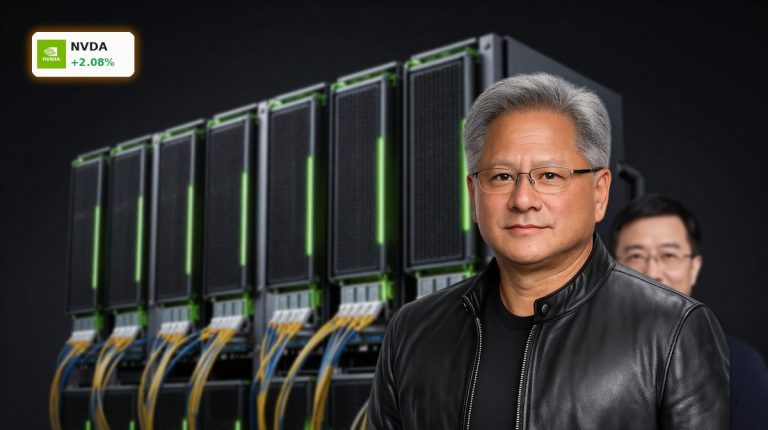
The latest move in NVIDIA Infrastructure is a sweeping deal with IREN Limited, a former Bitcoin miner turned AI data center operator. IREN will deploy up to 5 gigawatts of NVIDIA DSX-branded infrastructure across its global footprint, anchored by the Sweetwater and Childress sites in Texas. A separate five‑year, $3.4 billion AI cloud agreement will see IREN provide capacity built around NVIDIA’s Blackwell systems for NVIDIA’s own workloads.
The partnership has two key elements investors should watch. First, the 5‑gigawatt roadmap underscores how multi‑gigawatt “AI factories” are becoming a standard design point for hyperscale compute. Second, NVIDIA received a five‑year right to buy up to 30 million IREN shares at $70, an equity option worth as much as $2.1 billion if fully exercised. That ties NVIDIA’s upside directly to IREN’s success, while helping ensure long‑term access to scarce power and real estate.
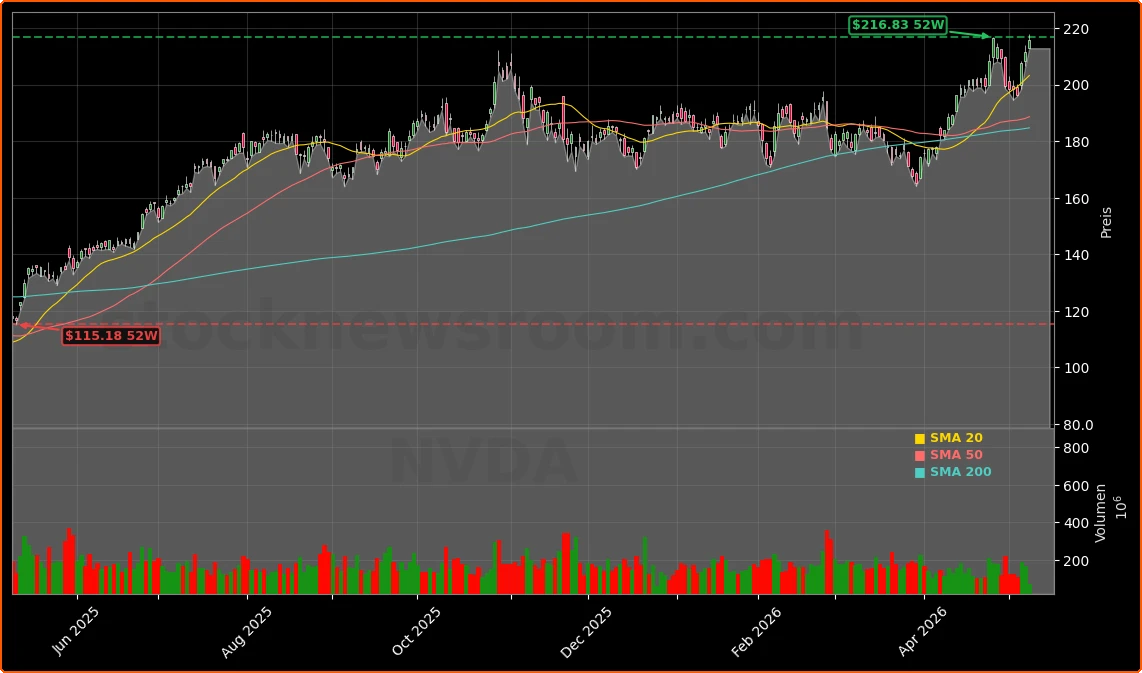
On Wall Street, NVDA shares are up about 2% around $215.89, outpacing the broader S&P 500, as traders digest the signal that demand for high‑end AI capacity remains structurally tight. The stock remains one of the heaviest weights in both the NASDAQ 100 and S&P 500, meaning any step‑change in AI capex or NVIDIA Infrastructure strategy quickly feeds through to index performance.
Why Corning matters for NVIDIA Infrastructure
The IREN agreement follows another strategic leg of NVIDIA Infrastructure: fiber optics. NVIDIA has committed an initial $500 million to buy Corning shares, with additional warrants that could take the total investment up to roughly $3.2 billion. In return, Corning is building three new plants in North Carolina and Texas to ramp glass and optical connectivity capacity, aiming for a tenfold increase in output for AI data centers.
Modern AI clusters are increasingly constrained by bandwidth rather than pure flops. NVIDIA’s high‑end platforms like Blackwell, Vera Rubin, NVLink and InfiniBand require dense, low‑latency optical links to keep thousands of GPUs, and emerging Grace CPUs, fed with data. By anchoring Corning’s expansion, NVIDIA is trying to ensure that optics do not become the choke point in its own growth story. Commentators such as Jim Cramer have called the Corning tie‑up a key reason NVIDIA remains “tough to beat,” even as cloud giants like Amazon and Google push their in‑house accelerators.
NVIDIA’s investment pattern is now visible: it has backed Coherent, Marvell, Corning and multiple AI cloud providers to secure everything from high‑speed transceivers to multi‑rail power systems. Coherent’s latest quarter showed a 21% year‑over‑year jump in revenue largely from AI data centers, and the company is quadrupling its indium phosphide capacity to support 800G and 1.6T optics that sit at the core of next‑generation GPU clusters. That is effectively leverage on the same demand curve driving NVDA’s own top line.
What risks does the build‑out carry?
The aggressive expansion of NVIDIA Infrastructure is not without controversy. U.S. prosecutors now suspect a Thai firm, OBON Corp, of routing Super Micro servers containing restricted NVIDIA AI chips into China, with Alibaba named among the end customers. The investigation raises questions about enforcement of U.S. export controls and the integrity of NVIDIA’s wider partner ecosystem. NVIDIA has responded by stressing that it expects strict compliance from partners and has downplayed the notion that complex server systems can be easily smuggled “in suitcases.”
At the same time, skeptics on Wall Street highlight echoes of the dot‑com era, when hundreds of billions flowed into internet infrastructure only for overcapacity to crush returns. Today, hyperscalers like Amazon, Microsoft, Alphabet and Meta are absorbing enormous capex bills for AI, while memory suppliers face looming shortages of DRAM and NAND to pair with GPUs from NVIDIA and AMD. Bears worry about a future period when supply finally catches up and pricing power erodes.
Valuation also splits opinions. NVDA trades on a trailing P/E near 43 with operating margins around 65% and free cash flow near $100 billion annually, numbers that look rich in isolation but cheaper than many slower‑growing chip peers. Trefis and other research outfits argue NVIDIA still offers superior growth and profitability relative to mid‑cap names like Microchip Technology, even after the run‑up. Institutional buyers such as Hobart Private Capital have been adding to positions, and Goldman Sachs recently reaffirmed a Buy rating with a $250 price target, implying roughly 15–20% upside from current levels.
How does this affect US portfolios?
For U.S. investors, the shift in NVIDIA Infrastructure strategy has two portfolio implications. First, NVDA is behaving less like a pure semiconductor stock and more like an AI utilities and infrastructure hybrid, with exposure to power, land, fiber, networking and full rack‑scale systems. That can dampen cyclicality if GPUs eventually face tougher competition from in‑house chips at cloud providers or rival platforms from AMD and Intel. Second, NVIDIA’s web of equity stakes—from IREN to Corning and Coherent—creates an extending ecosystem of secondary beneficiaries that can amplify gains but also concentrate risk if the AI capex cycle cools.
Within the “Mag 7,” NVIDIA and Apple remain the clearest infrastructure anchors, while Tesla and others lean more toward downstream AI and consumer exposure. For investors balancing growth with diversification, owning NVIDIA alongside select ecosystem names can offer a barbell between core compute and specialized optics or data center REIT‑like plays. Q1 FY2027 earnings on May 20 will be a crucial checkpoint on whether data center revenue, already north of $60 billion per quarter, can support the valuation as management guides toward $1 trillion in cumulative Blackwell and Vera Rubin sales across 2026–2027.
Related Coverage
Investors interested in how NVIDIA’s hardware dominance could extend beyond classical GPUs into emerging compute paradigms may want to read NVIDIA Quantum Computing Boom: Can AI Control the Next Wave?. That analysis explores whether NVIDIA’s AI software stack and control systems can become the orchestration layer for quantum machines, extending the same moat that today underpins its leadership in GPUs and AI data centers. Together with the current NVIDIA Infrastructure expansion, it sketches a long‑term picture of the company as a cross‑platform compute giant rather than just a graphics chipmaker.
In the end, NVIDIA Infrastructure is becoming the backbone of the global AI build‑out, from gigawatt‑scale data centers with IREN to glass and optics from Corning and Coherent. For long‑term investors, the question is less whether AI demand persists and more how much of the value chain NVIDIA can capture, with the next earnings report and further infrastructure deals set to show how far that integration can go.