
Is the latest NVIDIA Record rally a rational bet on AI cash flows or the moment the market finally overreaches?

Is the NVIDIA Record rally peaking?
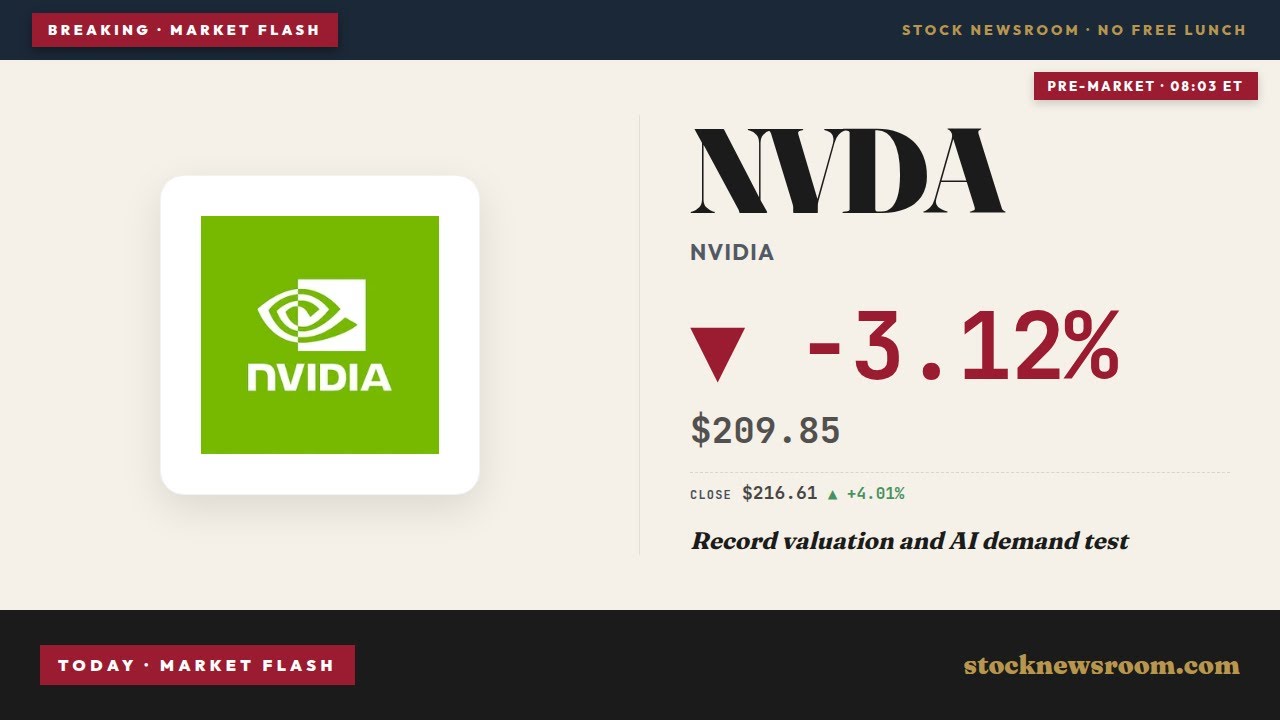
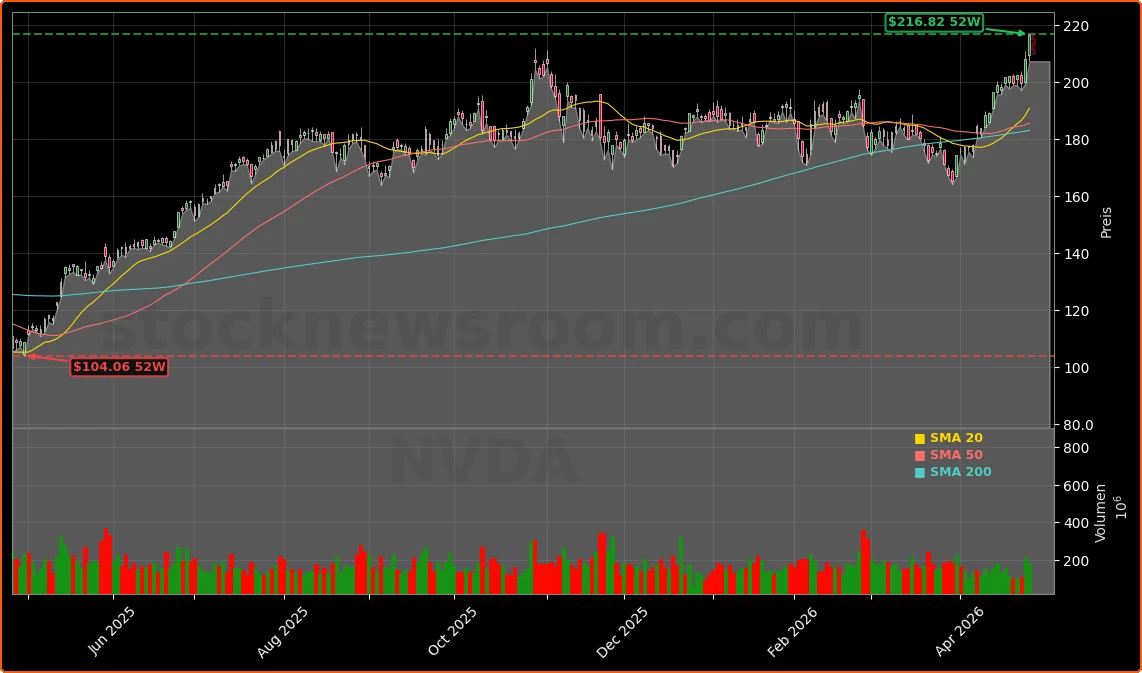
NVDA finished Monday’s US session at $216.61, up from a previous close of $208.26 and roughly 4.01% higher on the day, before easing to about $209.94 in early pre‑market action on Tuesday. That pullback still leaves the stock only a few dollars below its fresh intraday peak and firmly in NVIDIA Record territory, after adding more than $1 trillion in market value over the past month.
The latest surge has widened NVIDIA’s lead over other mega‑caps. With a market cap around $5.2 trillion, the company now sits ahead of Alphabet at roughly $4.2 trillion and Apple near $3.9 trillion, while Microsoft and Amazon trail further behind. Nine of the world’s ten largest listed companies are now tech‑focused, underscoring how central AI infrastructure and cloud compute have become to equity markets.
Despite the vertical move, valuation remains the central debate. On forward estimates, NVDA trades around a mid‑20s price‑to‑earnings multiple, unusually low for a stock that has risen roughly 1,300% over five years and dominates an 80% share of the AI accelerator market. Bank of America’s Vivek Arya estimates over $400–$425 billion in free cash flow for 2026–2027, implying close to $500 million of free cash generated per trading day and suggesting the stock could be at least 30% undervalued versus high‑growth peers.
Why NVIDIA Record matters for Wall Street
The NVIDIA Record valuation is not just a curiosity; it is reshaping index and ETF risk. NVDA now represents nearly 5% of the MSCI All Country World Index — a larger weight than entire national markets like Japan, France or Germany — and it is heavily concentrated in US vehicles such as the Invesco Top QQQ ETF (QBIG). QBIG’s trading volume recently spiked to 12 times normal, largely driven by its concentration in NVDA and other AI‑heavy names like Microsoft, Tesla and Amazon.
Institutional positioning remains robust. Sumitomo Mitsui Trust Group still holds over 63 million NVIDIA shares worth nearly $12 billion, even after trimming its stake by about 3% in Q4. Curtis Advisory Group increased its position slightly and now has NVDA as its single largest portfolio holding, at around 11% of assets. At the same time, there has been meaningful insider selling in recent months, with roughly $170 million of stock sold, a typical late‑cycle signal that some executives are locking in gains.
Wall Street research desks are broadly aligned on the bullish narrative. Consensus compiled by several brokerages puts the average price target around $274–$275, implying roughly 25–30% upside from Monday’s close. Bernstein recently reiterated an “Outperform” rating, while multiple US houses, including Bank of America and others, highlight the potential for a substantial step‑up in buybacks and dividends once the current heavy investment phase in NVIDIA’s “industrial AI” ecosystem moderates.
NVIDIA, OpenAI and the AI demand question
The immediate test for the NVIDIA Record story is demand durability across AI platforms. Reports that OpenAI recently missed internal targets for revenue and user growth have pushed OpenAI‑linked stocks lower and dragged on NVDA in pre‑market trading. The concern is straightforward: if one of the flagship AI labs is struggling to monetize, can $1.4 trillion in planned AI infrastructure spending really earn its keep?
So far, the capex backdrop still looks supportive for NVIDIA. Microsoft ran quarterly capital expenditures near $30 billion, Alphabet guided AI‑related capex into the $175–$185 billion range over the current investment cycle, Amazon is signaling roughly $200 billion, and Meta has outlined $115–$135 billion with multi‑year orders for Blackwell and Rubin GPUs. Altogether, that points to roughly $600 billion in committed AI infrastructure spend across just a handful of hyperscalers.
Crucially for NVDA, this spending is diversified well beyond any single model or lab. Demand spans cloud hyperscalers, sovereign AI projects, on‑premise enterprise deployments and emerging edge GPU networks. Datavault AI, for example, is rolling out a SanQtum GPU edge network across 100 US cities, backed by a $120 million funding deal and leveraging about $1.2 billion in installed NVIDIA GPUs. That kind of downstream build‑out reinforces the idea that GPUs have become the “picks and shovels” of the AI rush.
How does NVIDIA stack up against US tech peers?
Compared with other US AI leaders, NVDA’s trajectory is unique. Over the past year, Amazon has outperformed both NVIDIA and Alphabet year to date, but neither commands the profit margins or cash‑generation outlook that NVDA enjoys on its data center segment. SoundHound AI, by contrast, trades at roughly 20 times sales — richer than every “Magnificent Seven” name except NVDA — despite being a fraction of the size and profitability.
Meanwhile, ecosystem partners continue to tighten their links with NVDA. Cadence Design Systems just reported strong Q1 results and unveiled its AgentStack AI design platform, highlighting new collaborations with Google and NVIDIA to accelerate chip design. In the ETF world, dedicated single‑stock and covered‑call funds, such as the Roundhill NVDA WeeklyPay ETF, are proliferating and distributing high option‑derived yields to investors who are willing to accept NVDA‑specific risk.
For US portfolios, this concentration cuts both ways. On the one hand, NVDA remains the cleanest liquid proxy for AI infrastructure and a core driver of the NASDAQ 100 and S&P 500. On the other, its sheer size means any sharp reversal in the NVIDIA Record run could ripple through broad index funds, retirement accounts and AI‑themed products alike.
Related Coverage
We’re witnessing the largest infrastructure build‑out in human history, and accelerated computing is at the center of it.— Jensen Huang, NVIDIA CEO
For a deeper dive into whether this NVIDIA Record and $5 trillion valuation mark a sustainable AI super‑cycle or the top of a frothy market, readers can explore our earlier analysis in “NVIDIA Record +4.3% Rally: Can the $5T AI Boom Last?”, which examines scenario analyses for long‑term cash flows and potential downside risks if AI spending slows.